Friends Center, Philadelphia, Urban Heat Pump Retrofit
|
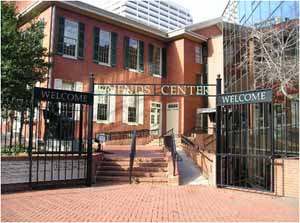
| Entrance to Friends Center, Philadelphia, PA |
Friends Center is a Quaker office complex and meeting house just two blocks from City Hall in Center City Philadelphia. The Race Street Meeting House was erected in 1856 and is still in use today. In 1993 it became a historic landmark for its role in the civil rights and women’s suffrage movements. The 56,000 square foot office building was added in 1974 and houses the central offices of American Friends Service Committee, Philadelphia Yearly Meeting, Central Philadelphia Monthly Meeting, which jointly own the complex, along with many other non-profit organizations working for peace and justice.
Thirty years later when major renovations were necessary, Friends Center received the first “Green Initiatives” grant from the Kresge Foundation to fund a charrette and greening feasibility study. Owners and users of the complex worked with designers and engineers from around the country to envision a truly sustainable project. In addition to learning about green design the charrette taught participants about the urgency of environmental problems.
As the planning proceeded, Friends began to see more clearly the connection between environmental responsibility and traditional Quaker concerns for peace and justice. Awareness that the wars of the 21st century are and will be over energy and water resources, strengthened commitment to modeling responsible use of those resources (Bray et al 2009, 1).
Friends Center’s equity partners saw a geothermal retrofit of their heating and cooling system as an important step in achieving their goal of becoming fossil fuel free. Geothermal performed best in life-cycle analysis of costs and energy use.
By removing Friends Center from the [Center City] steam loop, approximately 16,240 CCF of natural gas or 12,163 gallons oil will not be burned each year. By this calculation it will take less than 5 years to recover the carbon expenditure in the drilling of the wells. There are also savings in electricity for summer cooling and in gas for heating hot water, so the energy payback period is quite favorable and confirms the initial assessment that geothermal heat exchange meets the objectives of highly efficient use of energy Bray et al 2009 13).
The dense urban setting created significant site constraints. In order for the geothermal project to be completed, Friends Center had obtain permits from Streets Department for street closure, use of right of way, utility clearances necessary for excavation, groundwater discharge permits from the Water Department, clearance from the Historical Commission, and union clearance due to the selection of a non-local contractor (Bray et al 2009, 6). The site selected for the geothermal wells was the sidewalk along 15th Street, which is a heavily trafficked street that cuts through the city north-south past City Hall.
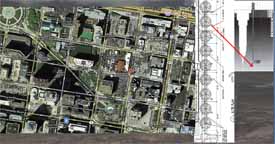 |
| Friends Center location and geothermal site plan. View large image |
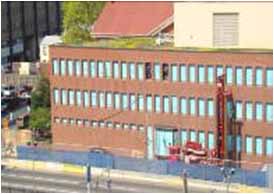
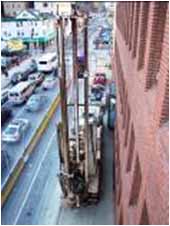
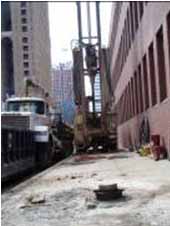
Because of the central location, Friends Center was only able to obtain a permit to block off the parking lane. The parking lane plus the sidewalk provided only a 20 foot wide construction site. Friends Center maintained its normal operations during the drilling period. The primary impact on tenants was noise, vibrations, and for those in offices on the east side of the building, the loss of natural light as the windows along 15th Street had to be covered for protection. Due to a variety of difficulties, the proposed seven week drilling period turned into eight months, lasting from February to October 2008 (Bray et al 2009, 10). Seven wells were drilled ranging in depths from 700 to 1500 feet just a few feet from the buildings foundation.
Substantial amounts of water were encountered before the first well reached 300 feet. The water flow allowed for more efficient heat exchange but caused drilling problems. As wells were drilled below 300 feet, the water was pumped out, and after being filtered through a container, discharged into the city’s sewer system. The construction team had to periodically test the water to ensure no contaminants were being discharged into the sewer system.
During drilling the 2nd and 3rd wells, a gravel bed was discovered at a depth of approximately 1,000 feet. Pressure grouting with “neat cement” was used to stabilize the loose bedrock before drilling Well 3 to the target depth of 1,500 feet. This method was used on subsequent wells also (Bray et al 2009, 9). Testing of the first three wells revealed that the bedrock had higher thermal conductivity then expected allowing the desired heat exchange capacity to be achieved at less depth.
 |
 |
 |
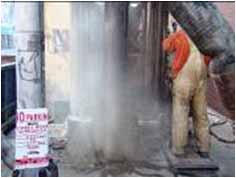 |
| View of drilling from accross 15th St. | View of drilling rig from above | Street level view of drilling rig | Close-up of drilling. Source Bray et al, 2009 |
In the newly completed system, water is pumped from the wells and distributed through a plate and frame heat exchanger and then through individual return pipe circuits back into the wells. The buildings circulation system routs the water to a water-to-water heat pump in the penthouse and water-to-air heat pumps throughout the building.
The connection between sustainability and Quaker testimonies and the goal of a landmark green building led to an extremely successful capital campaign for the renovation project. The initial target was $1.5 - $2 million. In the end $4.1 million was raised. Because the geothermal system was the first of its kind in Pennsylvania, Friends Center received $1,331,000 in combined grants including $505,540 from the Pennsylvania Energy Development Authority. The renovation project, which included the installation of a 10 KW solar array on the penthouse, a green roof, a rainwater collection system in the basement, and a passive lighting floor plan among other measures attracted Governor Ed Rendell, Mayor John Street and his successor Mayor Michael Nutter to different events. In 2008 Mayor Nutter chose Friends Center as the site for his press conference announcing his selection for the Director of the Mayor’s Office of Sustainability.