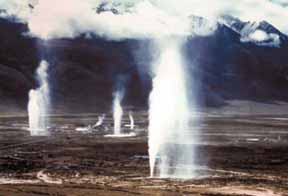
Source: International Geothermal Association Photo Gallery
Introduction
There is increasing focus at all levels of government on deploying renewable energy technologies to reduce greenhouse gas emissions, improve local environmental quality, and to hedge against volatile energy prices. Distributed energy is a strategy to improve the reliability, efficiency and sustainability of the energy infrastructure by emphasizing small scale power generation onsite or near the point of consumption in urban areas where the greatest loads exist and where land is already developed.
|
| Geothermal field, Yangbaijing, Tibet Source: International Geothermal Association Photo Gallery |
One of the oldest forms of renewable energy is geothermal energy. The Earth’s heat content is enormous, 99% of the Earth’s volume has temperatures greater than 1000°C (1832°F) , and only 0.1% of the volume is at a temperature of less than 100°C (212 °F) (Rybach 2007, 2). This heat is primarily created by the decay of naturally radioactive isotopes. This process is continuous which makes geothermal energy a renewable resource which can be used sustainably. While there are environmental impacts that must be mitigated, geothermal is one of the cleanest energy alternatives available. As one scientist, Ryback, says, “generally the environmental impacts of geothermal power generation and direct use are minor, controllable, or negligible” (Ryback 2003, 469).
This website presents a brief overview of the history of geothermal energy development and its current use worldwide. A discussion of the major technologies, environmental costs and benefits, and barriers to development is presented. Several cases where geothermal energy is being harnessed in the urban setting are examined. These cases represent multiple scales of geothermal development – from the building, to the neighborhood, to the city. The cases include district heating systems in Boise Idaho. The four systems in the city include the largest and the oldest geothermal district heating systems in the United States and the city owned system is in the process of expanding. The website also presents the case of Reykjavík, a city powered and heated by geothermal energy. Finally, I examine Friends Center, a Quaker meeting house and office complex in Philadelphia, has installed deep-standing geothermal wells to meet the majority of its heating and cooling needs as part of recent green renovation and presents a case at the building scale. The use of geothermal energy in urban design connects the city physically to the earth below. Geothermal resources vary by region and can be defining features of the places where they are located. Their utilization can also create and define place as in the case of the Blue Lagoon in Iceland. Other examples of the potential of geothermal energy to contribute to a sense of place are also discussed in this website.
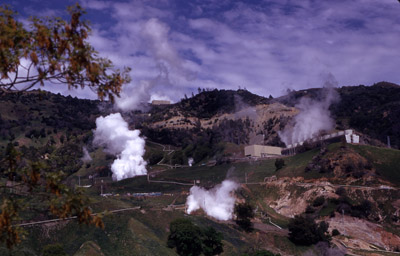 |
The Geysers, the U.S. first and largest geothermal power plant. Sonoma Co., California Photo by Don Follows; 1974 |
This website is a project for course 4.213J/11.308J Urban Nature and City Design taught at Massachusetts Institute of Technology’s School of Architecture and Planning by Professor Anne Whiston Spirn in the Fall of 2009. Because the class focuses on urban design, this project emphasizes geothermal energy technologies that are smaller in scale and can be incorporated into the design of a city. Thus district heating and geothermal heat pumps are highlighted by the cases and explored in greater depth than is the use of geothermal energy for producing electricity.