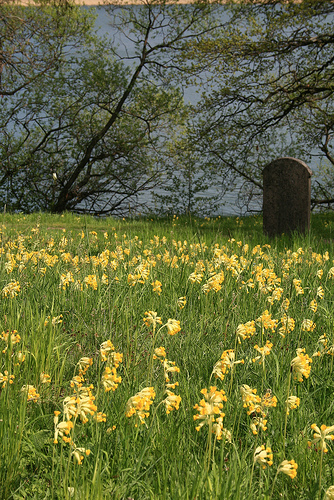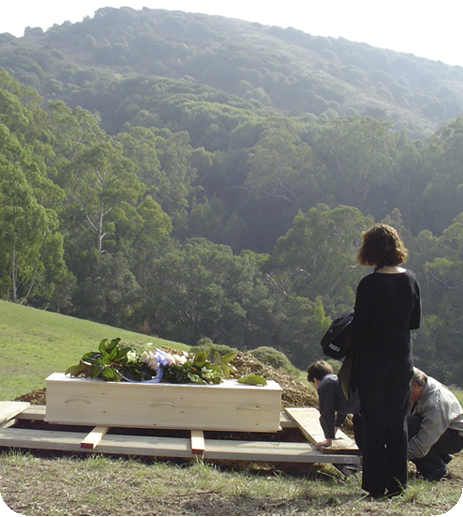
image: Fernwood Burial (www.foreverfernwood.com/)
click on image to learn more about the Forever Fernwood Natural Burial Ground
Forever Fernwood, Mill Valley, California
established 2004 as a 'natural' burial ground
E⋅co /ˈɛkoʊ; It. ˈɛkɔ/ Show Spelled Pronunciation [ek-oh; It. e-kaw] source: Oxford English Dictionary new edition (http://dictionary.oed.com.libproxy.mit.edu/entrance.dtl) "Conservation Burial", very simply is natural burial that serves a higher, significant conservation purpose. As used in the media, the term "green burial" ( we prefer the term "natural burial") is somewhat vague and used to describe a range of burial practices from a slightly greener version of contemporary burial to the creation of memorial landscapes/natural areas of high ecological quality and social value. Whether and to what degree a burial is “green” or “sustainable” depends on how the project contributes/fits into to a hierarchy of social and ecological processes and landscapes.
|
image: Fernwood Burial (www.foreverfernwood.com/) click on image to learn more about the Forever Fernwood Natural Burial Ground Forever Fernwood, Mill Valley, California established 2004 as a 'natural' burial ground
|
Today America's urban graveyards are either historically protected, closed, built over and around. The ones that have not been destroyed are finding a new life. There is often a rich wildlife habitat that coexists with those buried below. Environmentalists, gardeners and bird-watchers are all taking notice, and cemeteries are becoming a favored arcadian respite in the city. In this way cemeteries have become places as much for the living as for the dead. This could be attributed to the method of care that's given to such places. There is no use of pesticides, insectides or other harmful chemicals which promote healthy flora and fauna all around. The naturalist Richard Mabey, in his ecological argument for the future adaptation of graveyards, said: "At present, churchyards are regarded principally as resting places for the dead, where a respectful, sombre tidiness, clipped of all the excesses of nature, ought to prevail. That is an understandable feeling, but in the light of our growing sense of the interdependence of life, a more hospitable attitude towards the rest of natural creation might perhaps be an apter response." (Last Landscapes p24) |
|
|
|
Since the mid 19th century there has been tremendous pressure to remove graveyards from cities. William H Whyte, who wrote about new towns of the 20th Century, said "Some kinds of under-use will not be so easily resolved. For planners, the most frustrating open spaces to contemplate are the cemeteries of the city. Together they take up a large amount of space....Many a planner has toyed with the thought of all the good things that could be done with the land were there a relocation effort." (1968, p343)
Additionally problematic is that because urban neighborhoods no longer can or will provide the space necessary to bury their dead, they are geographically and anthropologically severing the proximity of life and death.
Contradictory, however, there is an on-going push for additional open space in cities. In 1965 Kevin Lynch wrote an essay entitled "The City as Environment". In it he made a plea for open space in the city. He wrote, "The fourth disability of the city is its rigidity, its lack of openness. For his satisfaction and growth an individual needs opportunities to engage in active interchange with his environment: to use it, change it, organize it, even destroy it. His physical surroundings should be accessible and open-ended...Woods, water and lonely places work this way, but so do empty buildings, back alleys, waste heaps, vegetable gardens, pits, caves, and construction sites. They are not usually regarded as being beautiful, but this is a narrow view. They are the physical basis of an open society." (CAE p90-91)
In this article Lynch is arguing that what we know as nature is embedded in cities and we have yet to fully recognize it. His words still ring true today, and I would argue that the only aspect of a city missing from this description is the urban burial ground.
|
|
|
As John Muir, famed naturalist, says: "Let the children walk with nature. Let them see the beautiful blendings and communions with death and life, their joyous and inseparable unity, as taught in woods and meadows, plains and mountains of our blessed star, and they will learn that death is stingless indeed, and as beautiful as life." www.foreverfernwood.com
|