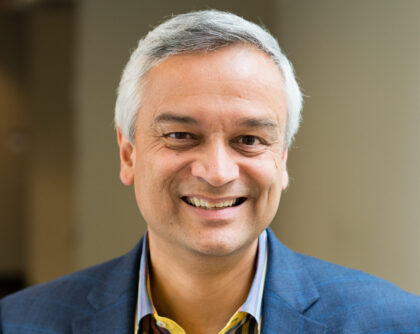
Krishna Rajagopal
Research Interests
Professor Rajagopal enjoys thinking about QCD at high temperature and/or density, where various phases of matter in which the quarks and gluons do not coalesce into hadrons or nuclei are found, because understanding these liquids requires linking usually disparate strands of theoretical physics including particle and nuclear physics, cosmology, astrophysics, condensed matter physics and string theory. Heavy ion collision experiments at the Relativistic Heavy Ion Collider (RHIC) and the Large Hadron Collider (LHC) recreate droplets of the hot quark-gluon plasma that filled the microseconds-old universe and show that it is a strongly coupled liquid. Understanding the properties of this phase of matter and how it emerges from QCD is a central challenge for the coming decade. Professor Rajagopal is incorporating insights obtained via gauge/string duality, perturbative QCD calculations, and hydrodynamics in modeling how jets produced in heavy ion collisions are modified via their passage through liquid quark-gluon plasma and how the wakes they leave behind in the droplet of liquid relax and evolve, discerning the most effective ways to use measurements of jets to probe the microscopic structure of this primordial liquid and understand how it forms and hydrodynamics as remarkably quickly as it does. The longer term challenge is to use the data to learn how a strongly coupled liquid which shows no signs of the individual particles of which it is made can emerge from QCD, a quest which resonates with challenges that are central to contemporary condensed matter physics. Professor Rajagopal has also analyzed the critical point in the QCD phase diagram and the interplay of hydrodynamics and fluctuations near it. He has proposed signatures for its experimental detection, showing how to use the collision-energy scan now underway at RHIC to search for the critical point in a large region of the QCD phase diagram.
Professor Rajagopal has also described the properties of the superfluid, color superconducting, quark matter that may lie at the centers of neutron stars, providing a clear understanding of the properties of matter at extraordinarily high densities. His work shows that cold quark matter at the highest densities is the QCD analogue of a superconductor but that if you could look at it using ordinary light it would look like a transparent insulator.
Courtesy of MITx Videos | YouTube
Biographical Sketch
After growing up in Toronto, Professor Rajagopal did his undergraduate work at Queen’s University in Kingston, Canada. He obtained his doctorate at Princeton University in 1993 and spent three years at Harvard as a Junior Fellow. He then spent one year at Caltech before coming to MIT in 1997. He became the Associate Head of the Department of Physics in 2009, served as the Chair of the MIT faculty from 2015 to 2017 and as MIT’s Dean for Digital Learning from 2017 to 2021.
Ad hoc committee releases report on remote teaching best practices for on-campus education
Task Force 2021 and Beyond report highlights innovative teaching practices that MIT instructors have incorporated into in-person classes.
Awards & Honors
- 2023 // Buechner Award for Undergraduate Advising (MIT)
- 2017 // Outstanding UROP Faculty Mentor Award (MIT)
- 2011 // Everett Moore Baker Award for Excellence in Undergraduate Teaching (MIT)
- 2010 // Margaret MacVicar Faculty Fellow (MIT)
- 2004 // American Physical Society Fellow "For seminal contributions to the theory of dense matter, including color-flavor-locked and crystalline phases of color-superconducting quark matter, and critical phenomena in heavy ion collisions."
- 1999 // Buechner Prize for Excellence in Teaching (MIT)
- 1998 // Sloan Research Fellowship