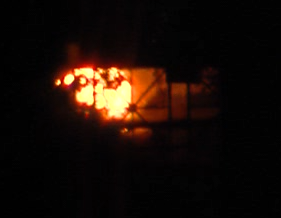
11 Nov. 2011, 4:20:13 p.m., the right side of the sun (az. 246.03 degrees true) hits the center mullion of the Lobby 7 window, viewed from left edge of corridor.
| January 27, 2026: | 4:52:12 pm | very low pass; probably too low to see |
| January 28, 2026: | 4:51:17 pm | low pass |
| January 29, 2026: | 4:50:18 pm | mid pass; probably the best day for visual observation |
| January 30, 2026: | 4:49:19 pm | high pass; probably the best day for photometric measurements of the sun's lower limb; try to take good observations, especially as the sun crosses the center of the corridor |
| January 31, 2026: | 4:48:18 pm | very high pass; probably too high to see |
| November 10, 2026: | 4:19:23 pm | very high pass; probably the best day for photometric measurements of the sun's lower limb; try to take good observations, especially as the sun crosses the center of the corridor |
| November 11, 2026: | 4:20:38 pm | mid-to-high pass; probably okay day for visual observation |
| November 12, 2026: | 4:21:54 pm | mid pass; probably good day for visual observation |
| November 13, 2026: | 4:23:10 pm | low pass; likely too low to see |
Note: These predictions are from high-resolution computations courtesy of Alan Eliasen.
The resulting azimuth estimate is 245.81 degrees true, with uncertainty about +/- 0.03 degrees. The total horizontal extent viewable from the eastern stairwell runs from about 245.05 to 246.55 degrees true, taking advantage of the ability to move from one side of the corridor to another.
The vertical extent runs roughly to +0.8 degrees above the horizon, with low visibility below +0.4 degrees.
These video frames were used in the estimates:
11 Nov. 2011, 4:20:13 p.m., the right side of the sun
(az. 246.03 degrees true) hits the center mullion of the Lobby 7
window, viewed from left edge of corridor.
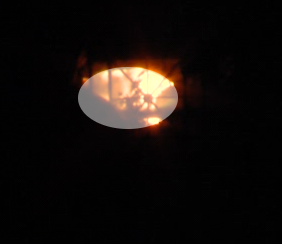
11 Nov. 2011, 4:21:10 p.m., the sun's oval (centered at 245.94 degrees true, with width 0.28 degrees) can be estimated. From left edge of corridor.
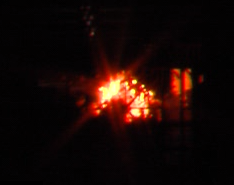
12 Nov. 2011, 4:20:20 p.m., the sun's azimuth (245.56) hits
the center mullion of the Lobby 7 window, viewed from right edge of corridor
 |
 |
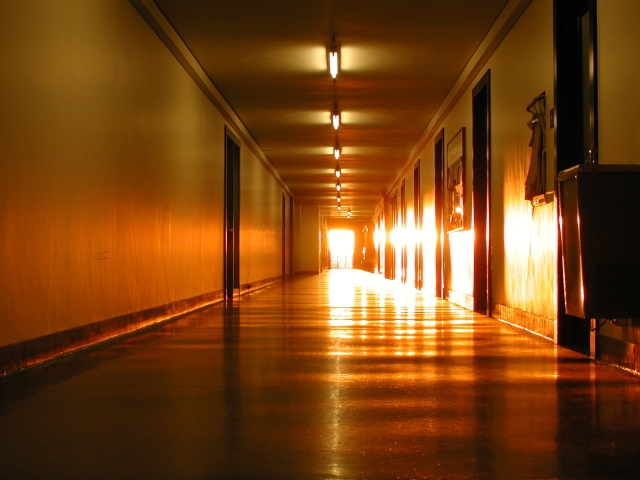
| January 2001. Photograph by Matt Yourst | November 1999. Photograph by Joseph Kaye |
 |
If you have more photographs of the sun through the length of the Infinite Corridor, please send them to Alan Eliasen (eliasen@mindspring.com); they may aid in more-precisely determining the corridor's azimuth. If your photographs are precisely dated and timed, even better: this helps our understanding of the corridor's azimuth and the light-bending effects of the atmosphere needed to correctly predict when MIThenge will occur. Please see the section on Ideal Observations on Alan's site for how to get timing and positioning data we can use. |
| February 2, 1998. Photograph by Paul Schechter, courtesy Rainer Weiss |
At some point, some portion of the sun's disc will be visible from the far end of the corridor. Which part of the disc will be seen first depends on whether the sun is crossing above or below the corridor. If the altitude in the table above is high, the sun will cross the upper right edge of the corridor as seen from the lower left. If the altitude is low, the sun will cross from the center left of the corridor and set below the hill.
The disc of the sun is close to the area of sky visible from the end of the corridor. Therefore if your timing is right and you get a good vantage point you will see almost nothing of the sky except for the interior of the sun's disc.
Observing this event depends strongly on atmospheric conditions. The best is a very red sunset. This decreases the total light intensity and makes it possible to see the corridor and the sun at the same time. If the sky is brilliantly transparent right down to the horizon then the setting sun will be too bright to look at. When you use a filter to save your eyes (see below) you won't be able to see much of the corridor.
The period of time during which the sun can be seen from the corridor end is quite short -- no more than two minutes, and only as long as that under ideal conditions.
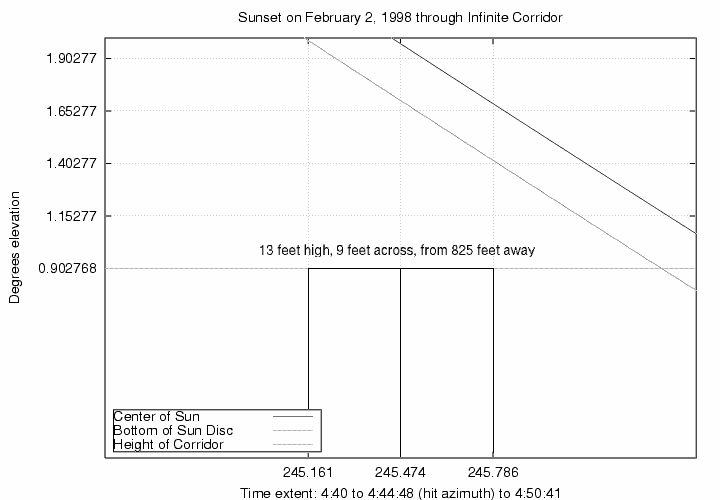
An anomalous photograph that led to azimuthal soul-searching: Until several years ago, the only available azimuth for the Infinite Corridor was the surveyed baseline of MIT's property along the Charles River baseline, of 245.47391075 degrees true. (Note that at this precision, an error of 1 in the last decimal place corresponds to a crosswise error of 438 angstroms over the length of the infinite corridor, or to shooting a bullet from the earth at the center of the sun and missing the center by 29 yards.) Ken Olum, Alan Eliasen, Lenny Foner, and KJW worked to improve this figure. We now believe the viewing centerline is roughly 245.81 degrees true, about 20 arcminutes from the property line. One early hint that the surveyed azimuth was wrong comes from the 1998 photo above. On the day Professor Schechter took the photograph (2/2/98), the sun's altitude was 1'58'' (almost 2 degrees) when it was at the right azimuth (4:44:48, with the photograph marked as "4:45"), with very little dependence (+/- five arcminutes) on temperature and barometric pressure. By our predictions (with the Infinite Corridor approximately 9 feet by 13 feet by 825 feet), this should not even have been visible.
Here is a graph showing the path of the center of the sun and its lower edge the day the picture was shot, using the same methodology used to predict MIThenge events. As you can see, the Sun disc comes nowhere near a level Infinite Corridor. The azimuth appears to be correct and confirmed by the "4:45" notation from the photograph, but the elevation seems to be way off. (Note: the plot says, "Time extent: 4:40 to ..." but the bottom of the Sun disc does not actually start to show up on the plot until 4:42:57.) If indeed the Infinite Corridor is tilted up as much as would be necessary to see this predicted sun, that would mean the floor in building 7 is higher (in ellipsoid height) than the ceiling in building 8. This seems hard to believe.
You can help improve the predictions by taking sightings during the event. Especially valuable are photographs from the length of the corridor with a precise timestamp, particularly if they show only half of the doorway on the far side of the corridor filled with the sun. If the entire doorway is filled with the sun, that's okay too, but then we don't know what part of the sun you ended up photographing (middle, side, etc.) You should make sure not to damage your camera. If your photographs are precisely dated and timed, even better: this helps our understanding of the corridor's azimuth and the light-bending effects of the atmosphere needed to correctly predict when MIThenge will occur. Please see the section on Ideal Observations on Alan's site for how to get timing and positioning data we can use, and send photos to him at eliasen@mindspring.com.