


Meeting the Challenge
Seeking to promote a just and peaceful world through research, teaching and public engagement.
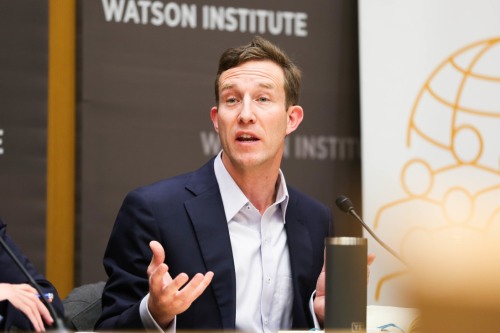



The Evolving Landscape of US Green Banks


Ieva Jusionyte Awarded the 2025 Salomon Award in Social Sciences


Upcoming Events
All EventsAcademics and Research
The Watson Institute houses several undergraduate and graduate programs that take an interdisciplinary, comparative approach to policy-relevant learning in the social sciences.

Academic Programs
Watson is home to a thriving undergraduate concentration, International and Public Affairs, as well as a highly rigorous and intensive 12-month Master of Public Affairs program. At the PhD level, the Watson Institute’s Graduate Program in Development provides training and research funding to Brown University doctoral students focused on issues of development in the Global South and beyond.


Student Experience
The Watson Institute houses several undergraduate and graduate programs that take an interdisciplinary, comparative approach to policy-relevant learning in the social sciences. Our programs are designed to inspire today's engaged scholars and creative thinkers to become tomorrow's leaders in international and public affairs.
“ I appreciate how multidisciplinary IAPA is — I've taken classes in anthropology, urban studies, economics and philosophy. They have all contributed to my concentration and my wider view of the world. ”


Centers, Initiatives and Programs
The Watson Institute is proud to house 11 region or topic-focused centers, initiatives and projects that are dedicated to research, teaching and outreach. These entities also serve as conveners, sponsoring informative events that inspire dialogue among scholars, students and the public.
learn more about our centers
Discover Our Research
Focusing on three main areas — development, security and governance — the Institute leverages Brown's tradition of true interdisciplinary to foster innovative, policy-relevant scholarly activities. Across all topics and fields, the Institute tackles the complexities of 21st century security threats, globalization and intractable inequalities. From Latin America to China, from the Middle East to India, the Institute's work helps us all make sense of the world.
From Our Social Channels
The Watson Institute for International & Public Affairs @BrownUniversity seeks to promote a more peaceful world through research, teaching & public engagement.


