Stretch and Curvature Effects in Hydrogen-enriched flames
- Ray Speth
- Youssef Marzouk
- Prof. Ahmed F. Ghoniem
The addition of small amounts of hydrogen has been suggested as a method for enhancing burning properties of lean methane–air flames. Methane combustion near the lean flammability limit has received much attention because of concerns about pollutant formation, especially NOx. The low temperatures of lean methane flames produce little NOx. However, lean methane combustion is complicated by low flame speeds and high susceptibility to extinction. It has been shown that small amounts of hydrogen have a relatively minor impact on the flame speed and lean flammability limit of unstrained laminar flames. In contrast, in turbulent or strained flames, the addition of hydrogen has been shown to substantially improve burning velocity and extinction characteristics [1].
To understand the impact of strain rate and curvature on hydrogen-enriched methane–air flames, we have developed a formulation of a cylindrical laminar flame stabilized in an axisymmetric stagnation flow [2]. The formulation is described by a one-dimensional set of governing equations incorporating detailed kinetics and transport, including thermal diffusion and Dufour effects.
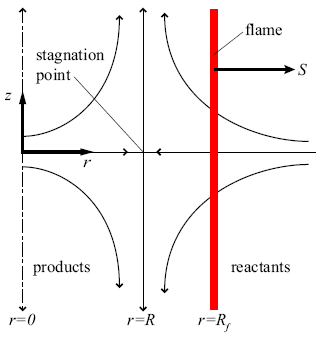
Schematic of a positively curved flame at finite stagnation radius.
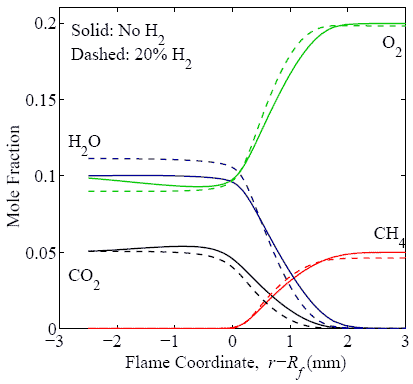
Major species profiles of strained (a=200s-1), positively curved (Rf=0.25
cm) flames with and without hydrogen enrichment.
Publications
- [1] R. L. Speth, Y. M. Marzouk and A. F. Ghoniem. Impact of Hydrogen Addition on Flame Response to Stretch and Curvature. 41st Aerospace Sciences Meeting. AIAA. 2005.
- [2] R. L. Speth, Y. M. Marzouk and A. F. Ghoniem. A Quasi-One-Dimensional Unsteady Laminar Flame Formulation with Independent Strain Rate and Curvature. In Third MIT Conference on Computational Fluid and Solid Mechanics. 2005.