 MASSACHUSETTS INSTITUTE OF TECHNOLOGY
Chemical Hygiene Plan
August 2004
 Department
of Materials Science and Engineering
Department
of Materials Science and Engineering
Table of Contents
1.1. Purpose,
Policy, and Scope
2.1. The DEPARTMENT,
LAB, or CENTER CHAIR
2.2. The CHEMICAL
HYGIENE OFFICER
2.4. The PRINCIPAL
INVESTIGATOR or LABORATORY SUPERVISOR
2.6. The
ENVIRONMENT, HEALTH and SAFETY (EHS) OFFICE
2.7. EMPLOYEES,
STAFF, STUDENTS, and VISITORS
2.8. DEPARTMENT,
LABORATORY, OR CENTER (DLC) EHS COMMITTEE
4.2. Chemical Safety
Information Sources
PART
II. General Chemical Hygiene Practices.
2. IDENTIFICATION AND CLASSIFICATION OF
HAZARDOUS CHEMICALS
2.3. Possible Animal Carcinogens
2.7. Flammable and Explosive Substances
2.8. Hazardous Substances with Toxic
Effects on Specific Organs
2.9. Particularly Hazardous Substances
3. STANDARD OPERATING PROCEDURES FOR WORK WITH
HAZARDOUS CHEMICALS
3.1. Preliminary Steps and Procedures
3.2. Essential Laboratory Work Practices
3.3. Additional Procedures for Work with
Particularly Hazardous Substances
3.4. Additional Requirements for Work
with Select Toxins
3.5. Special Precautions for Work with
Hydrofluoric Acid
3.6. Special Precautions for Work with
Formaldehyde
4. PERSONAL PROTECTIVE EQUIPMENT
5. OTHER SAFETY AND STORAGE EQUIPMENT
5.1. Laboratory Fume
Hoods/Ventilation
5.2. Fire Extinguishers, Safety Showers,
and Eyewash Stations
5.3. Safe Use of Warm and Cold
Environmental Rooms
6. CHEMICAL CONTAINER LABELING GUIDELINES
8.1. Waste
Management Responsibility
9. SHIPPING HAZARDOUS AND DANGEROUS
MATERIALS
10.1. Appendix II-A
OSHA Permissible Exposure Limits (PELs)
10.2. Appendix II-B
ACGIH Threshold Limit Values (TLVs)
10.3. Appendix II-C How
to Determine if a Chemical is a Particularly Hazardous Substance
PART III. Department, Lab, or
Center-Specific Chemical Hygiene Practices
2. STANDARD OPERATING PROCEDURE (SOP)
TEMPLATE INSTRUCTIONS
2.6. Special
Emergency Procedures
3. STANDARD OPERATING PROCEDURES
4.1. Appendix III-A DMSE-Specific
Standard Operating Procedure (SOP) Template
PART
IV. Additional Administrative Provisions
1. INTEGRATION WITH MIT EHS MANAGEMENT
SYSTEM
2. PRIOR APPROVALS AND PROCUREMENT
2.1. Department, Laboratory, or
Center-Based Prior Approvals
2.2. MIT-Wide
Signature Control Program for the Purchase of Certain Hazardous Materials
2.3. Purchase of
Large Chemical Quantities
2.4. Purchase of
Non-Returnable Gas Cylinders
2.5. Purchase
of Select Toxins
3. MEDICAL EVALUATION, EXAMINATION AND
SURVEILLANCE
4. EXPOSURE ASSESSMENT (MONITORING
& REPORTING)
5.2. Medical Consultation and
Examination
5.6. Laboratory-Specific Policies and
SOPs
6. LABORATORY INSPECTIONS AND AUDITS,
COMPLIANCE AND ENFORCEMENT
6.2. Compliance and
Enforcement
7. OSHA HAZARD COMMUNICATION STANDARD
(HAZCOM)
8. TOXIC SUBSTANCES CONTROL ACT (TSCA)
9. ANNUAL SARA III CHEMICAL INVENTORY
1.1.
Purpose, Policy, and Scope
Purpose
This
document constitutes the Chemical Hygiene Plan (CHP) required by the U.S. Occupational
Safety and Health Act (OSHA) of 1970 and regulations of the U.S. Department of
Labor including 29 CFR 1910.1450 "Occupational Exposure to Hazardous
Chemicals in Laboratories" (the "Laboratory Standard"). The purpose of the Plan is to describe the
proper use and handling practices and procedures to be followed by employees,
students, visitors, and other personnel working in each laboratory of the
Department of Materials Science and Engineering (DMSE) to protect them from
potential health and physical hazards presented by chemicals used in the
workplace, and to keep chemical exposures below specified limits. While the Plan establishes work practices to
promote safety in the laboratory, each individual has the first
responsibility for ensuring that good health and safety practices are
implemented in the laboratory. Not only does this individual responsibility
promote personal well-being and the well-being of others, it also advances
MIT’s commitment to excellence in research.
Policy and Scope
It
is the policy of the Massachusetts Institute of Technology (as
represented by the MIT Corporation and the Office of the President) to provide
a safe and healthy workplace in compliance with OSHA regulations including the
“Laboratory Standard” referenced above.
A link to the full OSHA Laboratory Standard is included in Part I.
Section 4.1. of this Chemical Hygiene Plan. This Plan applies to all laboratories in DMSE,
though laboratories in Building 13 (the
Part I. Getting Started contains the basic, minimal information
laboratory personnel need to know before using hazardous chemicals. It is
designed to get laboratory personnel directly to the relevant information they
need before beginning their laboratory work. This Part contains the purpose,
policy, and scope of the Plan, and defines the roles and responsibilities for
developing and implementing the Plan. Requirements for training and chemical
information available to personnel are also detailed here.
Part
II. General Chemical Hygiene Practices contains the minimum required precautions
and standard operating procedures for working with laboratory chemicals in MIT
laboratories. These precautions address broad classes of chemicals. This Part contains chemical hazard and risk
assessment information, and general procedures for safe chemical management
addressing the purchase, use, labeling, storage, disposal and shipping of
chemicals. This Part also discusses
common controls for safe use of chemicals including administrative and
engineering controls.
Part III. Department-Specific Chemical
Hygiene Practices contains
standard operating procedures generated by DMSE and EHS for specialized
materials, procedures, or practices related to chemical use that are not
adequately addressed in Part II. of this Plan. This
Part is provided to enable individual Department, Laboratories, or Centers to
customize this Chemical Hygiene Plan for their specific operations and hazards.
A Standard Operating Procedure (SOP)
Template is contained in this Part to provide assistance to laboratory
personnel generating specific safety procedures.
Part
IV. Additional Administrative Provisions contains information and procedures
essential to a successful chemical hygiene program that address activities
other than the direct handling and use of hazardous chemicals. These additional
administrative provisions include information on MIT’s Environment, Health and
Safety Management System; prior approval and procurement requirements; medical
evaluations and assessments; record keeping; laboratory inspections and audits;
compliance and enforcement; and other related federal regulations that impact
chemical use at MIT.
An essential component of any chemical
hygiene program is to clearly articulate and clarify the different roles and
responsibilities of all the stakeholders who work or visit in areas where
chemicals are present. Clarifying roles and responsibilities for implementing
the Chemical Hygiene Plan (CHP) will establish accountability, streamline
processes, enhance safety, and avoid confusion and questions in meeting the
Plan’s objectives.
The
DEPARTMENT CHAIR shall:
A.
Ensure the Chemical Hygiene Plan
is written, and updated.
B.
Appoint the Chemical Hygiene
Officer (CHO). The individual selected must be qualified by training or experience
to provide technical guidance in the development and implementation of this
written Chemical Hygiene Plan. This individual must have appropriate authority
to assist with implementation and administration of the Chemical Hygiene
Plan.
C.
Provide or obtain administrative
and financial support, as needed, for implementing and maintaining the Chemical
Hygiene Plan and the requirements of the Plan.
2.2.
The CHEMICAL HYGIENE OFFICER
The CHEMICAL HYGIENE OFFICER for DMSE is Prof.
David Roylance. The Chemical Hygiene Officer shall:
A.
Know and understand the
requirements of the OSHA Laboratory Standard regulation (29CFR 1910.1450) and
the DMSE Chemical Hygiene Plan.
B.
Oversee the implementation of the
CHP in the Department, Lab, or Center and assist Principal Investigators or
Supervisors (PI/Supervisors) with implementing the Chemical Hygiene Plan within
their laboratory.
C.
Ensure the Plan is distributed or
made available to all in the DMSE who are impacted by the Plan.
D.
Submit one copy of the CHP
electronically to the MIT Environment, Health and Safety (EHS) Office for
reference use and to facilitate the annual update process.
E.
Advise Principal Investigators or Supervisors concerning adequate
facilities, controls, and procedures for work with unusually hazardous
chemicals.
F.
Seek ways to improve the Chemical Hygiene Plan.
G.
Review and update the Chemical Hygiene Plan annually, when directed by
the EHS Office.
H.
Support the EHS Coordinator, as needed, with inspection and audit
activities and other requirements of the EHS Management System, such as the Space
Registration Database.
I.
Participate in investigation of serious accidents involving hazardous
chemicals, acting as a liaison to the EHS Office.
I.
Assist PI/Supervisors, as needed,
with obtaining services or supplies and equipment for correcting chemical
hygiene problems or addressing chemical hygiene needs.
J.
Ensure periodic exposure monitoring
requirements are met and maintain monitoring records.
K.
If requested, review proposed experiments for significant environment,
health, and safety issues, and/or contact the EHS Office to address concerns.
L.
Co-Chair the DMSE-EHS Committee with the EHS Coordinator.
M.
Attend annual CHO meeting conducted by the EHS Office.
The ENVIRONMENT, HEALTH AND SAFETY (EHS)
COORDINATOR for DMSE is Mr. Joseph Glogowski, who shall:
A.
Provide assistance to the CHO, if
appropriate and as requested, with developing and implementing the DMSE
Chemical Hygiene Plan.
B.
Be familiar with the DMSE Chemical Hygiene Plan.
C.
Compile information from the laboratory for the EHS Space Registration
Database.
D.
Ensure routine inspections are conducted in the laboratory areas.
E.
Participate in biannual inspections of laboratory operations.
F.
Ensure DMSE staff receive training required by
regulation for safe handling and proper disposal of chemicals and that the
training is documented.
G.
Serve as contact point for arranging special studies or support from the
EHS Office.
H.
Act as a contact for Building Services and Repair and Maintenance staff
to address concerns regarding safety for work in the laboratory area.
I.
Ensure appropriate local records are collected and maintained for inspections,
inspection follow-up, and lab-specific training for three years.
J.
Arrange for decommissioning of laboratory space.
2.4.
The PRINCIPAL INVESTIGATOR or LABORATORY SUPERVISOR
The PRINCIPAL INVESTIGATOR or LABORATORY
SUPERVISOR (PI/Supervisor) shall:
A.
Be familiar with this Chemical
Hygiene Plan and ensure that all work is conducted in accordance with requirements
of this Plan. They should contact the CHO for advice and assistance regarding
this Plan and implementing the provisions of this Plan when needed.
B.
Assess all chemicals in the research laboratories under their purview,
and ensure measures are established for safe use, storage, and disposal of the
hazardous chemicals within the laboratory.
Such measures include:
1.
Preparing additional, Standard Operating Procedures (SOPs) for research
activities involving hazardous chemicals, when needed. See Part II. Section 3. for more information on when additional SOPs are required.
2.
Providing personal protective equipment needed for safe handling of the
chemicals.
3.
Providing proper containers, containment, and cabinetry for safe storage
of materials.
4.
Defining the location and processes where particularly hazardous
substances will be used, ensuring these areas are labeled, and ensuring that a
list of these substances is maintained.
C.
Ensure new processes or experiments involving hazardous materials are
planned carefully and appropriate hazard information, safety equipment, and
SOPs are available prior to commencing work.
Always seek to minimize the amount of hazardous chemicals purchased and
used for experiments or processes.
D.
Ensure the information regarding the laboratory activities recorded in
the Space Registration Database is accurate.
E.
Plan for accidents and ensure that appropriate supplies are in place and
procedures are established for responding to an accident, including cleaning up
chemical spills.
F.
Ensure all employees working in the laboratory receive required training
for work with potentially hazardous chemical, including lab-specific training
on the hazardous materials that they use.
G.
Ensure that all personnel obtain medical examinations and participate in
the MIT medical surveillance program when required due to the materials they
are working with.
H.
Monitor the safety performance of the staff to ensure that the required
safety equipment, practices and techniques are understood and are being
employed and ensure that action is taken to correct work practices that may
lead to chemical exposures or releases.
I.
When needed, contact the Environment, Health and Safety (EHS) Office to
arrange for workplace air samples, swipes or other tests to determine the
amount and nature of airborne and/or surface contamination, inform employees
and students of the results, and use data to aid in the evaluation and
maintenance of appropriate laboratory conditions.
J.
Ensure laboratory inspections are conducted routinely, and address all
areas prescribed in the
K.
Ensure employees who suspect they may have received an excessive
exposure to a hazardous chemical report to the MIT Medical Department for
assessment. Such exposures may occur
through accidental inoculation, ingestion, or inhalation of the chemical.
L.
Report all accidents involving an employee’s chemical exposure or
involving a chemical spill that may constitute a danger of environmental
contamination to the EHS Office, the CHO or EHS Coordinator.
M.
Investigate all chemical accidents and near misses to determine the
cause and take appropriate corrective action to prevent similar accidents. Contact the CHO or the EHS Office, when needed,
for assistance with investigations, assessment, and recommendations for
corrective action.
N.
Ensure unwanted or excess hazardous chemicals and materials are properly
disposed according to all MIT, state, and federal procedures.
O.
Assist the EHS Office, EHS Coordinator, and CHO as requested.
The ENVIRONMENT, HEALTH AND SAFETY (EHS)
REPRESENTATIVE shall:
A.
Be familiar with the content and
requirements of this Chemical Hygiene Plan and assist the Principal Investigator
or Supervisor, as directed, with implementing and complying with requirements
of this Plan.
B.
Assist with contacting the DMSE EHS Coordinator or the CHO, when needed,
for assistance with addressing requirements for safe handling of chemicals.
C.
Assist with or provide lab-specific chemical hygiene training for
laboratory personnel, as directed by the PI/Supervisor.
D.
Assist with dissemination of EHS information to laboratory personnel.
E.
Assist with required routine inspections of the laboratory, correcting
problems that can be readily corrected.
F.
Assist with ensuring essential supplies and equipment are in place for
safe work in the laboratory.
G.
Assist with monitoring staff work practices for safety.
H.
Report safety problems or concerns to the PI/Supervisor and/or the EHS
Coordinator.
I.
Address, as directed, safety problems or concerns in the laboratory.
J.
Review and be familiar with DMSE Emergency Preparedness Plan.
2.6.
The ENVIRONMENT, HEALTH and SAFETY (EHS) OFFICE
The ENVIRONMENT, HEALTH, and SAFETY (EHS) OFFICE
shall:
A.
Oversee process for annual update
of the CHP, reminding CHOs and EHS Coordinators when
annual CHP updates are due and reviewing updated plans. See the CHP Preparer’s Guide on the
CHP website (http://web.mit.edu/environment/ehs/chp.html) for
more information on the annual update process.
B.
Provide a standard CHP template for use in developing and updating
Chemical Hygiene Plans.
C.
Provide “General Chemical Hygiene” training by classroom, web, or when
requested by DMSE.
D.
Provide “Managing Hazardous Waste” training by classroom, web, or when
requested by a DMSE.
E.
Provide materials and guidance to assist with Lab-Specific Chemical
Hygiene Training.
F.
Establish and maintain a system for maintaining training records.
G.
Conduct an annual meeting for CHOs and EHS
Coordinators to update them regarding changes in the Template,
the EHS Management System, and to review significant chemical safety concerns
from the year.
H.
Conduct special investigations and exposure monitoring, as requested or
as required by regulations, making recommendations for control when needed.
I.
Participate in inspections of laboratory operations at least once a
year.
J.
Oversee the fume hood survey program.
K.
Provide guidance regarding selection and use of personal protective
equipment. When respirators are
required, provide services to ensure personnel are provided the proper
equipment, to ensure the equipment fits properly, and to ensure users receive
the required training.
L.
Provide guidance and review standard operating procedures (SOPs) for new
experiments or operations, as requested.
M.
Provide, as requested, chemical safety information and guidance for
appropriate controls of hazards such as proper personal protective equipment
and local exhaust ventilation.
N.
Assist with investigations of serious accidents or chemical exposure
incidents.
O.
Report all DMSE-specific accidents and incidents, as appropriate, to the
DMSE EHS Coordinator.
2.7.
EMPLOYEES, STAFF, STUDENTS, and VISITORS
Employees,
staff, students, and visitors working with or around hazardous chemicals
in a laboratory shall:
A.
Read and understand the OSHA
Chemical Laboratory Standard and this Chemical Hygiene Plan.
B.
Understand the hazards of chemicals they handle and the signs and
symptoms of excessive exposure.
C.
Understand and follow all standard operating procedures.
D.
Understand and apply all training received.
E.
Understand the function and proper use of all personal protective
equipment and wear personal protective equipment when mandated or necessary.
F.
Report to the Principal Investigator or Laboratory Supervisor any
significant problems arising from the implementation of the standard operating
procedures.
G.
Report to the PI/Supervisor all facts pertaining to every accident that
results in exposure to toxic chemicals.
H.
Report to the PI/Supervisor or EHS Representative actions or conditions
that may exist that could result in an accident.
I.
Contact the PI/Supervisor, the Chemical Hygiene Officer, the EHS
Coordinator, or the EHS Office if any of the above procedures are not clearly
understood.
J.
If an emergency occurs related to an experiment, provide emergency
response personnel with information about the conditions that caused the
emergency and the existing situation in the laboratory.
With respect to the Chemical Hygiene Plan,
the DMSE EHS Committee shall:
A.
Participate in periodic
inspections and/or review inspection reports of DMSE’s
laboratories and facilities, providing guidance or directives, as needed, for
correcting problems found.
B.
Review chemical handling incidents or exposure issues that occur in DMSE
and recommend appropriate corrective action.
MIT has established systems to ensure you
are provided with OSHA-required training to inform you of the hazards and
precautions for work with chemicals, including chemicals present in your work
area. The process begins when you
complete a web-based Training Needs Assessment. You answer questions specific to your
research situation and job duties, and the system will provide you information
on your training needs and requirements.
You should then proceed to take the required web courses, or sign up for
classroom training. As a researcher or
employee working in a laboratory at MIT, you must complete the Training
Needs Assessment, and can do so by going to http://web.mit.edu/environment/training.
This will take you to a page that will direct you further. If you have problems or questions regarding
completing the Training Needs Assessment, you should contact your EHS
Coordinator or your EHS Representative.
Chemical hygiene training requirements are
detailed in the EHS-MS training system, which can be accessed at http://mit.edu/environment/training. The
following four components are required if you indicate in the Training Needs
Assessment within the training system that you use potentially hazardous
chemicals in a laboratory, or you are a Principal Investigator or Supervisor
for those who use potentially hazardous chemicals in a laboratory.
A.
General Chemical Hygiene
Training – can be taken as a web-based course or taken by attending a class
offered by the Environment, Health and Safety (EHS) Office. This course is required only once before
beginning work with potentially hazardous chemicals in a laboratory.
B. Read the Chemical Hygiene
Plan –
Signing a confirmation of having read and understood the Plan is required one
time before beginning work with potentially hazardous chemicals in a
laboratory.
C. Lab-Specific Chemical
Hygiene Training –
provided by the Principal Investigator or his or her designee on lab-specific
chemical hazards. Required before
beginning work with potentially hazardous chemicals in a laboratory and annually thereafter (usually within a
lab group meeting). The topics covered will depend,
in part, on the nature of the lab and research being done. Discuss Lab-Specific Chemical Hygiene
Training questions and requirements with your PI/Supervisor, EHS
Representative, Chemical Hygiene Officer or your EHS Coordinator.
D. Managing Hazardous Waste – can be taken as a web-based course or
taken by attending a class offered by the EHS Office. Required before beginning work with
potentially hazardous chemicals and annually thereafter.
The PI/Supervisor or designee will keep a
copy of the outline of the topics covered in Lab-Specific Chemical Hygiene
Training. The roster or lists of researchers who have completed the lab-specific training and
read the Chemical Hygiene Plan, will be submitted to the EHS Coordinator. These
training records are then entered into the EHS-MS Central Training Records
Database. Training records are kept for at least 3 years after an employee or
student leaves the Institute.
Information that must be available to laboratory
personnel includes:
A. A copy of the OSHA Laboratory
Standard and its Appendices. The Laboratory Standard can be
accessed on the OSHA website via http://www.osha.gov and
searching under the regulation number “1910.1450”.
B. The Permissible Exposure
Limits (PELs) for OSHA-regulated substances and
the American Conference of Governmental Industrial Hygienists (ACGIH) Threshold
Limit Values (TLVs) for hazardous substances not given OSHA PELs. These lists
are provided via a web link in Appendix II-A and II-B of this document.
C. Signs and symptoms associated
with exposure to hazardous substances used in the laboratory. General
information is integrated into Part II. Sections 2. and
3. of this document.
D. The location and availability
of known reference materials on hazards, safe handling, storage and disposal of
hazardous chemicals found in the laboratory. This information is provided in
the next section of this document.
In addition, your supervisor, Chemical
Hygiene Officer, EHS Coordinator and EHS Office staff are available to provide
safety information. Core safety information sources are discussed below.
4.2.
Chemical Safety Information Sources
4.2.1.
Material Safety Data Sheets (MSDSs)
Material
Safety Data Sheets (MSDSs) are documents, prepared by
chemical manufacturers, that provide information about
the chemical’s physical and chemical hazards and recommended exposure limits,
and list the means for controlling those hazards. MSDSs
also provide information about first aid, emergency procedures, and waste
disposal.
An
MSDS should be reviewed before beginning work with a chemical to determine
proper use and safety precautions. Once a chemical is present in the lab, the MSDS should be either book marked electronically or a
hard copy kept on hand for reference, or in case of emergencies. Specific information required by OSHA to be on an
MSDS includes:
Product Identity Reactivity Hazards
Hazardous Ingredients Spill Clean-Up
Physical/Chemical Properties Protective Equipment
Fire and Explosion Hazards Special Precautions
Health Hazards and Exposure Limits
MSDSs and
additional chemical hazard information can be obtained from a variety of
sources as outlined below:
A. The Internet. The EHS Office has compiled a list of
links to sites that contain MSDSs. This list can be
accessed at http://web.mit.edu/environment/ehs/topic/msds.html.
B. Chemical Manufacturer. A request may be made directly to the
chemical manufacturer or supplier. This is often the best source for “products”
or “mixtures” to determine what hazardous ingredients are contained in the
formulation.
C. EHS Office. A file of MSDSs
for common chemicals that are in use at MIT or have been used at MIT is
available through the EHS Office on the fourth floor of Building N52. They can
be reached at 617-452-3477 (2-EHSS or 2-3477 from an MIT telephone).
Please
contact the EHS Office if you need assistance in interpreting MSDS information.
4.2.2.
Newly Synthesized Chemicals and
MSDS Requirements
New
chemical substances synthesized or produced in your laboratory and used or shared
outside of your laboratory suite are subject to OSHA Hazard
Communication Standard (29 CFR 1910.1200) requirements. These rules mandate the preparation of a
Material Safety Data Sheet for each synthesized substance and labeling of
containers containing the chemical substance.
4.2.3.
Laboratory Chemical Safety
Summaries (LCSS)
The LCSSs provide
concise, critical discussions of the toxicity, flammability, reactivity, and explosibility of 88 chemicals commonly used in scientific
research laboratories. These are particularly useful as they address laboratory
use of chemicals. They are available from the Howard Hughes Medical Institute
website at http://hhmi.org/research/labsafe/overview.html.
4.2.4.
Chemical Container Labels
Chemical container labels are a good resource
for information on chemical hazards. All containers of hazardous chemicals must
have labels attached. Labels on purchased chemicals must include:
q
The common name of the chemical;
q
The name, address and telephone
number of the company responsible for the product; and
q
Appropriate hazard warning(s).
The warning may be a single word (e.g.
Danger, Caution, Warning) or may identify the primary hazard both physical (e.g.
water reactive, flammable, or explosive) and health (e.g. carcinogen, corrosive
or irritant).
Most labels provide additional safety
information to help workers protect themselves from the substance. This
information may include protective measures and/or protective clothing to be
used, first aid instructions, storage information and emergency
procedures.
Laboratory personnel are responsible for:
q
Inspecting incoming containers to be sure that labels are attached and
are in good condition and contain the information outlined above.
q
Reading the container label each time a newly purchased chemical is
used. It is possible that the manufacturer may have added new hazard
information or reformulated the product since the last purchase.
q
Ensuring that chemical container labels are not removed or defaced,
except when containers are empty.
q
Labeling any secondary containers used in the laboratory, to prevent
unknown chemicals or inadvertent reaction.
q
Verifying that chemical waste containers have complete
and accurate chemical waste labels.
Additional guidance on labeling chemical
containers can be found in Part II. Section 6.
4.2.5.
Environment, Health and Safety
Reference Literature
The EHS Office maintains a library of
reference materials addressing environment, health and safety issues. These
references include applicable exposure standards and recommended exposure
levels, as well as copies of the OSHA Lab Standard and its Appendices. These
materials, as well as additional health and safety references, may be reviewed
by visiting the EHS Office located on the fourth floor of Building N52.
PART II. General Chemical Hygiene Practices
Part II. of this
Chemical Hygiene Plan contains the minimum required precautions and standard
operating procedures for working with laboratory chemicals in MIT laboratories.
These precautions address broad classes of chemicals. This Part contains chemical hazard and risk
assessment information, and general procedures for safe chemical management
addressing the purchase, use, labeling, storage, disposal and shipping of
chemicals. This Part also discusses
common controls for safe use of chemicals including administrative and
engineering controls, such as fume hoods, personal protective equipment, and
designated areas.
Hazardous chemicals can cause harm when they
enter the body in sufficient amounts via inhalation, ingestion, injection or
skin absorption. Harmful effects can also occur by eye or skin contact alone.
The nature of the hazardous chemical and the routes by which it enters or
contacts the body determine the type of controls that are needed. The
Occupational Safety and Health Administration (OSHA) and other organizations
have set occupational exposure limits on airborne chemical exposure. Keeping
exposures below these limits is generally believed to protect employees and
students. Permissible Exposure Limits (PELs) set by
OSHA are contained in Appendix II-A. Threshold Limit Values (TLVs) established by the American Conference of
Governmental Industrial Hygienists (ACGIH) are contained in Appendix II-B. For
many laboratory chemicals, exposure limits have not been established. In addition, little is known about the
effects of combined exposures.
Therefore, all laboratory workers should take steps to minimize chemical
exposure via all routes of entry.
OSHA recognizes that some classes of
chemical substances pose a greater health and safety risk than others. To
differentiate this different risk characteristic, OSHA identifies two
categories of hazardous chemicals: hazardous
chemicals and particularly hazardous
substances. Particularly hazardous substances (PHSs) is a
subset of hazardous chemicals that is regulated more stringently because they
have been deemed to pose a substantially greater risk. Because of this, OSHA
requires additional precautions and procedures be
undertaken when particularly hazardous
substances are used in the laboratory.
Introduction
to Standard Operating Procedures
A standard operating procedure (SOP) is a written set of
instructions or guidelines that detail the uniform procedures to be followed
routinely, and safety precautions to take when carrying out a particular
experiment or procedure. The development and implementation of standard
operating procedures for critical activities is a core component of promoting
excellence in a laboratory and for ensuring a safe, healthy, and
environmentally sound workplace. For these reasons, the development of SOPs is
an essential administrative tool to be used in the laboratory and is a tool
that is required by the OSHA Laboratory Standard.
Literally thousands of different compounds
are involved in the research being conducted in campus laboratories. The specific health hazards associated with
many of these compounds are unknown, and many substances are new compounds
which have not been reported previously in the chemical literature. Consequently, it is impossible in this
Chemical Hygiene Plan to provide standard operating procedures for each specific hazardous substances. Instead,
this Part outlines general procedures that should be employed in the use of all
hazardous substances. Individual
research groups may be required to supplement these general procedures with
additional standard operating procedures for handling specific hazardous
substances that are used in their laboratories.
This Chemical Hygiene Plan contains core standard operating
procedures for the safe use of two categories of chemicals: hazardous
chemicals, and particularly hazardous
substances (PHS). These standard operating procedures are contained in Part
II. Section 3. These general safety procedures are
designed to ensure basic levels of staff health and safety in the laboratory,
for routine and common practices, uses, and chemicals.
You are required to develop additional written standard
operating procedures if the general SOPs provided in Part II. of this Plan DO NOT adequately ensure the protection of
personal health and safety, and the environment for a particular activity, operation,
or experiment conducted in your laboratory. This requirement is particularly
applicable if a procedure requires detailed and specific guidance to avoid
dangerous exposures or consequences such as an explosion. SOPs must be
developed prior to initiating any significantly hazardous procedures.
Guidelines and a template for preparing SOPs when required
as noted above, are contained in Part III. of this
Plan. A copy of all SOPs developed must be located in the laboratory spaces,
and be available to all people in the laboratory. It is recommended, but not
required, that all additional SOPs be included in Part III. of
this Chemical Hygiene Plan.
Prior to working with chemicals following
the SOPs in Part II. Section 3, there are certain steps you must take to
understand the hazards of the work you are doing with chemicals. A process for
assessing the hazards of chemical use is outlined below.
2. IDENTIFICATION AND
CLASSIFICATION OF HAZARDOUS CHEMICALS
Determine the specific chemicals you are working with and the type of
hazard they present. Many of
the substances encountered in the laboratory are known to be toxic or
corrosive, or both. Compounds that are
explosive and/or are highly flammable pose another significant type of hazard. New and untested substances that may be
hazardous are also frequently encountered.
Thus, it is essential that all laboratory workers understand the types
of toxicity, recognize the routes of exposure, and are familiar with the major
hazard classes of chemicals. The most
important single generalization regarding toxicity in chemical research is to treat all compounds as potentially harmful,
especially new and unfamiliar materials, and work with them under conditions to
minimize exposure by skin contact and inhalation.
When considering possible toxicity hazards
while planning an experiment, it is important to recognize that the combination
of the toxic effects of two substances may be significantly greater than the
toxic effect of either substance alone.
Because most chemical reactions are likely to contain mixtures of
substances whose combined toxicities have never been evaluated, it is prudent
to assume that mixtures of different substances (e.g., chemical reaction
mixtures) will be more toxic than the most toxic ingredient contained in the
mixture. Furthermore, chemical reactions
involving two or more substances may form reaction products that are
significantly more toxic than the starting reactants.
The OSHA Laboratory Standard defines a hazardous chemical as "a chemical for which there is
statistically significant evidence based on at least one study conducted in
accordance with established scientific principles that acute or chronic health
effects may occur in exposed employees.
The term 'health hazard' includes chemicals which are carcinogens, toxic
or highly toxic agents, reproductive toxins, irritants, corrosives,
sensitizers, hepatotoxins, nephrotoxins,
neurotoxins, agents which act on the hematopoietic
systems, and agents which damage the lungs, skin, eyes, or mucous
membranes". Highly flammable
and explosive substances comprise a category of hazardous chemicals.
The major classes of hazardous and particularly hazardous chemicals and
their related health and safety risks are discussed in further detail below.
2.3.
Possible Animal Carcinogens
Carcinogens are chemical or physical agents
that cause cancer. Generally they are
chronically toxic substances; that is, they cause damage after repeated or
long-duration exposure, and their effects may only become evident after a long
latency period. Chronic toxins are
particularly insidious because they may have no immediate apparent harmful
effects. For a large number of compounds there is limited evidence of
carcinogenicity to animals from studies involving experimental animals. These compounds should be handled using the
general procedures for work with hazardous substances outlined in Part II. Section 3.1 and 3.2 below.
Certain select
carcinogens are classified as "particularly hazardous substances"
and must be handled using the additional special precautions described in Part
II. Section 3.3. Select carcinogens (defined in detail
below) consist of compounds for which there is evidence from human studies that
exposure can cause cancer. It is
important to recognize that some substances involved in research laboratories
are new compounds and have not been subjected to testing for
carcinogenicity.
As a health hazard, corrosive substances cause destruction
of, or alterations in, living tissue by chemical action at the site of
contact. Major classes of corrosive
substances include strong acids (e.g., sulfuric, nitric, hydrochloric, and
hydrofluoric acids), strong bases (sodium hydroxide, potassium hydroxide, and
ammonium hydroxide), dehydrating agents (sulfuric acid, sodium hydroxide,
phosphorus pentoxide, and calcium oxide), and
oxidizing agents (hydrogen peroxide, chlorine, and bromine). Symptoms of
exposure for inhalation include a burning sensation, coughing, wheezing,
laryngitis, shortness of breath, nausea, and vomiting. For eyes, symptoms
include pain, blood shot eyes, tearing, and blurring of vision. For skin,
symptoms may include reddening, pain, inflammation, bleeding, blistering and
burns. As a physical hazard, corrosive substances may corrode materials they
come in contact with and may be highly reactive with other substances. It is important to review information
regarding materials they corrode, and their reactivity with other substances,
as well as information on health effects.
Irritants are defined as non-corrosive chemicals that cause
reversible inflammatory effects on living tissue by chemical action at the site
of contact. A wide variety of organic
and inorganic compounds, including many chemicals that are in a powder or
crystalline form, are irritants and consequently, skin contact with all
laboratory chemicals should always be avoided.
A sensitizer (allergen) is a substance that
causes exposed people to develop an allergic reaction in normal tissue after
repeated exposure to the substance.
Examples of allergens include diazomethane, chromium, nickel,
formaldehyde, isocyanates, arylhydrazines,
benzylic and allylic
halides, and many phenol derivatives.
2.7.
Flammable and Explosive Substances
A number of highly flammable substances are
in common use in campus laboratories.
Explosive substances are materials that decompose under conditions of
mechanical shock, elevated temperature, or chemical action, with the release of
large volumes of gases and heat. Some materials, such as peroxide formers, may
not be explosive, but may form explosive substances over time.
2.8.
Hazardous Substances with Toxic
Effects on Specific Organs
Substances included in this category include
(a) hepatotoxins (substances that produce liver
damage such as nitrosamines and carbon tetrachloride); (b) nephrotoxins
(agents causing damage to the kidneys such as certain halogenated hydrocarbons);
(c) neurotoxins (substances which produce their primary toxic effects on the
nervous system such as mercury, acrylamide, and
carbon disulfide); (d) agents which act on the hematopoietic
system (such as carbon monoxide and cyanides which decrease hemoglobin function
and deprive the body tissues of oxygen); and (e) agents which damage lung
tissue such as asbestos and silica.
2.9.
Particularly Hazardous Substances
As discussed in earlier sections of this
Chemical Hygiene Plan, hazardous chemicals are chemicals for which there is
scientific evidence that adverse acute or chronic health effects may occur in
exposed workers. An agent is an acute
toxin if its toxic effects are manifested after a single or short-duration
exposure. Chronically toxic agents show
their effects after repeated or long-duration exposure and the effects usually
become evident only after a long latency period. Many of the substances in frequent use in
laboratories are classified as hazardous substances, and the procedures for
working with these chemicals are detailed in Part II Section 3.1. and 3.2 There are
some substances, however, that pose such significant threats to human health
that they are classified as "particularly hazardous substances" (PHSs). The OSHA
Laboratory Standard requires that special provisions be established to prevent
the harmful exposure of researchers to PHSs. General procedures for working with such
materials are presented in detail in Section 3.3.
Chemicals are classified as particularly hazardous substances if they belong to one or more of the
following three categories. Compounds
classified as particularly hazardous
substances generally must then be handled using the procedures outlined in
Part II. Section 3.3 in addition to the procedures outlined for
hazardous chemicals in Part II. Section 3.1 and 3.2. Appendix II. C.
provides procedures to assist you in how to determine if a chemical is a
particularly hazardous substance, as well as additional information on PHSs.
2.9.1.
Select Carcinogens
Certain potent carcinogens are classified as
"select carcinogens" and treated as PHSs. A select carcinogen is defined in the OSHA Laboratory
Standard as a substance that meets one of the following criteria:
q
It is regulated by OSHA as a carcinogen,
q
It is listed as "known to be a carcinogen" in the latest
Annual Report on Carcinogens published by the National Toxicology Program
(NTP),
q
It is listed under Group 1 ("carcinogenic to humans") by the
International Agency for Research on Cancer (IARC), or
q
It is listed under IARC Group 2A or 2B, ("probably carcinogenic to
humans") or under the category "reasonably anticipated to be a
carcinogen" by the NTP, and causes statistically significant tumor
incidence in experimental animals in accordance with any of the following
criteria: (i) after inhalation exposure of 6-7 hours
per day, 5 days per week, for a significant portion of a lifetime to dosages of
less than 10 mg/m3; (ii) after repeated skin application of less than 300 mg/kg
of body weight per week; or (iii) after oral dosages of less than 50 mg/kg of
body weight per day.
The following Table lists the substances
meeting criteria (a), (b), or (c). For
information on compounds meeting criteria (d), examine IARC Group 2A and 2B
lists and the NTP lists that are available on the Internet. See Appendix II-C
for more information on PHSs.
Partial
List of Select Carcinogens (Includes OSHA Carcinogens)
|
2-acetylaminofluorene acrylamide acrylonitrile 4-aminodiphenyl arsenic and certain arsenic compounds asbestos azathioprine benzene benzidine bis(chloromethyl)
ether 1,3 butadiene 1,4-butanediol dimethylsulfonate
(myleran) cadmium chlorambucil chloromethyl methyl ether chromium and certain chromium compounds coal-tar pitches coal tars coke oven emissions conjugated estrogens cyclophosphamide 1,2-dibromo-3-chloropropane 3,3'-dichlorobenzidine (and its salts) diethylstilbestrol dimethylaminoazobenzene |
dimethyl sulfate ethylene dibromide ethylene oxide ethylenimine formaldehyde hexamtehylphosphoramide hydrazine melphalan 4,4'-methylene-bis(2-chloroaniline) methylene chloride methylene dianiline mustard gas N,N'-bis(2-chloroethyl)-2-naphthylamine
(chlornaphazine) alpha-naphthylamine
beta-naphthylamine nickel carbonyl 4-nitrobiphenyl N-nitrosodimethylamine beta-propiolactone thorium dioxide treosulphan vinyl chloride |
Note:
the above list is not intended to be complete, and it is the
responsibility of the researcher (in consultation with their laboratory
supervisor) to evaluate each compound involved in their work and to determine
whether it should be handled as a select carcinogen.
2.9.2.
Reproductive and Developmental
Toxins
Reproductive toxins can affect the
reproductive health of both male and female employees and students if proper
procedures and controls are not used. For women, exposure to reproductive
toxins during pregnancy can cause adverse effects on the fetus; these effects
include embryolethality (death of the fertilized egg,
embryo or fetus), malformations (teratogenic
effects), and postnatal functional defects.
Examples of embryotoxins include thalidomide
and certain antibiotics such as tetracycline.
Women of childbearing potential should note that embryotoxins
have the greatest impact during the first trimester of pregnancy. Because a woman often does not know that she
is pregnant during this period of high susceptibility, special caution is
advised when working with all chemicals, especially those rapidly absorbed
through the skin (e.g., formamide). Pregnant women and women intending to become
pregnant should consult with their laboratory supervisor and the Environment,
Health and Safety (EHS) Office before working with substances that are
suspected to be reproductive toxins. As
minimal precautions, the general procedures outlined in Part II. Section 3.3
below should then be followed for work with such compounds. For men, the affects of certain reproductive
toxins may include decline in fertility, malformations in off-spring, and
certain types of cancer. Therefore, adequate protection from exposure must be
employed.
Information on reproductive toxins can be
obtained from Material Safety Data Sheets, by contacting the EHS Office Industrial
Hygiene Program (617-452-3477).
The following Table lists some common
materials that are suspected to be reproductive toxins; in most laboratories it
will be appropriate to handle these compounds as particularly hazardous substances.
Partial
List of Reproductive Toxins
|
arsenic and certain arsenic compounds benzene cadmium and certain cadmium compounds carbon disulfide ethylene glycol monomethyl
and ethyl ethers ethylene oxide |
lead compounds mercury compounds toluene vinyl chloride xylene |
Note:
The above list is not intended to be complete, and it is the
responsibility of the researcher (in consultation with their laboratory
supervisor) to evaluate each compound involved in their work and to determine
whether it should be handled as a reproductive toxin.
2.9.3.
Compounds with a High Degree of
Acute Toxicity
Compounds that have a high degree of acute
toxicity comprise a third category of particularly
hazardous substances as defined by the OSHA Laboratory Standard. Acutely toxic agents include certain
corrosive compounds, irritants, sensitizers (allergens), hepatotoxins,
nephrotoxins, neurotoxins, agents that act on the hematopoietic systems, and agents
which damage the lungs, skins, eyes, or mucous membranes. Substances that have a high degree of acute
toxicity are interpreted by OSHA as being substances that "may be fatal or
cause damage to target organs as the result of a single exposure or exposures
of short duration".
Toxic
and Highly Toxic Agents
OSHA regulations (29 CFR 1910.1200 Appendix
A) define toxic and highly toxic agents as substances with median lethal dose
(LD50) values in the following ranges:
Test Toxic
Highly Toxic
Oral LD50 50-500
mg/kg <50
mg/kg
(albino rats)
Skin Contact LD50 200-1000 mg/kg <200 mg/kg
(albino rabbits)
Inhalation LC50 200-2000
ppm/air <200
ppm/air
(albino rats)
It is important to note that the above
classification does not take into consideration chronic toxicity (e.g. carcinogenicity and reproductive
toxicity). Also, note that LD50
values vary significantly between different species, and the human toxicity for
a substance may be greater or less than that measured in test animals. OSHA
considers substances that are either toxic or highly toxic, as defined above,
to be particularly hazardous substances.
In evaluating the acute toxicity of chemical substances, the HMIS (Hazardous Materials
Identification System) rating criteria developed by the National
Paint and Coatings Association may be helpful.
HMIS numbers can often be found in MSDSs. LD50 values can be found in MSDSs and in references
such as the Sigma-Aldrich Library of
Chemical Safety Data and Patnaik's A Comprehensive Guide to the Hazardous
Properties of Chemical Substances.
The following Table lists some of the
compounds that may be in current use in campus laboratories and that have a
high degree of acute toxicity:
Partial
List of Compounds with a High Degree of Acute Toxicity
|
abrin |
nitrogen dioxide |
|
acrolein |
osmium tetroxide |
|
arsine |
ozone |
|
chlorine |
phosgene |
|
diazomethane |
ricin |
|
diborane (gas) |
sodium azide |
|
hydrogen cyanide |
sodium cyanide (and other cyanide salts) |
|
hydrogen fluoride |
strychnine |
|
methyl fluorosulfonate |
|
|
nickel carbonyl |
|
Note:
the above list is not intended to be complete, and it is the
responsibility of the researcher (in consultation with their laboratory
supervisor) to evaluate each compound involved in their work and to determine
whether it is a substance with a high degree of acute toxicity.
Compounds classified as having a high degree
of acute toxicity must generally be handled using the procedures outlined in
Part II. Section 3.3 below in addition to the procedures outlined for
hazardous chemicals in Part II. Section 3.1 and 3.2. Finally, several of the compounds listed may
require prior approval from the DMSE EHS Committee before work with them can be
carried out. See Part IV. Section 2. for a discussion of
prior approval requirements.
In evaluating the hazards associated with
work with toxic substances, it is important to note that a number of factors
influence the response of individuals to exposure to toxic compounds. For example, people are rarely exposed to a
single biologically active substance.
With this point in mind, it is noteworthy that one toxin can influence
the effect of a second. This underscores
the importance of maintaining good laboratory practices at all times, and with
all chemicals.
3.
STANDARD OPERATING PROCEDURES FOR WORK WITH HAZARDOUS CHEMICALS
3.1.
Preliminary Steps and Procedures
All work
involving chemicals in MIT laboratories must be conducted using the “Standard
Operating Procedures” outlined below. In
addition, laboratory workers must determine whether any of the chemicals to be
handled in the planned experiment meet the definition of a particularly
hazardous substance due to high acute toxicity, carcinogenicity, and/or
reproductive toxicity. If so, consider
the total amount of the substance that will be used, the expected frequency of
use, the chemical's routes of exposure, and the circumstances of its use in the
proposed experiment. Use this
information to determine whether it is appropriate to apply the “Additional
Procedures for Work with Particularly Hazardous Substances” outlined in Part
II. Section 3.3.
For very toxic or hazardous substances, or specialized practices,
consideration must be given to whether additional consultation with safety
professionals and development of specialized SOPs is warranted or required.
STEP 1:
Determine the toxicity and warning properties of the chemicals to be used in
your experiment.
q
Identify the chemicals involved in
the proposed experiment and determine the amounts that will be used.
q
Use an up-to-date LCSS or MSDS to
determine the exposure limit, type of toxicity, warning properties (smell,
irritation, etc.) and symptoms of exposure for each chemical involved in the
planned experiment.
q
If a new chemical substance(s)
will be produced during the experiment and the toxicity is unknown, assume it is
a particularly hazardous substance and follow the procedures in Part II.
Section 3.3.
q
Assume that any mixture of
chemicals will be more toxic than its most toxic component.
q
Consider substituting less toxic
chemicals.
STEP 2: Determine most
likely routes of exposure based on how chemicals will be used and their
physical/chemical properties.
q
Inhalation –
Inhalation risks are highest when volatile liquids, gases, dusts, or mists are
used or generated. Heating will increase
the volatility of liquids. Pay
particular attention to chemicals with low exposure limits. Potential for inhalation is highest when
chemicals are used on an open lab bench.
Use in enclosed apparatus or chemical laboratory hoods decreases
inhalation exposure potential.
q
Skin Exposure
– Chances for skin exposure exist for most laboratory chemical procedures. When
the “skin” notation is listed in the exposure limit section of the MSDS, the
chemical can be absorbed through the intact skin.
q
Injection or
ingestion – Not normally a major route of exposure if proper
handling procedures are used. Determine whether the experiment involves a
significant risk of inadvertent ingestion or injection of chemicals.
STEP 3:
Determine required control measures, personal protective equipment, and proper
work practices to minimize exposure.
A.
Inhalation Control Measures
Determine When to Use Laboratory
Chemical Hoods (Fume Hoods)
Procedures
involving volatile toxic substances and those operations involving solid or
liquid toxic substances that may result in the generation of vapors or aerosols
should be conducted in a laboratory hood or other type of local exhaust
ventilation. See Part II. Section 5. for a more detailed
discussion of laboratory hoods. Other types of control devices include glove
boxes, custom designed hoods, shut-off valves, and monitoring equipment linked
to alarms and shut-off valves.
Determine Whether Respirators
Might Be Required
Generally,
hazards should be controlled by use of ventilation and it should not be
necessary to use respirators. Contact the Industrial Hygiene Program for help
in evaluating the need for a respirator.
If one is needed and you are medically qualified to wear a respirator,
obtain one of the correct type and size from the Industrial Hygiene
Program. Do not use a lab mate’s
respirator. The MIT Respirator Protection Program is described in full at http://mit.edu/environment/ehs/respiratory.html.
B.
Personal Protective
Equipment For Eyes and Skin
Select and wear appropriate eye and face protection.
MIT policy
requires that personnel use eye protection when directly handling chemicals or
when closely observing chemical processes.
Use safety glasses with side shields as basic eye protection for
handling chemicals where there is no risk of splash or splatter. When pouring large amounts of chemicals,
observing processes that are under heat or pressure, making adjustments to
chemical containing apparatus, or performing other operations or tasks with
potential splash risk or severe consequences in the event of a splash, chemical
goggles should be used. A face shield
can be used with the goggles to protect the face under these
circumstances.
Wear appropriate clothing in the laboratory when working with hazardous
substances.
Wear
laboratory coats with long sleeves. Wear
long pants (trousers) or long skirt that cover your legs and shoes that cover
your feet. Do not wear sandals or
open-toed shoes or shoes made of woven material when working with
hazardous substances. Confine long hair
and loose clothing.
Avoid skin contact and ingestion of hazardous substances by using
appropriate hand protection, protective clothing, and proper work practices.
Contact
with the skin is a frequent mode of chemical injury. A common result of skin contact is localized irritation,
but an appreciable number of hazardous substances are absorbed through the skin
with sufficient rapidity to produce systemic poisoning. Ingestion of substances is rarely deliberate,
but may occur because of contamination of hands handling food, contamination of
common work surfaces in the lab, and incidental contamination of food or
materials that come in contact with the mouth, and through poor work practices.
Avoid contact with, and ingestion of, hazardous substances by taking the
following precautions:
q
Select and wear appropriate hand
protection, generally gloves, to prevent injury to hands or exposure by
absorption of chemicals through the skin of the hands. Gloves for work with chemicals must be
selected based on the potential contact hazard, and the permeability of the
glove material. For incidental skin
contact with small amounts of chemicals on a surface, or work with most
powders, disposable nitrile gloves are usually
adequate. For work involving materials
that are readily absorbed through the skin, the glove must be carefully
selected using glove impermeability charts.
Silver Shield brand gloves work well for many common
laboratory chemicals that can be absorbed through the skin, but you should
verify their effectiveness for your
application. You should also evaluate
need for hand protection from physical hazards such as extreme heat or cold,
and make sure you use appropriate gloves.
q
Never use mouth suction to pipette chemicals or to start a siphon; a
pipette bulb or aspirator should instead be used to provide vacuum.
q
Never taste laboratory chemicals.
q
Wash your hands with soap and
water immediately after working with hazardous chemicals.
q
Eating, drinking, smoking,
gum-chewing, and applying cosmetics in laboratories where hazardous substances
are in use is prohibited. Do not store
food, beverages, cups, or other drinking and eating utensils in areas where
hazardous chemicals are used or stored.
q
Immediately clean up small spills
on work benches or in laboratory hoods.
Properly use and maintain personal protective equipment (PPE).
Personal protective equipment should be kept clean and
stored in an area where it will not become contaminated. Personal protective
equipment should be inspected prior to use to be sure it is in good
condition. It should fit properly and be
worn properly. If it becomes
contaminated or damaged, it should be cleaned or fixed or, in the case of
disposable equipment, discarded and replaced.
For additional requirements and information on selection of
PPE, see Part II. Section 4. and
visit the EHS Office website at http://web.mit.edu/environment/ehs/ppe.html.
STEP 4: Be Prepared for Emergencies
Before beginning an experiment, know what specific action
you will take in the event of the accidental release of any hazardous
substances involved. Know the location
and how to operate all safety equipment including fire blankets, eye washes,
safety showers, spill carts and spill control materials. Be familiar with the
location of the nearest fire alarm and telephone, and know what telephone
numbers to call in the event of an emergency.
Know the location of the circuit breakers for your laboratory.
For all accidents requiring emergency police, fire, or
medical response, contact Campus Police at 617-253-1212 or 100 from an MIT
telephone.
An MIT Emergency Response Guide should be posted in
every laboratory in an area accessible to all. This guide outlines the
procedures to follow for most types of emergency situations. The MIT Emergency
Response Guide is available electronically at http://web.mit.edu/environment/pdf/MITERG.pdf.
Carefully review the guidelines for handling medical emergencies, personal
injury, chemical spills and fire in the laboratory. This information could save
your or your lab mate's life. Only a
subset of that information is repeated here.
In addition, Emergency Action Plans are required for
each Department, Laboratory, or Center (DLC) under the Occupational Health and
Safety Administration (OSHA) regulations. All staff and students should be
familiar with their laboratory’s Emergency Action Plan, as it specifies the
appropriate response and building exit plans for a variety of life-safety
emergency situations.
A. Chemical Contamination
If the victim or their clothes are chemically contaminated,
put on appropriate personal protective equipment and remove victim's
contaminated clothing. Using a chemical shower, eyewash, or sink in a safe
area, flood contaminated body part(s) with large amounts of water
for 15 minutes.
B. Material Safety Data Sheets
(MSDS)
As time permits, and if you will not be placed at risk,
attempt to identify the chemicals involved and obtain MSDS' or other relevant
information. Provide the MSDS to the ambulance crew.
C.
Chemical Spills
– Minor vs. Major
Be prepared in advance. Have spill supplies available for
the types of spills that might occur. Know under what circumstances you should
clean up the spill, or when you should evacuate and seek help.
Minor hazardous materials or waste spills that present no
immediate threat to personnel safety, health, or to the environment can be
cleaned up by laboratory personnel that use the materials or generate the
waste. A minor hazardous material spill
is generally defined as a spill of material that is not highly toxic, is not
spilled in large quantity, does not present a significant fire hazard, can be
recovered before it is released to the environment, and is not in a public area
such as a common hallway. Such a spill
can usually be controlled and cleaned up by one or two personnel.
Major hazardous material and waste spills should be reported
to the MIT emergency number (617-253-1212, or 100 from an MIT telephone) to
receive immediate professional assistance and support in the control and clean
up of the spilled material. Major
hazardous materials or waste spills are generally defined as having a
significant threat to safety, health, or the environment. These spills generally are a highly toxic
material or is spilled in large quantity, may present a significant fire
hazard, cannot be recovered before it is released to the environment, or is
spilled in a public area such as a common hallway. Upon reporting such a spill personnel should
stand-by at a safe distance to guide responders and spill clean up experts to
the spill area. Reporting personnel
should also keep other personnel from entering into the spill area.
In the case of a spill that presents a situation immediately
dangerous to life or health, or a situation with significant risk of a fire,
personnel should evacuate the area and summon emergency assistance by dialing
the MIT emergency number (617-253-1212, or 100 from an MIT telephone),
activating a fire alarm station, or both.
3.2.
Essential Laboratory Work
Practices
3.2.1.
Properly use, maintain, and
dispose of laboratory glassware and other sharps.
Improper use of glassware is a frequent cause of injuries
and accidents in the laboratory.
q
Careful handling and storage
procedures should be used to avoid damaging glassware. Always carefully inspect glassware for flaws
and cracks before use. Damaged items
should be discarded or repaired.
q
Adequate hand protection should be
used when inserting glass tubing into rubber stoppers or corks or when placing
rubber tubing on glass hose connections.
Tubing should be fire polished or rounded and lubricated, and hands
should be held close together to limit movement of glass should fracture
occur. The use of plastic or metal
connectors should be considered.
q
Glass-blowing operations should
not be attempted unless proper annealing facilities are available.
q
Vacuum-jacketed glass apparatus
should be handled with extreme care to prevent implosions. Equipment such as Dewar flasks should be
taped or shielded. Only glassware
designed for vacuum work should be used for that purpose.
q
Hand protection should be used
when picking up broken glass. (Small
pieces should be swept up with a brush into a dustpan).
q
Broken glassware, syringes, and other "sharp objects" must be disposed of
properly. Such waste should be separated
from other trash and stored for pickup in clearly marked containers labeled
"sharps". See Part II. Section 8. for more
details on handling “sharps”.
3.2.2.
Attend to housekeeping by
establishing and following routine cleaning procedures as part of the work you
do.
There is a
definite relationship between safety and orderliness in the laboratory. The following housekeeping rules should be
adhered to in all laboratories:
q
Clean bench tops and other work
areas and equipment regularly. Do not
allow dirty glassware, expired or unneeded samples or chemicals, and trash or boxes to
accumulate. When floors require
cleaning, notify building services.
q
Maintain ready access to exits and
safety equipment such as fire extinguishers, eyewashes, and safety showers. Do not store materials in a way that will
block access to exits or safety equipment.
q
Ensure all compressed gas tanks
are properly secured to walls or benches.
q
Chemical storage refrigerators should be defrosted periodically and should
not be overcrowded.
3.2.3.
Avoid work conducted outside
normal hours.
Researchers
should avoid conducting work with hazardous substances when they are alone in
the laboratory. When working alone, arrange with Campus Police
or workers in other laboratories to check on you periodically. Some experiments are too hazardous to be
conducted alone under any circumstances; it is the responsibility of
researchers to consult with their supervisor to identify such high hazard
operations or experiments.
Laboratory
operations involving hazardous substances are sometimes carried out
continuously or overnight. It is the
responsibility of the researcher to design these experiments with provisions to
prevent the release of hazardous substances in the event of interruptions in
utility services such as electricity, cooling water, and inert gas. Laboratory lights should be left on and
appropriate signs should be posted identifying the nature of the experiment and
the hazardous substances in use. In some
cases arrangements should be made for periodic inspection of the operation by
other workers. Information should be
left indicating how to contact you in the event of an emergency.
3.2.4.
Discourage children and pets in
laboratories.
Prudent
safety practices discourage allowing children and pets in laboratories where
hazardous substances are stored or are in use. In fact, regulations prohibit pets
from certain biosafety-rated laboratories. It is
therefore urged that children and pets not be permitted in laboratories.
However, if children are allowed, they must be under the direct supervision of
their parent or other qualified adult, and should be allowed to visit only for
a brief period of time.
3.2.5.
Establish and follow safe chemical
storage procedures for your laboratory.
Researchers
should consult the Environment, Health and Safety (EHS) Office standard
operating procedure (SOP) on Chemical Storage at http://web.mit.edu/environment/ehs/topic/sops.html
for a discussion of procedures for storing chemicals in laboratories. All procedures employed must comply with
OSHA, flammable material, and building code regulations. The following minimum
guidelines must be adhered to:
q
Access to all hazardous chemicals,
including toxic and corrosive substances, should be restricted at all
times. Specifically, good practice would
dictate that these materials be stored in laboratories
or storerooms that are kept locked at all times when laboratory personnel are
not present. In the case of unusually
toxic or hazardous materials, additional precautions are advisable and likely
required, such as keeping the materials in locked storage cabinets. Contact the
EHS Office to determine the appropriate controls.
q
To avoid the accumulation of
excess chemicals, it is recommended that you maintain a list of chemicals in
your lab and check this list prior to purchasing new chemicals. When purchasing
new chemicals, purchase the minimum quantities of commercial chemicals
necessary for your research.
q
Make sure all containers of
chemicals are in good condition.
q
Make sure all containers of
chemicals, (including research samples), are properly labeled. When appropriate, special hazards should be
indicated on the label. For certain
classes of compounds, (e.g. ethers), the date the container was
opened should be written on the label. More guidance on labeling is provided in
Part II. 6.
q
Store incompatible materials in
separate cabinets. If they must be
stored together due to space limitations, provide secondary containment to
separate incompatible materials.
q
Do not store liquids above
eye-level. Particularly, large containers (more than 1 liter) should be stored
below eye-level on low shelves. Avoid
storage of hazardous chemicals on the floor. If such storage is required,
provide secondary containment for liquids stored on the floor.
q
For refrigerated storage of
chemicals, ensure refrigeration equipment is selected properly for the types of
materials to be stored. For flammable or
explosive chemicals, special refrigerators are required. See flammables and
explosives section below. Food should never be kept in refrigerators used for
chemical storage.
q
Do not store items in the working
space of fume hoods.
3.2.6.
Take precautions when transporting
hazardous substances between laboratories.
Chemicals
must be transported between stockrooms and laboratories in break-resistant or
approved secondary containers. Approved
secondary containers are defined as commercially available bottle carriers made
of rubber, metal, or plastic, with carrying handle(s), and which are large
enough to hold the contents of the chemical container in the event of
breakage. When transporting cylinders of
compressed gases, always strap the cylinder in a suitable hand truck and
protect the valve with a cover cap. For shipping hazardous materials off-site,
please refer to Part II. Section 9.
3.2.7.
Follow established procedures for
handling excess and waste chemicals to ensure compliance with regulatory
requirements.
Consideration
of the means of disposal of chemical wastes should be part of the planning of
all experiments before they are carried out.
The cost of disposing of excess and waste chemicals has become extremely
expensive, and frequently exceeds the original cost of purchasing the
chemical. Whenever practical, order the
minimum amount of material possible in order to avoid the accumulation of large
stocks of "excess chemicals" which will not be needed in future
research. Such collections of
"excess chemicals" frequently constitute safety hazards, since many
substances decompose upon long storage and occasionally their containers become
damaged or degrade. In addition, the
disposal of significant quantities of excess chemicals ultimately presents a
very significant financial burden to faculty research accounts.
The
procedures for handling excess and waste chemicals are outlined in Part II. Section 8.
3.2.8.
Take additional precautions for
work with flammable substances.
Flammable
substances are among the most common of the hazardous materials found in campus
laboratories. Flammable substances are
materials that readily catch fire and burn in air. A flammable liquid does not itself burn; it
is the vapors from the liquid that burn.
The rate at which different liquids produce flammable vapors depends on
their vapor pressure, which increases with temperature. The degree of fire hazard depends also on the
ability to form combustible or explosive mixtures with air, the ease of
ignition of these mixtures, and the relative densities of the liquid with
respect to water and of the gas with respect to air.
An open
beaker of diethyl ether set on the laboratory bench next to a Bunsen burner
will ignite, whereas a similar beaker of diethyl phthalate will not. The difference in behavior is due to the fact
that the ether has a much lower flash point.
The flash point is the lowest temperature, as determined by standard
tests, at which a liquid gives off vapor in sufficient concentration to form an
ignitable mixture with air near the surface of the liquid within the test
vessel. As indicated in the following
table, many common laboratory solvents and chemicals have flash points that are
lower than room temperature and are potentially very dangerous.
Flash Point (°C) Flash Point (°C)
Acetone -17.8 Ethanol 12.8
Benzene -11.1 Hexane -21.7
Carbon
disulfide -30.0 Methanol 11.1
Cyclohexane -20.0 Pentane -40.0
Diethyl
ether -45.0 Toluene 4.4
Precautions for handling flammable substances include:
q
Flammable substances should be
handled only in areas free of ignition sources.
Besides open flames, ignition sources include electrical equipment
(especially motors), static electricity, and for some materials, (e.g. carbon
disulfide), even hot surfaces.
q
Never heat a flammable substance
with an open flame.
q
When transferring flammable
liquids in metal equipment, static-generated sparks should be avoided by
bonding and the use of ground straps.
q
Ventilation is one of the most
effective ways to prevent the formation of flammable mixtures. A laboratory hood should be used whenever
appreciable quantities of flammable substances are transferred from one
container to another, allowed to stand or be heated in open containers, or
handled in any other way. Be sure that
the hood is free of all ignition sources including, in particular, variable
transformers (variacs).
q
Generally, only small quantities
of flammable liquids should be kept at work benches. Larger quantities should be stored away from
ignition sources in flammable storage cabinets.
It is advisable to purchase highly flammable solvents (e.g., acetone,
hexane, diethyl ether, ethyl acetate, tetrahydrofuran)
only in metal or break-resistant (e.g., plastic or plastic-coated), containers.
q
Refrigerators used for storage of
chemicals must be explosion-proof or flame proof. Storage trays or secondary containers should
be used to minimize the distribution of material in the event a container
should leak or break.
3.2.9.
Take additional precautions for
handling explosive or peroxide forming substances.
Explosive
substances are materials that decompose under conditions of mechanical shock,
elevated temperature, or chemical action, with the release of large volumes of
gases and heat. Special precautions are
required for the safe use of explosive materials. It is the responsibility of the researcher to
evaluate the explosive hazards involved in their work and to consult with their
supervisor to develop detailed standard operating procedures for any work
involving explosive substances. Work
with explosive materials will generally require the use of special protective
apparel (face shields, gloves, lab coats) and protective devices such as
explosion shields and barriers.
Organic
peroxides are among the most hazardous substances
handled in campus laboratories. As a
class, they are low-power explosives, hazardous because of their sensitivity to
shock, sparks, and even friction (as in a cap being twisted open). Many peroxides that are routinely handled in
laboratories are far more sensitive to shock than most primary explosives such
as trinitrotoluene (TNT). All organic
peroxides are highly flammable, and most are sensitive to heat, friction,
impact, light, as well as strong oxidizing and reducing agents.
Some
peroxides in use at MIT are commercial compounds such as m-chloroperoxybenzoic
acid, benzoyl peroxide, hydrogen peroxide, and
t-butyl hydroperoxide. However, many common solvents and reagents
are known to form peroxides on exposure to air, and these chemicals often
become contaminated with sufficient peroxides to pose a serious hazard. Classes of compounds that form peroxides by autoxidation include:
q
Aldehydes including acetaldehyde and benzaldehyde,
q
Ethers with primary and/or
secondary alkyl groups, including acyclic and cyclic ethers, acetals, and ketals. Examples include diethyl ether, diisopropyl ether (especially dangerous!), dioxane, dimethoxyethane, tetrahydrofuran, ethyl vinyl ether and alcohols protected
as tetrahydropyranyl ethers. Isopropyl alcohol also frequently forms
peroxides upon storage.
q
Hydrocarbons with allylic, benzylic, or propargylic hydrogens. Examples of this class of peroxide-formers
include cyclohexene, cyclooctene,
methyl acetylene, isopropylbenzene (cumene), and tetralin (tetrahydronaphthalene).
q
Conjugated dienes,
enynes, and diynes, among
which divinylacetylene is particularly hazardous.
q
Saturated hydrocarbons with
exposed tertiary hydrogens; common peroxide-formers
include decalin (decahydronaphthalene)
and 2,5-dimethylhexane.
Precautions for work with peroxides forming materials:
q
Store peroxide forming materials
away from heat and light.
q
Protect peroxidizable
compounds from physical damage, heat, and light.
q
Date peroxidizable
containers with date of receipt and date of opening. Affixing a label stating “Warning, Peroxide
Former” can also be helpful to alert others regarding these materials.
q
Use or dispose of peroxides within
time limits recommended on the label or MSDS.
q
Test for peroxidizables
before distilling or evaporating peroxidizable
solvents for research purposes. Do not
distill for research purposes without treating to remove peroxides. It is illegal to evaporate or treat a
regulated waste to avoid disposal of that material. All waste material should
be disposed of properly as outlined in Part II. Section 8.
q
If crystals are visibly present on
the container or lid, or if the container is open but has not been tested, do
not open. Contact the EHS Office to arrange for disposal.
q
Immediately rinse empty containers
that once held peroxidizables. Do not let residues evaporate.
For
assistance in disposing of larger quantities of peroxides or other explosive
materials, contact the EHS Office at 617-452-3477.
3.2.10. Take additional precautions for work with corrosive substances.
Corrosivity
is a complex hazard. Corrosives can be
solids, liquids, and gases and includes acids, bases, oxidizers, as well as
other chemical classes. Corrosives may
belong to more than one chemical class.
What is at risk varies, as well.
Elemental mercury is considered a toxic substance, but it is shipped as
a corrosive substance because it can deteriorate some metals. For purposes of these standard operating
procedures, a corrosive is any chemical that can rapidly damage human tissue,
metals, and other compounds, such as wood or concrete by chemical action. Store by compatibility. Segregate acids from bases. Segregate oxidizing acids, such as nitric
acid from organic acids, such as acetic acid.
q Store corrosives on a lower shelf or in ventilated corrosive storage
cabinets.
q Make sure containers and equipment, such as tubing, etc. used with
corrosive materials is compatible with those materials.
q Personal protective equipment is important for work with corrosives. Neoprene or rubber gloves, goggles and face
shield, rubber apron, and rubber boots should be considered.
q Always add acid to water, never water to acid.
q Wherever corrosives are used or stored, be sure there is a working,
readily accessible eyewash and safety shower, and
q
Seek medical attention immediately
in the event of a potentially injurious exposure.
3.3.
Additional Procedures for Work
with Particularly Hazardous Substances
3.3.1.
Compile Information.
Before beginning a laboratory operation, each researcher should consult
the appropriate literature for information about the toxic properties of the
substances that will be used. The
precautions and procedures described below should be followed if any of the substances
to be used in significant quantities is known to have high acute or moderate
chronic toxicity. If any of the
substances being used is known to be highly toxic, it is desirable that there
be at least two people present in the area at all times. These procedures should also be followed if
the toxicological properties of any of the substances being used or prepared
are unknown. Appendix II-C outlines a process for determining whether a
chemical is considered a particularly
hazardous substance (PHS).
3.3.2.
Establish designated areas in the laboratory
for use of Particularly Hazardous Substances.
A key requirement of the OSHA Laboratory Standard is that all work with particularly hazardous substances be
confined to designated areas. The
designated area established in your laboratory depends on the circumstances of
use for the PHS. A designated area may
be the laboratory, a specific area of the laboratory, or a device such as a
glove box or fume hood. There also may
be designated equipment such as a specific balance, or centrifuge in which you
work with or process PHS materials. It
is most common for laboratory hoods to serve as designated areas for most
research. Laboratory supervisors are
required to notify the Chemical Hygiene Officer of the specific location of any
designated areas established in their research groups that are not laboratory hoods.
3.3.3.
Make sure designated areas are
posted with a yellow and black caution sign.
It is the responsibility of laboratory
supervisors to define the designated areas in their laboratories and to post
these areas with conspicuous signs reading "DESIGNATED AREA FOR USE OF
PARTICULARLY HAZARDOUS SUBSTANCES--AUTHORIZED PERSONNEL ONLY".
Printed signs can be obtained from the EHS Office. In some cases it may be appropriate to post
additional signs describing unusual hazards present and/or identifying the
specific hazardous substances in use.
You can also consider marking with yellow tape a section of a bench
space or section of a lab hood where PHSs are used.
3.3.4.
Use particularly hazardous
substances only in
the established designated areas.
Using PHSs outside of areas
designated for their use, poses a significant danger to you and the others in
your laboratory and surrounding areas, as well as violates MIT and OSHA rules
and regulations.
3.3.5.
Take action to prevent skin
contact.
Contact with the skin is a frequent mode of
chemical injury. Avoid all skin contact with
particularly hazardous substances by using suitable protective apparel
including the appropriate type of gloves or gauntlets (long gloves) and a
suitable laboratory coat or apron that covers all exposed skin. Always wash your hands and arms with soap and
water immediately after working with these materials. In the event of accidental skin contact, the
affected areas should be flushed with water and medical attention should be
obtained as soon as possible.
3.3.6.
Avoid inhalation of PHSs.
Avoid inhalation of PHSs by ensuring
that work involving potential for exposure to a gas, vapor or airborne dust is
conducted in a laboratory hood, or other suitable containment device such as a
glove box. Purchase material in liquid form rather that powder form when possible.
3.3.7.
Thoroughly decontaminate and clean
the designated area(s) at regular intervals.
Decontamination procedures should be established
in writing, especially those involving chemical treatments, and consist of any
necessary periodic (daily, weekly, etc.) procedures performed to control
exposure of employees. Depending on the chemical material, this may consist
only of wiping a counter with a wet paper towel, or periodic use of a
neutralizing agent. To determine the proper decontamination procedures, one
must consider the chemical (or type of chemical), the amount of chemical used,
the specific use, the location of use, and other factors. Contact the EHS
Office if assistance is needed to determine the most appropriate
decontamination procedures at 617-452-3477.
3.3.8.
Be prepared for accidents.
The laboratory worker should always be
prepared for possible accidents or spills involving toxic substances. To minimize hazards from accidental breakage
of apparatus or spills of toxic substances in the hood, containers of such
substances should generally be stored in pans or trays made of polyethylene or
other chemically resistant material and, particularly in large-scale work,
apparatus should be mounted above trays of the same type of material. Alternatively, the working surface of the
hood can be fitted with a removable liner of adsorbent plastic-backed
paper. Such procedures will contain
spilled toxic substances in a pan, tray, or adsorbent liner and greatly
simplify subsequent cleanup and disposal.
If a major release of a particularly hazardous substance occurs outside
the hood, then the room or appropriate area should be evacuated and necessary
measures taken to prevent exposure of other workers. The EHS Office should be contacted immediately
(617-452-3477) for assistance and equipment for spill clean-up. EHS Office
personnel can be contacted for assistance after working hours by calling Campus
Police (617-253-1212, or 100 from an MIT telephone). Spills should only be cleaned up by personnel
wearing suitable personal protective apparel. Contaminated clothing and shoes
should be thoroughly decontaminated or incinerated. See Part II. 3.1. for further discussion of
the control of accidental releases of toxic substances.
3.3.9.
Don't contaminate the
environment.
Vapors that are discharged from experiments involving particularly hazardous substances should
be trapped or condensed to avoid adding substantial quantities of toxic vapor
to the hood exhaust air. The general
waste disposal procedures outlined in Part II. Section 8.
should be followed; however, certain additional
precautions should be observed when waste materials are known to contain
substances of high toxicity.
3.3.10. Recordkeeping.
It is recommended that every research group
in the department maintain a list of all particularly
hazardous substances in use in their laboratories, including an inventory
of the maximum quantity present at any given time. It is recommended that EHS Representatives be
assigned the responsibility for ensuring that this inventory list is kept up to
date. In addition, records that include
amounts of material used and names of workers involved should be kept as part
of the laboratory notebook record of all experiments involving particularly hazardous substances.
3.3.11. When necessary, restrict access to designated areas when particularly
hazardous substances are in use.
Designated areas should be posted with
special warning signs indicating that particularly toxic substances may be in
use. As discussed above, many laboratory hoods are designated areas for work
with particularly hazardous substances.
3.4. Additional
Requirements for Work with Select Toxins
Select Toxins are biologically derived toxic chemicals
that are specifically regulated by the federal U.S. Department of Health and
Human Services under regulation 42 CFR Part 73 when handled at levels above
specified quantities. To ensure that MIT
inventories of select toxins are maintained at levels below the regulatory
threshold, all researchers using these toxins must order them and register
their research through the Biosafety Program (BSP) of
the EHS Office. For details regarding
ordering these materials, contact the BSP at 617-452-3477 or visit the EHS
Office website at http://web.mit.edu/environment/ehs/rdna.html.
A list of Select Toxins is provided in Appendix II-C.
These materials are highly toxic and special
precautions should be taken whenever handling concentrated forms, even in small
amounts. Stocks of these chemicals
should be stored under lock and key. A
log must be maintained that tracks the use of these materials. Researchers working with these materials
should contact the EHS Office for Select Toxin information and should develop a
standard operating procedure (SOP) for work with these materials based on Biosafety in Microbiological and Biomedical
Laboratories (BMBL) guidelines, Appendix I (U.S. Department of
Health and Human Services, Centers for Disease Control and Prevention and National
Institutes of Health, Washington, DC: 1999).
This SOP should be maintained and accessible in the researchers’
laboratory space and should be provided to the Chemical Hygiene Officer. It is
suggested that Select Toxin SOPs be added to the Chemical Hygiene Plan in Part
III. Information and a template form are
available from the EHS Office for assistance with development of an SOP for
work with Select Toxins. Contact the EHS
Office at 617-452-3477 for information and assistance.
3.5.
Special Precautions for Work with
Hydrofluoric Acid
Hydrofluoric acid (HF) is a particularly hazardous
substance, like many acids, but has added dangers that make it especially
dangerous to work with. HF is less dissociated than most acids and deeply
penetrates the skin. Symptoms of
exposure may be delayed for up to 24 hours, even with dilute solutions. HF
burns affect deep tissue layers, are extremely painful, and disfiguring. The
highly reactive fluoride ion circulates throughout the body and can cause
multiple organ toxicity, including heart arrhythmias and death, if not
treated. Any suspected exposure
to HF should be immediately flooded with water, decontaminated with calcium gluconate gel, and treated at MIT Medical.
All
employees are required to be trained by the EHS Office before beginning work
with HF. The training covers safe use,
personal protective equipment, and decontamination procedures. The training can be taken on the web or in
the classroom. Please go to the EHS
Training website (http://web.mit.edu/environment/training/)
to register for the training. All laboratories using HF must have unexpired
calcium gluconate decontamination gel on hand. The gel can be obtained at no cost from the
EHS Office at 617-452-3477.
3.6.
Special Precautions for Work with
Formaldehyde
Formaldehyde is a particularly hazardous substance
that is widely used at MIT and is covered under a specific OSHA Standard
1910.1048. MIT must identify all laboratory
activities that are above the OSHA action level or STEL through initial air
monitoring and provide training, medical surveillance, and engineering and work
practice controls if air levels warrant it.
Formaldehyde is an animal carcinogen and a suspect human
carcinogen according to OSHA and IARC.
It is also a sensitizer and can cause allergic skin reactions and
asthma-like respiratory symptoms. It is
an irritant to eyes, nose, and throat.
The Industrial Hygiene Program (IHP) has performed extensive
air sampling for formaldehyde during a variety of lab activities such as animal
perfusion, dissections, and tissue fixation and found the results to be below
OSHA levels provided that suitable exhaust ventilation is used. Almost all formaldehyde procedures should be
performed with ventilation such as a fume hood, slot hood, or vented downdraft
table. All work should be done using
gloves with adequate resistance to formaldehyde, such as the Best N-Dex brand (a disposable nitrile
glove).
With proper exhaust ventilation, you should not detect any
odors from formaldehyde work nor experience any symptoms of exposure such as
eye tearing or throat irritation. If you
do, please contact IHP immediately at 617-452-3477 for an evaluation. IHP sends
a questionnaire annually to laboratory EHS representatives to survey
formaldehyde use and conducts air sampling of procedures where there may be a
potential for exposure. Notify IHP for
an evaluation if your procedures change and you work with large quantities of
formaldehyde, perform animal perfusions, or do extensive tissue dissection
work.
4. PERSONAL
PROTECTIVE EQUIPMENT
Personal protective
equipment (PPE), to include eye and face protection, gloves, protective
clothing, head protection, hearing protection, protective footwear, and
respiratory protection may be needed to ensure an employee is adequately
protected from hazards associated with the work they are doing. When personal
protective equipment is needed, it is required by regulation that a hazard
assessment be made to identify the specific hazards of concern and the PPE
required for protection from those hazards. This hazard assessment may be done
for a work area, or for a specific experiment, job, or task. The protective
equipment is selected based on the hazard assessment. This assessment needs to
be documented in writing. This hazard assessment and documentation requirement
would be satisfied through the application of the standard operating procedures
outlined in this Chemical Hygiene Plan, namely Part II. Section
3. or through the development of additional
SOPs in Part III., except for the use of respiratory protective equipment. If
you believe respiratory protection is warranted, you must first contact the
Environment, Health and Safety (EHS) Office for a consultation. For more
information on PPE, visit the EHS Office website at http://web.mit.edu/environment/ehs/ppe.html .
5.
OTHER
SAFETY AND STORAGE EQUIPMENT
5.1. Laboratory Fume
Hoods/Ventilation
Laboratory Fume Hoods
Local exhaust ventilation is the primary method used to control
inhalation exposures to hazardous substances.
The laboratory hood is the most common local exhaust method used on
campus; other methods include vented enclosures for large pieces of equipment
or chemical storage, and snorkel types of exhaust for capturing contaminants
near the point of release. Some systems
are equipped with air cleaning devices (HEPA filters or carbon adsorbers).
It is advisable to use a
laboratory hood when working with all hazardous substances. In
addition, a laboratory hood or other suitable containment device must be used
for all work with "particularly hazardous substances". For more
information see Part II. Section 3.3. A properly operating and correctly used
laboratory hood can control the vapors released from volatile liquids as well
as dust and mists.
General Rules
The following general rules should be followed when using laboratory
hoods:
A.
No hoods should be used for work
involving hazardous substances unless it has a certification label less than
one year old.
B. Always keep hazardous chemicals at least six inches behind the plane of
the sash.
C. Never put your head inside an operating laboratory hood to check an
experiment. The plane of the sash is the
barrier between contaminated and uncontaminated air.
D. Work with the hood sash in the lowest
possible position. The sash will
then act as a physical barrier in the event of an accident in the hood. Keep the sash closed when not conducting work
in the hood.
E. Do not clutter your hood with bottles or equipment. Keep it clean and clear. Only materials actively in use should be in
the hood. This will provide optimal
containment and reduce the risk of extraneous chemicals being involved in any
fire or explosion that may occur in the hood.
F. Clean the grill along the bottom slot of the hood regularly so it does
not become clogged with papers and dirt.
G. Promptly report any suspected hood malfunctions to the Industrial
Hygiene Program (617-452-3477).
Do not make any modifications to hoods or duct work without first
contacting the DMSE EHS Coordinator and the Industrial Hygiene Program
(617-452-3477). Any changes made to the
local exhaust system must by approved by the Industrial Hygiene Program. Do not use a laboratory hood for large pieces
of equipment unless the hood is dedicated to this use (large obstructions can
change the airflow patterns and render the hood unsafe for other uses). It is generally more effective to install a
specifically designed enclosure for large equipment so that the laboratory hood
can be used for its intended purpose.
The Industrial
Hygiene Program annually inspects all laboratory hoods on campus. This inspection consists of measuring the
face velocity of the hood and using a smoke stick to check its containment
effectiveness visually. If the
laboratory hood passes both the face velocity and smoke containment tests, then
it is posted with an updated certification label. If the hood does not pass and the problem is
so severe that the hood is unsafe for use, then it is labeled with a "DO
NOT USE" sign. For more information on fume hoods, please visit http://web.mit.edu/environment/ehs/fumehoods.html
.
5.2. Fire Extinguishers, Safety Showers, and Eyewash Stations
5.2.1.
Fire Extinguishers
Laboratory
supervisors are required to instruct new personnel in the location of fire
extinguishers, safety showers, and eyewashes before they begin research in the laboratory. All laboratories
should be outfitted with fire extinguishers. All fire extinguishers should be
mounted on a wall in an area free of clutter or stored in a fire extinguisher
cabinet. Research personnel should be
familiar with the location, use, and classification of the extinguishers in
their laboratory.
It is
MIT policy that personnel are not required to extinguish fires that occur in
their work areas. Researchers are not permitted to use fire extinguishers
unless they have attended a Fire Extinguisher Training Session presented by the
MIT EHS Office. Refer to MIT’s standard operating
procedure on Portable Fire Extinguishers available at http://web.mit.edu/environment/ehs/topic/sops.html. Any time a fire extinguisher is used, no
matter for how brief a period, it should be inspected and recharged.
5.2.2.
Safety Showers and Eyewash
Stations
Every
laboratory in which hazardous substances are in use must be equipped with an
unobstructed safety shower and eyewash facility that meets the requirements of
OSHA regulations (29 CFR 1910.151(c)). It is recommended that a
person, such as the EHS Representative or EHS Coordinator, be assigned in each
laboratory to check eyewashes once a week by running the water for one
minute. This will flush out any bacteria
that grow in the stagnant water. If an
eyewash or safety shower needs to be tested or repaired, call the Department of
Facilities and give the operator the location of the defective equipment and
(for safety showers) the number on the blue preventive maintenance tag.
5.3.
Safe Use of Warm and Cold Environmental Rooms
Both warm and cold rooms at MIT use a refrigerant gas
(Freon-22, R-12, or MP39) to control temperatures. In order to keep temperatures stable, there
is minimal ventilation to the rooms. These rooms are NOT designed for chemical
use because of the minimal ventilation.
Storage or use of dry ice should not be done in cold rooms because large
quantities of carbon dioxide are released when dry ice sublimes, displacing
oxygen in the room.
Each room is alarmed if the temperature changes by more than
one degree, which may indicate that a door has been left open or in rare instances, that refrigerant gas is leaking. If an alarm sounds, please leave the room and
the alarm should reset. If it does not,
please call the Department of Facilities (617-253-4948, or FIXIT from an MIT telephone) and report
the alarm condition. Do not enter the
room until it has been checked. Minimize
time spent in environmental rooms.
Notify a coworker if you are using the room alone.
If you have any questions about work or general air quality
in environmental rooms, please contact the Industrial Hygiene Program (617-452-3477)
for an evaluation. For more information on safe use of warm and cold rooms, go
to http://web.mit.edu/environment/ehs/warm_cold_room.html.
6. CHEMICAL CONTAINER LABELING
GUIDELINES
Labeling is important for safe management of chemicals, preventing
accidental misuse, inadvertent mixing of incompatible chemicals, and
facilitating proper chemical storage.
Proper labeling helps assure quick response in the event of an accident,
such as a chemical spill or chemical exposure incident. Finally, proper labeling prevents the high
costs associated with disposal of “unknown” chemicals.
Labeling
requirements. With the
exception for transient containers that will contain chemicals for brief
periods, one day or less, all containers of chemicals being used or generated
in MIT research laboratories must be labeled sufficiently to indicate contents
of the container. On original
containers, the label should not be removed or defaced in any way until the
container is emptied of its original contents.
Incoming containers should be inspected to make sure the label is in
good condition. It is also advisable to
put a date on new chemicals when they are received in the lab, and to put a
date on containers of chemicals generated in the lab and the initials of the
responsible person.
Abbreviations, or other
acronyms may be used to label containers of chemicals generated in the lab, as
long as all personnel working in the lab understand the meaning of the label or
know the location of information, such as a lab notebook, or log sheet that
contains the code associated with content information. In addition, small containers, such as vials
and test tubes, can be labeled as a group by labeling the outer container (e.g.,
rack or box). Alternatively, a placard
can be used to label the storage location for small containers (e.g., shelf,
refrigerator, etc.).
Containers of practically non-toxic and relatively harmless chemicals
must also be labeled with content information, including containers such as
squirt bottles containing water.
Compressed gas
cylinders are used in many workplaces to store gases that vary from flammable
(acetylene) to inert (helium). Many of these cylinders store gases at high
pressures that can turn a damaged cylinder into a torpedo, capable of going
through multiple concrete block walls. Other cylinders store the contents as a
liquid (acetylene) and have special orientation requirements. If handled
properly, compressed gas cylinders are safe. Regardless of the properties of
the gas, any gas under pressure that is improperly stored can result in a
hazardous release of energy.
Any person who
handles compressed gas cylinders should be informed of their potential health
and safety hazards and trained to handle them properly. The EHS Office has
developed a standard operating procedure, “Compressed Gases”, located at http://web.mit.edu/environment/ehs/topic/sops.html.
Refer also to
http://web.mit.edu/environment/ehs/topic/compressed_gas.html for securing gas
cylinders.
For additional
advice, and/or assistance in training, contact the EHS Office.
8.1.
Waste Management
Responsibility
Hazardous waste may
be generated from laboratory operations, construction and renovation
activities, photo processing, and a variety of other activities at the Institute. The proper disposal of waste chemicals at the
Institute is of serious concern, and every effort must be made to do it safely
and efficiently. The responsibility for
the identification and proper management of waste chemicals within the
Institute prior to pick-up by the Environment, Health and Safety Office or
their designated contractor, rests with the individuals who have generated the
waste.
All personnel using
hazardous chemicals must complete the training requirements on managing hazardous
waste as outlined in Part
The
following summary provides a general overview of regulatory requirements
applicable to hazardous waste generators.
8.3.1.
Waste Identification
A.
Waste Identification:
Hazardous waste
(HW) includes materials that possess hazardous characteristics (e.g. toxic,
ignitable, corrosive or reactive), or substances that are listed as hazardous
waste by the regulatory agencies.
B. Containers and Labeling:
Separate containers
must be used for different categories of chemical wastes and the container must
be compatible with the waste contained. Compatible wastes can be consolidated.
Empty containers in the lab can be reused for collecting hazardous waste
provided the old label is removed or completely defaced. Only compatible chemicals shall be combined
in a container. Any chemicals spilled on
the outside of the container must be immediately cleaned off. Containers that store hazardous waste must
be properly and clearly labeled. Labels must include: 1) the words
"Hazardous Waste"; 2) the chemical names of constituents written-out
with no abbreviations (e.g. "ethanol"); and 3) the hazards associated
with the waste in words (e.g. "TOXIC”). The label must be dated as soon as
a container becomes full, and then that container must be moved to a satellite
accumulation area. The hazardous waste labels are available from the EHS Office
Environmental Management Program (617-452-3477 or http://web.mit.edu/environment/ehs/chem_collection.html).
8.3.2.
Accumulation and Storage
A.
Accumulation & Storage:
Federal
Environmental Protection Agency (U.S. EPA) and
Satellite
Accumulation Areas: SAAs must be established at or near the point of generation
and remain under the control of the person generating the waste. SAAs must be clearly delineated and are to be posted with
the sign “Hazardous Waste Satellite Accumulation Only.” The Environmental Management Program has
green “Hazardous Waste Satellite Accumulation Only” stickers available upon
request.
A maximum of 55
gallons of hazardous waste or 1 quart of acutely hazardous waste may be
accumulated at each SAA. Only one in-use container is allowed per waste
stream. Hazardous waste containers must
be closed unless waste is being added to the container.
Hazardous wastes
with free liquids must be kept within secondary containment. EMP will provide secondary containers upon
request. In addition, containers of
incompatible wastes must be kept segregated and stored in separate secondary
containers.
Hazardous waste containers in SAAs
must be marked or labeled with the following:
q
The words "Hazardous Waste"
q
The hazardous waste(s) identified in words (e.g., acetone, toluene)
q
The type of hazard(s) associated with the waste(s) indicated in words
(e.g., ignitable, toxic, etc.)
Once a hazardous
waste container is filled, the label must be dated and the container removed
from the satellite accumulation area within three business days. The Environmental
Management Program provides a hazardous waste pick-up service for the waste
ready for disposal, or you can move those containers to a 90-day area if one is
available. Hazardous waste pick-up can
be requested online at http://web.mit.edu/environment/ehs/chem_collection.html
or by calling the Environmental
Management Program (617-452-3477). Another container may be started while
awaiting pick-up.
Less than 90 Day
Storage Area: The
Environmental Management Program must set up and manage your less than 90-day
storage area. EMP will delineate the
90-day area with appropriate markings.
All wastes in the 90-day area must be labeled as per SAA requirements
with the additional requirement that the date must be marked on the waste
tag. Hazardous waste containers must be
closed unless waste is being added to the container.
B.
Inspections
Hazardous waste
areas (satellite accumulation areas and 90-day storage areas) must be inspected
on a weekly basis. Personnel managing satellite accumulation areas are
responsible for conducting their area’s inspections. Environmental Management
Program personnel conduct the weekly inspection of all 90-day areas.
8.3.3.
Waste Minimization
Guidelines
for Waste Reduction
Plan a procedure
for waste disposal before you start on a project. Protection of the environment
makes the disposal of large quantities of chemical and solid wastes a difficult
problem. It is in everyone's best
interest to keep quantities of waste to a minimum.
The following suggestions may help:
A.
Order only the amount of material
you need for your project or experiment even if you can get more quantity for
the same money.
B. Use only the amount of material that is needed for conclusive results.
C. Avoid storing excess material, particularly if it is an extremely toxic
or flammable material as this often only adds to the waste stream.
D. Before disposing of unwanted, unopened, uncontaminated chemicals check
with others in your department who may be able to use them.
E. On termination of a research project or completion of a thesis, all
unused chemicals to be kept by the laboratory shall be labeled.
F. Make sure all samples and products to be disposed of are properly
identified, labeled with its chemical name, and containerized. Do not leave them for others to clean up
after you.
8.3.4.
SPECIAL PROCEDURES REQUIRED
Unknown waste chemicals cannot be accepted for disposal. It is the responsibility of the Department,
Laboratory, or Center involved to identify all chemicals and this may require
polling laboratory personnel, students and faculty members to ascertain the
owner of such unknown waste and its identity. If identification is not
possible, the Environmental Management Program can arrange for analysis of
unknown materials and the Principal Investigator/Lab Group will be responsible
for the cost of analysis.
Gas cylinders are to be returned to the supplier. Some small lecture bottles are non‑returnable,
which become a disposal problem when empty or near empty with a residual amount
of gas. The Environmental Management
Program will arrange for disposal of lecture bottles. However, the Principal
Investigator/Lab Group is responsible for the cost of disposal. As outlined in Part IV. Section 2.4, small
non-returnable gas cylinders originally purchased from MIT’s preferred vendor Airgas, can be returned to the vendor.
Controlled drugs to be discarded cannot be disposed of as
hazardous waste. The
handling, records, and disposal of controlled drugs are the responsibility of
the Department, Laboratory, or Center involved operating within the Drug
Enforcement Agency (DEA) regulations. However, the Environmental Management
Program can provide assistance during the process.
Radioactive waste disposal is handled in accordance with
procedures established by the EHS Office Radiation Protection Program (617-452-3477). Wastes marked as radioactive must not be
sent to the waste chemical storage area.
Biological waste is handled in accordance with procedures
set forth by the EHS Office Biosafety Program (617-452-3477).
Wastes marked as biohazardous must not be sent to
the waste chemical storage area.
Sharps waste - chemically contaminated must be packaged in puncture proof
containers and must be labeled as Hazardous Waste with the chemical
contaminants listed. Containers must be
managed in accordance with hazardous waste regulations. Chemically contaminated sharps waste must not
be packaged in Biohazard containers.
Sharps waste - biohazardous
and infectious must be
packaged in puncture proof containers and is handled in accordance with
procedures set forth by the Environmental Management Program (617-452-3477). All
non-chemically contaminated sharps waste originating from a Biosafety
Level (BL) rated laboratory is considered to be biohazardous.
Sharps waste – clean needles and syringes are considered to be “medical waste” and
must be packaged in puncture proof containers.
No tags are needed, but the laboratory building, room number, and PI/Supervisor’s
name must be marked on the container. If
the lab produces a large volume of needles and syringes, a container will be
provided and a regular pick-up schedule will be arranged.
Sharps waste – cleaned and rinsed glass bottles, glassware, broken glass, wires, razor blades, tooth picks and other
sharps from non-BL rated laboratories shall be collected in a in a VWR vendor glass box or other sturdy
puncture resistant cardboard or plastic container. Any chemical labels must be
defaced. Mark the box “clean broken glass” and note the laboratory
building, room number, and PI/Supervisor’s name. When full, tape shut and secure. Place containers in the hall.
Custodians will pick up. If there are any problems or questions, contact the
EHS Office. This waste shall contain no chemical, radioactive, biological or hazardous waste residue.
9.
SHIPPING HAZARDOUS AND DANGEROUS
MATERIALS
The transportation
of hazardous materials and compressed gases over public roads or by air is
strictly governed by federal and state regulations. Dangerous goods, as defined by governing
regulations, include:
q explosives (class 1)
q compressed gases (class 2)
q flammable liquids (class 3)
q other flammables, e.g.
spontaneously combustible materials (class 4)
q oxidizers --- oxygen sources
(class 5)
q poisonous/toxic substances
(class 6)
q biohazardous materials (class 6)
q radioactive material (class 7)
q corrosive materials (class 8)
q miscellaneous hazards, e.g.
dry ice and asbestos (class 9)
Any shipment of
these items that is to travel over public roads or by air must comply with
regulations regarding quantity, packaging, and labeling. The principle regulations are the U.S.
Department of Transportation (DOT) (49 CFR 100-185), regulations for shipping
hazardous materials. Information can be accessed at http://hazmat.dot.gov/. DMSE personnel who
intend to ship or convey these items over public roads by Institute or personal
vehicles must contact the EHS Office for packaging and labeling instructions or
receive training through the EHS Office.
Shipping
requirements include:
q Classify the hazardous
material to be shipped, using the class designations above.
q Select a proper shipping name
and determine maximum quantity being shipped.
q Determine proper packaging
requirements.
q Pack the material according to
manufacturer’s instructions and to prevent leaks.
q Mark and label package with
proper shipping name, hazard label, and contact information.
q Complete documentation
(declaration of dangerous goods) and retain a copy on site for 375 days.
q Check for additional permit requirements (e.g. import permits and
select agent transport permits).
Individuals who sign hazardous materials manifests and
shipping papers and those who package hazardous material for shipment must be
trained and certified by the EHS Office.
For more information, the EHS Office offers two awareness courses,
“Shipping Hazardous Chemicals Awareness” and “Shipping Biohazardous
Materials Awareness”. Individuals may
register for the courses at http://web.mit.edu/environment/training/.
If you are shipping or receiving chemicals that are not
generally found in commerce (i.e. available commercially), you may be subject
to additional rules through the EPA Toxic Substances Control Act (TSCA). See Part
IV. Section 8. for additional
information on TSCA.
10.1. Appendix
II-A OSHA Permissible Exposure Limits (PELs)
Most
MSDSs provide PELs for
individual chemicals, if a PEL has been established. For a complete list of all
PELs, consult the OSHA web site at http://www.osha-slc.gov/SLTC/pel/index.html
10.2. Appendix
II-B ACGIH Threshold Limit Values (TLVs)
Most
MSDSs also provide TLVs for
individual chemicals. American
Conference of Governmental Industrial Hygienists (ACGIH) TLVs
can also be looked up on the National Library of Medicine Toxnet
web site at http://toxnet.nlm.nih.gov/, (then search the Hazardous Substance Data
Bank by individual chemical). A complete list of all ACGIH TLVs
is available at the EHS Office (N52-496) or can be purchased at http://www.acgih.org/home.htm.
10.3. Appendix
II-C How to Determine if a Chemical is a Particularly Hazardous Substance
As
discussed in Section 3, particularly hazardous substances (PHSs) are those chemicals with special acute or chronic
hazards. OSHA did not provide a list of PHSs because new chemicals are continually being developed
and tested in research laboratories. The
OSHA Laboratory Standard provides a definition with which researchers can
classify their chemicals to determine which ones have special hazards. OSHA
defines PHSs as those chemicals that are select
carcinogens, reproductive toxins, or have a high degree of acute toxicity.
Details of the definitions and places to obtain information are provided below.
10.3.1. Particularly Hazardous Substance Evaluation of Common Laboratory
Chemicals Used at MIT
The
first place to look for information on PHSs is on the
searchable list Toxicity Evaluation of Common Laboratory Chemicals Used at
MIT, available from the EHS Office at the Chemical Hygiene Plan website (http://mit.edu/environment/ehs/chp.html). The EHS Office has taken 160 chemicals
used widely in MIT laboratories and evaluated them to determine whether they
are particularly hazardous. If a
chemical is not on the list, it does not mean that it is not a PHS. You then must perform your own determination
using the criteria provided below.
10.3.2. Select Carcinogens
Certain
potent carcinogens are classified as “select carcinogen” by OSHA and treated as
PHSs.
A
select carcinogen is a chemical that is:
q
Regulated by OSHA as a carcinogen in a specific standard,
q Listed as “known to be a
carcinogen” or “reasonably anticipated
to be a carcinogen” by the National Toxicology Program (NTP), or
q Listed as “carcinogenic to
humans” (Group 1) or “probably or possibly carcinogenic to humans” (Groups 2A
and 2B) by the International Agency for Research on Cancer (IARC).
OSHA
Carcinogens: A list of all OSHA carcinogens is provided in Part II. Section 3. under Partial List of
Select Carcinogens. For more information on any of these chemicals, consult the
OSHA web site at http://www.osha-slc.gov/SLTC/carcinogens/index.html.
NTP
and IARC Carcinogens: The MSDS for an
individual chemical frequently lists whether the chemical is an NTP or IARC
carcinogen. If not provided on the MSDS,
go to the National Library of Medicine Toxnet web
site at http://toxnet.nlm.nih.gov/ and search the Hazardous Substance Data
Bank by individual chemical. The data
bank will indicate if the chemical is an NTP or IARC carcinogen. If you want
additional information on why these chemicals were classified as confirmed or
possible human carcinogens or complete lists of all chemicals evaluated,
consult the NTP or IARC web sites. The
NTP Annual Report on human carcinogens can be found at: http://ehp.niehs.nih.gov/roc/toc10.html. The
IARC Monographs on human carcinogens can be found at: http://193.51.164.11/.
10.3.3. Reproductive Toxins
Reproductive
toxins are chemicals that adversely affect the reproductive process. These
toxins include mutagens that can cause chromosomal damage and teratogens, the effects of which include retarded fetal
growth, birth defects, fetal malformations, and fetal death. They also include chemicals that may injure
male and female reproductive health.
Knowledge
of how chemicals affect reproductive health is in its preliminary stage. It has
been only since 1973 that manufacturers were required by the Toxic Substances
Control Act (TSCA) to test chemicals other than drugs for their effects on reproductive
health. Only a limited number have been tested thoroughly on animals for
reproductive effects.
MSDSs
will often indicate if the chemical has been found to have reproductive health
effects. If there is no information on
the MSDS, the most comprehensive list of reproductive toxins is the chemical
list of the State of California’s Safe Drinking Water and Toxic Enforcement Act
of 1986 (Proposition 65). This list
includes chemicals known to the State of
You
may also consult general references such as the Catalog of Teratogenic
Agents, Seventh Edition, T.H. Shepard, ed., 1992, and other references
available in the EHS Office library in N52-496.
Please call the Industrial Hygiene Program (617-452-3477) for additional
information.
10.3.4. Substances with a High Degree of Acute Toxicity
Acutely
toxic substances produce adverse effects when exposed individuals receive only
small doses of that substance for a short period of time (hydrogen fluoride,
for example). OSHA defines substances that have a high degree of acute toxicity
as those “which may be fatal or cause damage to target organs as the results of
a single exposure or exposures of short duration.”
For
many chemicals, the health effects in humans may not have been tested. Frequently, only basic animal testing has
been done, such as the LD50 or the LC50. The LD50 is the Lethal Dose that
kills 50 percent of the animals in an 8 hour period, when the chemical is given
orally or applied to the skin. The LC50
is the Lethal Concentration in air, which kills 50 percent of the animals in an
8 hour period.
OSHA
has given dose criteria for substances of high acute toxicity based on LD50
and LC50 animal tests as follows:
Compounds
with High Degree of Acute Toxicity:
|
TEST |
TOXIC |
HIGHLY TOXIC |
|
Oral LD50 (albino rats) |
50-500 mg/kg |
<50 mg/kg |
|
Skin Contact LD50 (albino
rabbits) |
200-1000 mg/kg |
<200 mg/kg |
|
Inhalation LC50 (albino rats) |
200-2000 ppm in
air |
<200 ppm in
air |
|
Probable Equivalent Lethal Oral Dose for
Humans (for 70 kg or 150 lb person) |
<35 g (about 1 oz or 2 tablespoons) |
<3.5 g (about 1/10 oz or 1/2 teaspoon) |
Note: both “toxic” and “highly toxic”
chemicals in the table above are considered by OSHA to have a high degree of
acute toxicity, and therefore are particularly hazardous substances.
Animal
toxicity test results are often presented in MSDSs. If not provided on the MSDS, go to the
National Library of Medicine Toxnet web set at http://toxnet.nlm.nih.gov/ and search the Hazardous Substance Data
Bank by individual chemical. Under your chemical, select “Animal Toxicity
Studies” and then ”Non-Human Toxicity Values” from the
table of contents to obtain LD50 and LC50 test results.
Select
Toxins
As a result of requirements of the U.S. Patriot Act, the U.S. Department
of Health and Human Services (DHHS) and the U.S. Department of Agriculture
(USDA) have identified a select group of biologically-derived toxins, which are
considered particularly hazardous because of their acute toxicity. They
have enacted regulations pertaining to these agents when they are present in
amounts above regulatory threshold quantities. These agents and the threshold
quantities are provided in the tables below.
DHHS
Toxins
|
Toxin |
Regulatory
Threshold Quantity Requiring CDC Certificate of Registration |
|
Abrin |
100
mg |
|
Contotoxins |
100
mg |
|
Diacetoxyscirpenol |
1000
mg |
|
Ricin |
100
mg |
|
Saxitoxin |
100
mg |
|
Tetrodotoxin |
100
mg |
|
Shiga-like ribosome inactivating proteins |
100
mg |
Overlap
Toxins (DHHS and USDA)
|
Toxin |
Regulatory
Threshold Quantity Requiring CDC or USDA Certificate of Registration |
|
0.5
mg |
|
|
Clostridium perfringens
epsilon toxin |
100
mg |
|
Shigatoxin |
100
mg |
|
Staphylococcal enterotoxins |
5
mg |
|
T-2 toxin |
1000
mg |
Please
see Part II. Section 3.4 for MIT requirements for ordering,
use and storage of these biotoxins to ensure that the
Institute as a whole does not exceed threshold quantities, and to ensure that
the Institute manages these biotoxins safely.
Please
note also that there are other biotoxins such as aflatoxins and picotoxin that are
not regulated under DHHS and
USDA, but that would be considered PHSs because they
meet the definition of acute toxicity.
Appropriate precautions should be taken when handling these biotoxins, as well as other biotoxins
not mentioned because, as a class of chemical, they are usually highly toxic.
10.3.5. Substances with Unknown Toxicity
New substances used in laboratories
frequently have not been tested for their acute, carcinogenic, or reproductive
toxicity. These compounds should be used
with the utmost caution and generally handled as if they are particularly
hazardous substances. For example, a laboratory working with chemicals it knows
to be potent mutagens, but which have not yet been screened for carcinogenic or
reproductive effects, may choose to consider these chemicals PHSs and handle them accordingly.
PART
III. DMSE-Specific Chemical Hygiene Practices
This Part contains
policies, procedures or precautions that are required DMSE. This Part is
provided to enable individual laboratories to customize this Chemical Hygiene
Plan for their operations. A template for developing specific Standard
Operating Procedures (SOPs) is included in this Part to provide assistance to
laboratory personnel generating specific safety procedures.
Additional SOPS
must be developed for any operation or hazardous material for which the general
safety procedures contained in Part II. of this
Chemical Hygiene Plan are inadequate to address hazards. These procedures must
be written to clearly identify additional or special precautions, controls,
personal protective equipment and emergency procedures that are required, as
well as the nature of the hazards the procedure is intended to minimize. Each
SOP must be reviewed by the Chemical Hygiene Officer (CHO).
An SOP that
addresses the requirements noted above must be documented and maintained in the
laboratory and it is suggested to be included in Part III. of
this Chemical Hygiene Plan. An SOP template is provided in Appendix III-A to
facilitate SOP development. Instructions regarding use of the SOP template are
contained in the following section. The EHS Office is available to assist
laboratory personnel in the development of SOPs.
2.
STANDARD OPERATING PROCEDURE (SOP)
TEMPLATE INSTRUCTIONS
Complete the
blanks shown in this section. The revision date should indicate when the most
recent modifications were made to this procedure. The title of the procedure
should indicate the specific chemical, task or experiment for which it was
written. Note that each procedure, and its subsequent revisions, should be
reviewed by the Chemical Hygiene Officer.
Include a general
description of what activities are covered under this procedure. List any
specific examples of when the procedure must be implemented or any exemptions
when the procedure is not required. If authorization for this procedure is
limited to designated staff, that fact should be noted in this section.
Complete the
hazard description table for each of the principal materials utilized in this
procedure. Material Safety Data Sheets, when available, should be obtained and
attached to the procedures template. Many operations can result in secondary
materials or hazardous by-products. A discussion of these materials should be
included in this section if they represent a significant, but different hazard
than the other materials.
The description of
equipment and instrumentation should be limited to any items utilized to
control or monitor specific hazards associated with the material or the
operation. Conduct a comprehensive Personal Protective Equipment (PPE)
evaluation for the referenced materials or operation. The determination should
include both the type of equipment, as well as the clothing materials. The
results from this evaluation should be identified by completing the PPE and
Clothing tables. Questions regarding the selection or procurement process
should be directed to the Chemical Hygiene Officer, EHS Coordinator, or the EHS
Office.
Indicate and
describe any management approvals, medical surveillance, training or specific
permits that must be obtained in order to conduct this procedure. Questions
regarding applicability of these categories should be directed to the Chemical
Hygiene Officer.
Enumerate or list
the safety steps to be followed in performing the procedure. The steps should
be sufficiently detailed, and should include any prohibited activities or any
potentially dangerous conditions.
2.6.
Special Emergency Procedures
Generic
information related to emergency response activities is already addressed in
Part II. Section 3.
of the Chemical Hygiene Plan. List any additional or specific equipment, supplies or procedures
that are unique to the referenced materials or operation.
3.
STANDARD OPERATING PROCEDURES
This section will contain
procedures as they are developed for specific DMSE laboratories, experiments or
operations.
4.1. Appendix III-A DMSE-Specific Standard Operating Procedure (SOP)
Template
HEADING Title
of Procedure: ___________________________ Revision Date:
____________________ Authors
(Names): ___________________________ Signature:
________________________ ___________________________ Signature:
________________________ ___________________________ Signature:
________________________ Reviewed by CHO:
_________________________ Signature:
________________________ MATERIALS AND
HAZARDS Principal Materials Used Flammable Corrosive Sensitizer Mutagen Teratogen Biological Toxin Acutely Toxic Pyrophoric Water-reactive Shock Sensitive Carcinogen Unstable Other Comments: MSDS
attached: qYes q
No If not, please explain:
____________________________ _____________________________________________________________________________ Describe
equipment/instrumentation used to monitor/control hazards: ______________________ ________________________________________________________________________________________________________________________________________________________________________________________________________________________________________________________________________________________________________________________

SPECIAL
PRECAUTIONS q
Permits: __________________________________________________________________ q
Mgmt. Approval: __________________________________________________________ q
Training: _________________________________________________________________ q
Medical Surveillance: _______________________________________________________ q
Other: _________________________________________________________________________
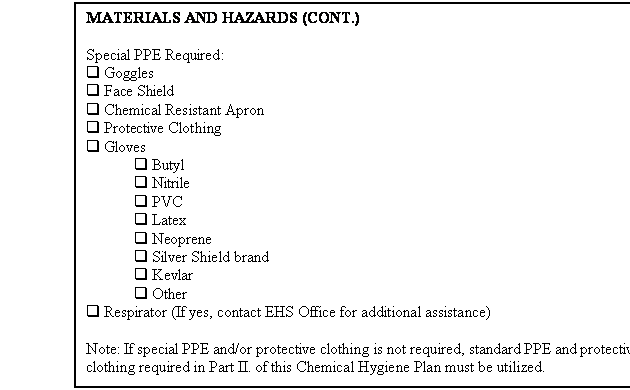
PROCEDURE Enumerate the
steps to be followed in performing the procedure and the required
precautions to avoid harm. The steps should be detailed and should include
prohibited activities and cautionary statements, where applicable. Task Hazards Precautions SPECIAL EMERGENCY PROCEDURES Fire/Evacuation:
_____________________________________________________________ Chemical Spill: ______________________________________________________________ Medical Emergency:
__________________________________________________________ Personal Exposure:
___________________________________________________________
SPECIAL EMERGENCY
PROCEDURES Fire/Evacuation:
_____________________________________________________________ Chemical Spill:
______________________________________________________________ Medical
Emergency: __________________________________________________________ Personal
Exposure: ___________________________________________________________
PART IV. Additional Administrative Provisions
1.
INTEGRATION WITH MIT EHS
MANAGEMENT SYSTEM
MIT has designed and implemented a comprehensive and integrated
Environment, Health and Safety Management System (EHS-MS). This
management system provides better institutional accountability for achieving
and maintaining compliance with federal, state, and local environment, health
and safety regulations in MIT's departments, laboratories, and centers, while
simultaneously retaining the independence of research and teaching. The EHS-MS
also seeks to create a more sustainable campus by encouraging the incorporation
of positive initiatives into activities, such as reducing wastes and toxics,
preventing pollution, and conserving and reusing resources. One of the defining
features of MIT's EHS-MS is the integration of regulatory compliance with
positive initiatives and educational programs in a decentralized academic
research setting.
This Chemical Hygiene Plan is an integral component of the
EHS-MS. It is an administrative tool that provides for the establishment of
safe and sound workplace practices in the laboratory, and ensures the
Institute’s regulatory compliance with the OSHA Laboratory Standard. The Chemical Hygiene Plan incorporates and
advances core components of the EHS-MS, such as clarifying roles and
responsibilities, outlining training requirements, identifying chemical risks,
and documenting safe operating procedures to mitigate those risks. For more
information on the EHS Management System, please visit http://informit.mit.edu/ehs-ms.
2.
PRIOR APPROVALS AND PROCUREMENT
2.1.
MIT-Wide Signature Control Program for the Purchase of Certain Hazardous
Materials
The MIT Procurement Department through its Purchasing
Policies and Procedures has established Institute-wide restrictions on the
purchase of certain hazardous materials. These materials require pre-approval
by authorized MIT agents prior to purchase. These materials include:
|
q Radioactive Materials |
q Nitrous Oxide Gas |
|
q Controlled Substances, such as drugs |
q Explosives |
|
q Hypodermic Needles and Syringes |
q Liquid Petroleum Gases |
|
q Ethyl Alcohol |
q Certain Biological Materials |
|
q Certain Poisons |
|
Detailed information on the purchase of these materials can
be found on the Procurement Department’s website at http://web.mit.edu/purchasing/pol&proced/4.1.pdf.
2.2.
Purchase of Large Chemical Quantities
In most cases, MIT
discourages the practice of bulk ordering of chemicals that reduces the
chemical cost per unit volume. Although bulk orders may save individual
Departments, Laboratories, and Centers (DLCs) money in the short-term, in the
long run, the cost of disposal of unused chemicals can far outweigh any savings
from the bulk order. However, if it can be demonstrated that the bulk purchase
of a chemical for an on-going laboratory process can simultaneously reduce
disposal costs and not increase risks to environment, health and safety, the
EHS Office may support some degree of bulk purchasing. Contact the EHS Office
to discuss particular situations if you are considering a bulk purchase.
The following
points should be addressed to determine the proper volume of any chemical to order.
Consider the
following when placing an order:
q Investigate if there is a less hazardous substitute that can be used to
achieve the same results. This could
reduce the hazards involved in the process as well as the waste disposal costs.
q Order only the amount likely to be used for its intended purpose within
the specified shelf life of the material and within the planned timeframe of
the procedure. This can minimize chemical waste if processes or research
changes and previously purchased chemicals are no longer needed.
Although many chemicals can be safely stored over long periods of time,
decomposition can result in explosions, ruptured containers and the formation
of hazardous by-products.
q Evaluate the chemical
properties that may preclude long-term storage before the chemical quantity to
be ordered is decided.
q Order only the quantity that will fit into the appropriate storage
area(s). Storing excess chemicals in a
fume hood or outside adequate storage facilities will create other
hazards.
q Request that the chemical
vendor package the material in smaller containers on large orders and request
that stock be delivered on an as needed basis. This is particularly
useful when one lot or a special blend is required.
q Consult laboratory chemical inventory lists, if available, before
ordering additional stock. If the
decision is made to order new stock because of concerns about quality of
existing stock, please properly dispose of existing stock of questionable quality
as soon as possible.
q Manage the stock so that the oldest materials are used first.
q Refer to the EHS Office Flammable Liquids SOP when applicable.
EHS Office SOPs are available at http://web.mit.edu/environment/ehs/topic/sops.html.
q Refer to the EHS Office Hazardous Waste Management SOP when
applicable. EHS Office SOPs are available at http://web.mit.edu/environment/ehs/topic/sops.html.
If you need assistance in making a determination on the most
appropriate quantity of chemical to purchase, please contact the EHS Office at 617-452-3477.
2.3.
Purchase of Non-Returnable Gas Cylinders
The purchase of non-returnable gas cylinders should be
avoided. All gas cylinders should be returned to the supplying vendor when
their use is completed. All non-returnable cylinders will have to be disposed
of as hazardous waste, and the cost of doing so will be charged to the Department,
Laboratory, or Center.
“Lecture bottles” are often considered non-returnable by the
vendor. However, MIT has an agreement with their preferred chemical vendor, Airgas, to take back non-returnable gas cylinders,
including “lecture bottles” that were purchased through them. Contact Airgas Gas on-campus directly at 617-253-4761 (3-4761 from
an MIT telephone) for more information.
2.4.
Purchase of Select Toxins
Certain biological toxins are governed by special
regulations that require strict controls if threshold amounts are
exceeded. Researchers working with
regulated toxins must submit paper requisitions to the EHS Office Biosafety
Program. More details are provided at http://web.mit.edu/environment/ehs/rdna.html.
3.
MEDICAL EVALUATION, EXAMINATION
AND SURVEILLANCE
Employees or students who wish to discuss
occupationally-related medical issues with the MIT Medical Department,
Occupational Medicine Service may do so.
During this medical evaluation, the clinician will determine if a
medical examination is necessary.
Medical evaluations and examinations may be arranged by contacting the
Medical Department, Occupational Medicine Service at 617-253-8552.
When
a Medical Evaluation May be Necessary
Any employee who exhibits adverse health effects from a
chemical or hazardous material exposure as a result of MIT-related research or
work should report to the Medical Department immediately for a medical
evaluation.
Employees or students who work
with hazardous materials are entitled to a medical evaluation when any of the
following conditions occur:
q the individual(s) develops signs/symptoms associated with hazardous
chemicals to which they were exposed;
q exposure monitoring results are routinely above action level or PEL
(permissible exposure limit) for a substance for which there are
monitoring/medical surveillance requirements; or
q a spill, leak, explosion or other incident
creates a likelihood of exposure.
Information
to Provide to the Clinician
At the time of the medical evaluation, the following
information shall be provided to the clinician:
q
identity of the hazardous
chemicals to which the individual may have been exposed;
q a description of the conditions under which the exposure occurred;
q a description of the signs and symptoms of exposure, if any; and
q a copy of the chemical information sheet
(MSDS, or Material Safety Data Sheet) shall be provided.
Clinician’s
Written Opinion
The MIT Medical Department and the Industrial Hygiene
Program within the Environment, Health and Safety Office have a collaborative
relationship in dealing with chemical and other work-related exposures that may
result in the need for medical care.
This collaborative relationship includes protecting patient information
while ensuring that supervisors receive the information necessary to ensure that
an individual’s return to work following medical treatment for a work-related
exposure does not compromise the patient’s health.
All patient medical information is protected by law and is
considered strictly confidential. A
patient, however, is entitled to view his/her medical record. When a work-related
exposure has occurred that results in medical examination and/or treatment, the
Medical Department will notify the supervisor of the incident, along with any
recommended restrictions on work activity.
Additional
Steps to be Taken
MIT requires the Supervisor’s Report of Occupational
Injury and Illness to be completed within 24 hours, when a spill or other
accident triggers a medical evaluation or examination. The report, to be completed by the Supervisor,
is available online at the secure MIT Human Resources website “https://web.mit.edu/hr/restrictforms/injury_report.html”.
An MIT personal certificate is required to access this document.
The MIT EHS Office has developed a standard operating procedure
(SOP), “Reporting Work-Related Injuries and Illnesses of OSHA-Covered
Personnel” to assist Departments, Laboratories, or Centers (DLCs) in this type
of reporting, which OSHA requires. The SOP
may be found at http://web.mit.edu/environment/ehs/topic/sops.html.
Medical surveillance is the
process of using medical exams and/or biological monitoring to determine
potential changes in health as a result of a hazardous chemical or other
exposure. Certain OSHA standards require
a clinician evaluation as part of medical surveillance. Medical surveillance is required when initial
monitoring reveals exposure levels that exceed levels (called “action levels”)
allowed under OSHA standards. MIT
Medical Department provides medical surveillance services. If you expect that your work will involve a
hazardous exposure that may not be sufficiently addressed through engineering
or administrative controls, a baseline exam may be advised before beginning
work. The baseline exam is compared
against follow up exams to determine any changes in health that may have
resulted from exposure to the hazard. In
addition, medical surveillance is offered to employees or students who are
routinely exposed to certain hazards.
Examples of hazards that are monitored through the medical surveillance
program include:
q Asbestos
q Beryllium
q Noise (Hearing Loss)
q Respirator Use (See Respirator Policy)
This is not a full list of hazards for which medical
surveillance is available. Individuals
with questions pertaining to occupational hazards and the possible need for
medical surveillance are encouraged to contact the Occupational Medicine
Service within the MIT Medical Department.
The Occupational Medicine Service in turn works collaboratively with the
EHS Office to determine the need for and extent of medical surveillance.
Enrollment
in Medical Surveillance
For those individuals whose work involves exposures with
potential medical surveillance requirements, it is the responsibility of
supervisors to identify new employees/students who are exposed to hazards, and
to provide names, work addresses, and MIT Identification Numbers (MIT ID) to
the EHS Office. Individuals not
otherwise identified but who believe that they incur hazardous exposures, or
believe they may have been inadvertently omitted, may self-enroll by dialing 617-452-3477. Supervisors who believe that individuals have
been inadvertently omitted from medical surveillance may also contact this
number. Finally, the EHS Office may
identify individuals or populations of individuals at risk and invite their
participation.
More information on Medical Consultation, Evaluation, and
Surveillance may be obtained from the Medical Department’s Occupational
Medicine webpage at http://web.mit.edu/medical/services/s-occupational.html.
4.
EXPOSURE ASSESSMENT (MONITORING
& REPORTING)
The EHS Office Industrial Hygiene Program provides exposure
assessment services to the Institute community.
Exposure assessments are measurements of air contaminants, noise levels,
or other health hazards such as heat stress to determine if they are within
limits that are considered safe for routine occupational exposure. Employees who believe they have had an
exposure should report it to the PI/Supervisor or the EHS Representative. The
PI should contact the Chemical Hygiene Officer or the Industrial Hygiene
Program (617-452-3477) for an evaluation.
The employee can also contact the CHO or the EHS Office directly, but
should notify their PI/Supervisor of the situation. In addition, anyone with a reason to believe
that exposure levels for a substance routinely exceed the action level, or in
the absence of an action level the PEL, may request exposure monitoring. Monitoring may be requested at any time,
however, the Chemical Hygiene Officer must be notified of monitoring
requests. The Industrial Hygiene Program
will conduct, or arrange to have conducted, exposure monitoring.
If the initial monitoring reveals an employee exposure over
the action level (or the PEL) for a hazard for which OSHA has developed a
specific standard (e.g. lead), the exposure monitoring provisions of that
standard, including medical surveillance, shall be followed. It will be the responsibility of the
Principal Investigator or Supervisor to insure that necessary periodic
monitoring requirements are met.
Within 15 working days after the receipt of any monitoring
results, the Industrial Hygiene Program will notify the employee or student of
the results in writing, either individually or by posting results in an
appropriate location that is accessible to employees. The PI/Supervisor and CHO will also be
notified of monitoring results and be provided a copy of a written report. A
copy will be kept in the Industrial Hygiene Program's records.
The Industrial Hygiene Program and the Chemical Hygiene
Officer will establish and maintain for each employee an accurate record of any
measurements taken to monitor exposures.
Records, including those from monitoring provided by other qualified
services, will be managed in accordance with OSHA standard 29 CFR 1910.1020,
Access to Employee Exposure and Medical Records.
The Industrial Hygiene Program and the Chemical Hygiene
Officer will establish and maintain an accurate record of any measurements
taken to monitor exposures. Records,
including those from monitoring provided by other qualified services, will be
managed in accordance with OSHA standard 29 CFR 1910.1020, Access to Employee
Exposure and Medical Records.
5.2.
Medical Consultation and
Examination
Results of medical consultations and examinations will be
kept by the MIT Medical Department for a length of time specified by the
appropriate medical records standard. This time will be at least the term of employment
plus 30 years as required by OSHA.
The PI/Supervisor or designee must keep a copy of the
outline of the topics covered in Lab-Specific Chemical Hygiene Training. The roster or lists of researchers who have
completed the lab-specific training and read the Chemical Hygiene Plan must be
submitted to the EHS Coordinator. These
training records are then entered into the EHS-MS central training records
database. Web-based training records are
automatically entered into the database when a course is completed. The EHS
Office is responsible for entering training records into the database for the
courses they teach. When an employee or student leaves the Institute, their
training records are moved into an archive training database. Training records are kept for at least 3 years
after an employee or student leaves the Institute.
Data on annual fume
hood monitoring will be kept by the EHS Office. Fume hood monitoring data are
considered maintenance records, and as such, the full data will be kept for one
year and summary data for 5 years.
A copy of the most recent Level II.
Laboratory Inspection Checklist and PI Inspection Report, as
outline below, should always be maintained locally within the Department,
Laboratory, or Center by the EHS Coordinator. An additional copy will be
maintained centrally by the EHS Office.
5.6.
Laboratory-Specific Policies and
SOPs
If standard operating procedures (SOPs) are developed in
addition to the SOPs contained in Part II. of this
Chemical Hygiene Plan, copies must be maintained in the laboratory accessible
to laboratory personnel. In addition, copies of the additional SOPs may be
included in Part III. of this Chemical Hygiene Plan.
6.
LABORATORY INSPECTIONS AND AUDITS, COMPLIANCE AND ENFORCEMENT
As a component of the MIT Environment,
Health and Safety Management System (EHS-MS), the Institute has implemented a
framework for conducting laboratory/work space inspections and audits to determine
laboratory/work space-specific compliance with environment, health, and safety
policies, laws, and regulations. The EHS-MS inspections examine a broad
spectrum of areas including postings, documentation and training, safety
equipment, laboratory/shop protocol, waste, and satellite accumulation areas
(SAA).
The purpose of the inspection and audit
system is to assist the Institute and laboratories in maintaining a safe work
and study environment, ensuring compliance with regulations, identifying the locations
where training or retraining is needed, and to fulfill MIT’s commitment to
environment, health and safety stewardship. This program will satisfy the DMSE
requirements for chemical hygiene inspections.
The MIT EHS-MS requires three levels of
inspection and audit that must be implemented across the Institute: Local
Periodic Inspections (Level I. Inspections), DMSE-Wide Inspections (Level II. Inspections), Institutional
Audits (Level III. Audit). For more
information on the MIT EHS Inspection and Audit Program, visit the EHS
Management System website at http://informit.mit.edu/ehs-ms,
and click on “Inspections” in the EHS-MS Manual.
6.2.
Compliance and Enforcement
Each individual at the Institute is responsible for
complying with all MIT, state, and federal rules, regulations, and required
procedures; and is held accountable for their actions. If a PI/Supervisor does
not take appropriate action to address problems noted during inspection or
audits, he or she may be subject to compliance and enforcement action. Issues of non-compliance will be taken to the
DMSE EHS Committee for recommendations regarding disciplinary action. The EHS Committee will provide recommendations
to the Department Head for action.
Deliberate failure to comply that results in
serious jeopardy to personnel safety and health or the environment may result
in loss of laboratory privileges.
A framework for establishing consequences for poor EHS
performance and incentives for promoting best management practices has been
adopted by the Institute. Visit the EHS Management System website for
additional detail at http://informit.mit.edu/ehs-ms
and click on “Roles and Responsibilities” in the EHS-MS Manual.
7.
OSHA HAZARD COMMUNICATION STANDARD
(HAZCOM)
OSHA Hazard
Communication Requirements
This Chemical Hygiene Plan also applies to those areas
within this Department, Lab, or Center where hazardous chemicals are used that
are not laboratory operations. Such
spaces include All provisions of this Plan
apply to these spaces. In addition, for
these work areas the PI/Supervisor must:
q Ensure a list of all hazardous chemicals used in the non-laboratory work
area is compiled. The list shall include
chemical or product name (as found on the label), manufacturer, location of use
or storage, and maximum quantity likely to be present at one time during the
year. This list must be updated
annually, and a copy of the old list submitted to the EHS Office for
archiving.
q Ensure that for each
chemical on the list, there is a copy of an MSDS in a notebook readily
accessible to all personnel using the chemical. This notebook should be updated annually when
the list is updated.
q Ensure all personnel are informed of the chemical list and the MSDS
notebook during work area-specific training.
With respect to training, employees and students working in
these areas may choose to take General
Chemical Hygiene for Laboratories or General
HAZCOM training for non-laboratory areas.
They will still need work area-specific training.
With respect to chemical labeling, all potentially hazardous
chemicals transferred from their original container to a second container must
be labeled with the chemical name and the principal hazard. For more
information on labeling, see Part II. Section 6.
8. TOXIC SUBSTANCES CONTROL ACT (TSCA)
The Toxic Substances Control Act (TSCA) is a set of EPA
regulations (40 CFR 700-799) designed to review new chemicals for environmental
and health risks before they enter the market.
Certain laboratory activities may trigger TSCA. Please contact the EHS Office at 617-452-3477
if you plan to:
q Import a chemical substance
q Export a chemical substance
q Synthesize a new chemical
substance, in which case you need to determine if that chemical substance
is currently in commerce. If the
chemical is not currently in commerce, you need to determine if it is regulated
by another agency; if it isn’t, the substance is regulated under TSCA. Additional TSCA requirements may apply.
q Transfer a new chemical
substance to another lab outside your own (on campus or to another facility
in the
9.
ANNUAL SARA III CHEMICAL INVENTORY
The Superfund Amendments and Reauthorization Act (SARA)
Title III regulations were developed by the EPA to deal with the release of
hazardous materials into the community, emergency response planning, and
community right to know. A section of
these regulations requires that all facilities in a community using hazardous
chemicals report quantities greater than the “Threshold Planning Quantity” to
local fire departments, the Local Emergency Planning Committee, and the
Massachusetts State Department of Environmental Protection. The purpose is to give fire fighters and
emergency responders information on what is inside a
facility before an emergency occurs.
To comply with this regulation, MIT submits a chemical
inventory each year on March 1 that covers both its facilities and laboratory
operations. The EHS Representative in
each laboratory receives a list of approximately 40 SARA Title III chemicals in
December. The quantity of each SARA Title III chemical on hand must be inventoried
and reported back to the EHS Office. The
EHS Office tabulates the lab inventories for the entire campus and reports
total amounts and amounts by location to the required authorities. Note that most of the SARA Inventory
chemicals are particularly hazardous substances (as defined by OSHA).
The SARA Inventory includes only those chemicals that are in wide use on campus
and is most likely only a partial list of all the particularly hazardous
substances that may be in use in a lab.
A separate list of all particularly hazardous substances is
recommended under the OSHA Laboratory Standard but does not require
quantity information to be tabulated.