Note that the inclination angle increases, as predicted by Fintan Ryan [Phys. Rev. D 52, R3159 (1995)]. Fintan's formula is an expansion in both 1/r and a, and so we expect that it should agree fairly well with the numerical result shown here (leading cause of disagreement is likely to be due to the large value of a). Indeed, Fintan's prediction for this orbit is 1.34 × 10⁻¹⁰, off by about 10%.
In a different paper, Fintan gives the rate of change of radius for inclined orbits [Phys. Rev. D 53, 3064 (1995)]; his prediction for this orbit is -1.28 × 10⁻⁵, off by only 1.5% from the numerical result.
Note also that the energy and angular momentum flux from the horizon is positive, i.e. the particle's energy and angular momentum increase due to radiation falling into the horizon. This is due to superradiant scattering: radiation is scattered by the hole's ergosphere, absorbing some of the energy stored in the spin of the spacetime, and then gives a "kick" to the orbiting particle.
Here's what the waveform looks like at this point in the particle's evolution:
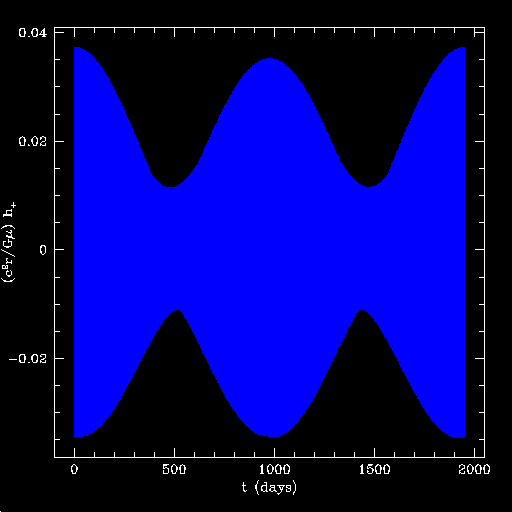
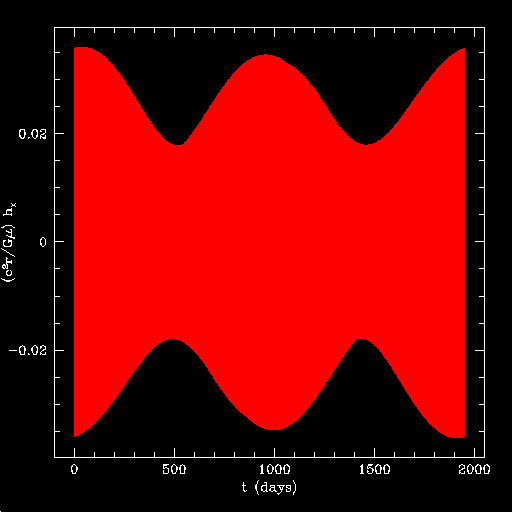
This waveform is observed in the hole's equatorial plane. The blue lines are h+, the red lines h×. The low-frequency amplitude modulation is due to Lense-Thirring precession, i.e. the dragging of the orbit's nodes by the black hole's spin. The frequency of this modulation is 2 × (Omegaphi - Omegatheta) = 3.66 × 10⁻⁶ M-1. This difference is rather small in this weak-field region; thus, orbital precession is rather slow, and there are many cycles in each peak.
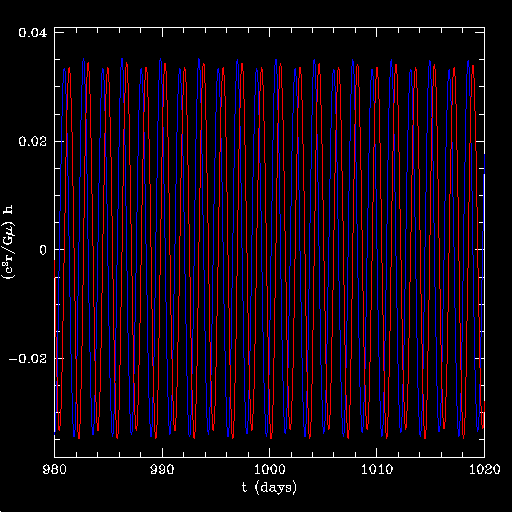
Here's a zoom on one of the peaks. Notice that the signal is practically monochromatic aside from the precession induced modulation.
The radiated energy has the following distribution:
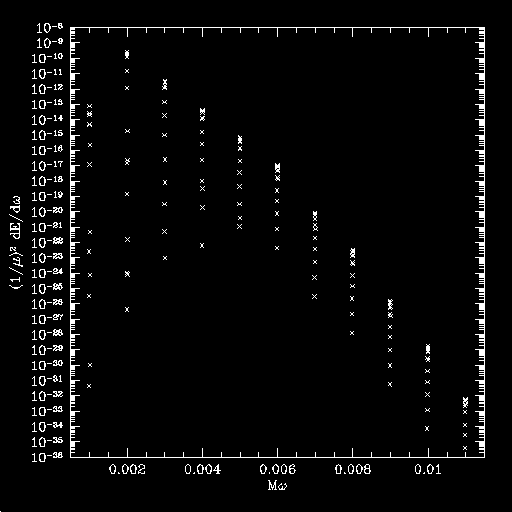
This is fairly narrow; notice that there is no noticeable break in the rate with which the energy falls off. This is consistent with the spectrum for a = 0.95M, r = 7M.