Welcome to the Schauer Lab!
This site was one of the first virtual molecular biology laboratories established on the net. The Schauer Lab is part of the Division of Toxicology at the Massachusetts Institute of Technology . This site is designed so that you can experience what it's like to be a part of a research lab group. In order to do so we have included biographies of your virtual co-scientists, selected abstracts of current research papers published by the lab, electron micrographs and diagrams of bacteria and lab equipment, and links to excellent microbiology sites. We hope you enjoy your experience as a virtual scientist!
Personalities of the Schauer Lab
Research is a dynamic field, so we have divided the group into those currently active in research affiliated with the lab, and those who have gone on to other (bigger and better?) projects.
The Scientists:
Assistant Professor and Principle Investigator: Dr. David Schauer
Lab Technician: Sharda Jha
The Post-Doctoral Fellows:
Vincent Young
Joe Newman
Kim Saunders
The Graduate Students:
Lori Cahill
Elaine Chin
Steve Luperchio
UROP (Undergraduate Research Opportunities) Students:
Brian Zabel
Jon Brasher
Sejal Patel
Members Who Have Gone On To Other Projects!
Isabel Pedraza was our former lab technician.
Noe Gomez and Katrina Linning were visiting undergrad research scientists. Previous UROP students include Julie Miller , Jason Handwerker , Wendy Jen , Marjie Delo, and Stacy Young. Sonya McCathey worked in the Schauer Lab as part of her post-doc rotation, and we all miss Yan Wang , a brilliant scientist who graduated in 1996 with her Doctorate in Toxicology. Sam Roberts receieved her Masters degree and moved on to work in the pharmacetical industry as of June 1996. Kalpana Mani , Adriane Chapman, Becky Perlow, and Lisa Tatterson are UROP students who have taken the term off to concentrate on their academics. And of course we'll never forget Zhifeng Zhang, or 'Z' for short.
Current Research Endeavors
Perhaps in general terms the focus of our investigations lie in determining the underlying molecular mechanisms of microbial pathogenesis and the connection between bacterial infection and human pathophysiology and neoplasia. Currently we have been interested in studying Citrobacter rodentium and Helicobacter hepaticus and pylori. Our general objectives include producing animal models to study disease and identifying and cloning genes necessary for virulence. A list of selected abstracts is available for your viewing pleasure.
Electron Microscopy of Enteric Microrganisms
 |
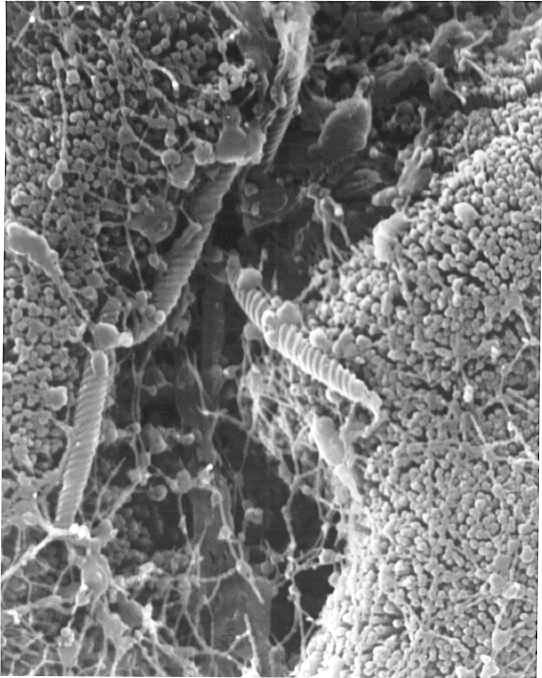
These images were generated using scanning and trasmission electron microscopy- Flexispira rappini appear above the surface of the microvilli of a murine intestinal tract.
Citrobacter rodentium appear entrenched in the microvilli of a murine intestinal tract. C. rodentium has the ability to intimately attach to the microvilli of the murine intestinal tract.
Here we see an interesting consequence of intimate attachment: pedestal formation at the site of attachment due to an accumulation of actin filaments.
Cyberbacter internetii
Get down and dirty as you get a first hand look at what life is like as an enteric bacterium- introducing Cyberbacter internetii!! Take a wild trip through a fully rendered descending colon from the safety and aseptic conditions of your own terminal. (Feel free to visit the Three Dimensional Medical Reconstruction page yourself).
Net Resources for Microbiology
You can check out a basic introduction to bacteria , or go for the On-line Course in Medical Bacteriology .
Other microbiology sites include:
CELLS alive!
Micobial Underground!
FDA's Foodborne Pathogens
Bugs in the News!
Images of Proteins and DNA
Centers for Disease Control
National Institutes of Health
If you have any comments or questions, don't hesitate to send email . We'll respond as quickly as we can.
"...Always at your service..."
Last modified: 5-7-96 / bazabel@mit.edu