

 SERC Home Page
 Aero/Astro Home Page
 [BIG]
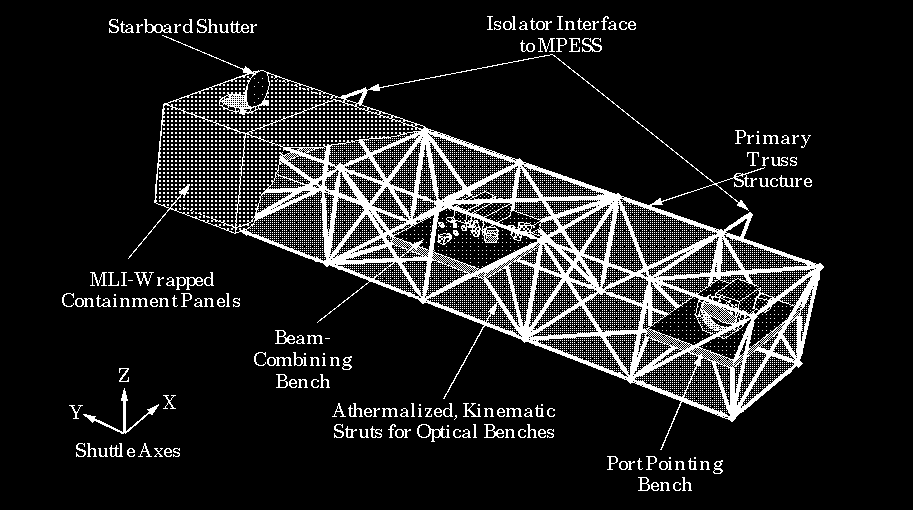
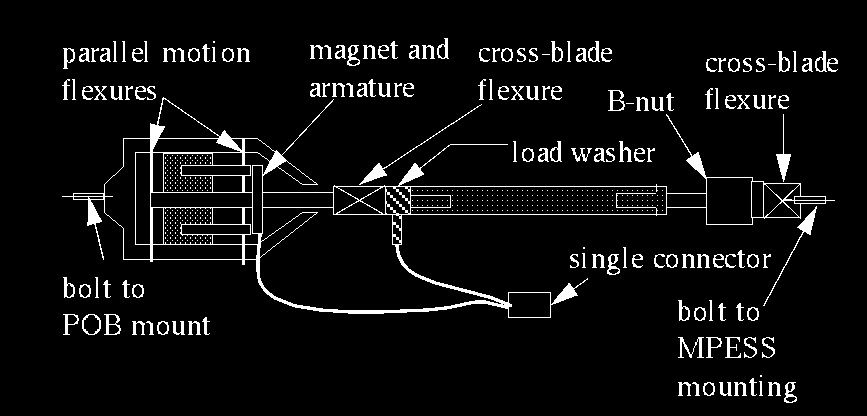
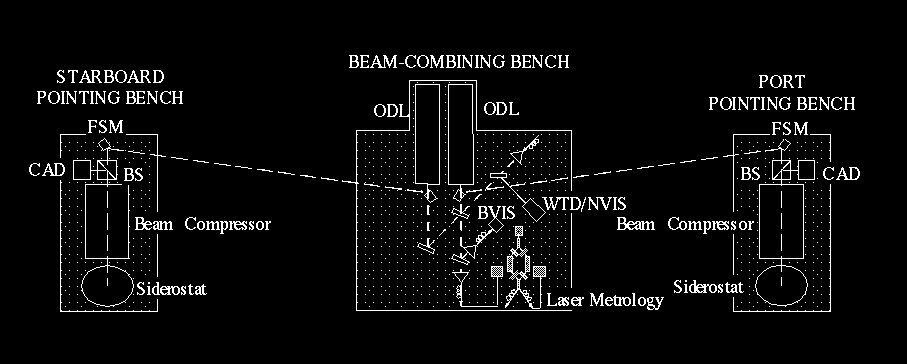
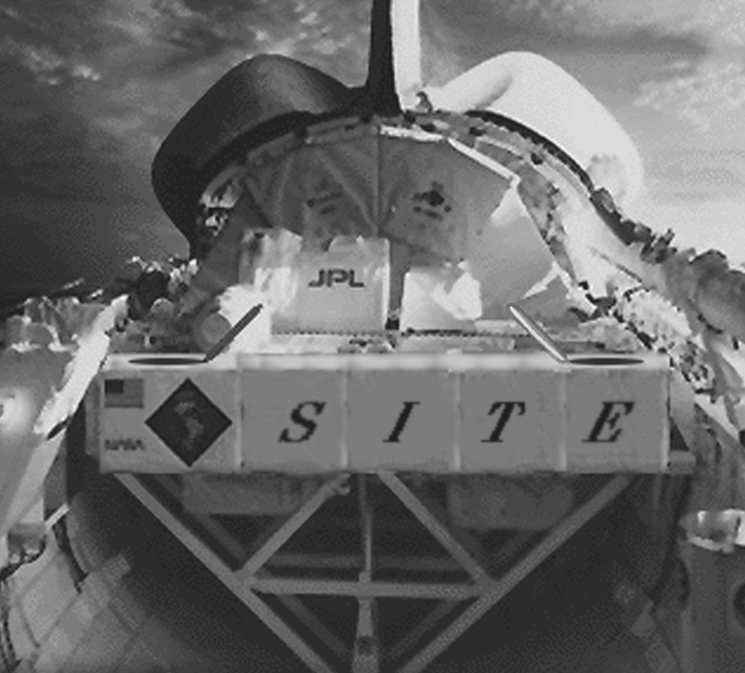
[BIG]Shown above is a creative pseudo-photo of what SITE may look like in the Shuttle payload bay. There is also a hardware sketch of the SITE experiment on the MPESS, as well as diagrams of the SITE operation, structure, isolation and optics.
An experiment to demonstrate the technology required for space-based stellar interferometry. Investigated by the MIT Space Engineering Research Center (SERC) and the Jet Propusion Laboratory (JPL). The four meter baseline, two aperture stellar interferomter will fly (launch planned for 1999) in the shuttle payload bay as part of the Space Shuttle Small Payload Program of NASA Goddard Space Flight Center (GSFC). Phase A of the program was completed in February 1995. The remainder of this page is a paper describing the experiment.
Michael Shao,** Robert Laskin**
Presented at the 44th International Astronautical Federation (IAF), Graz, Austria, October 14-16, 1993. The paper is copywrite IAF and the authors. It has a designating number of IAF-93-I.5-247
These characteristics lead to three fundamental problems. First, the cost and difficulty of fabricating monolithic, passive mirrors increases dramatically with diameter. Second, the diameter of the primary mirror is limited by the size of the available launch vehicle. Third, the integrity of the passive accuracy and alignment must be maintained throughout ground handling, launch loads and unforeseen on-orbit disturbances. Thermal cycling is also a large contributor to image degradation of passive telescopes. Since the exorbitant cost of large filled aperture earth-orbiting instruments essentially prohibits the launch of any near ultraviolet/optical telescopes exceeding the angular resolution of the Hubble Space Telescope (HST), the only recourse is to consider segmented or partially filled aperture concepts such as interferometers.
Interferometry is an approach to phase coherent imaging that alleviates the problems associated with filled aperture instruments. By spatially separating smaller but discrete apertures, angular resolution is improved as the separation distance is increased, while cost is reduced through the use of smaller diameter optics and innovative technologies. The Stellar Interferometer Tracking Experiment (SITE) is proposed to validate the operation of a space-based optical interferometric telescope. Figure 1 shows the envisioned SITE experiment in the Shuttle payload bay.
Figure 1: The SITE Experiment
The principle of operation of an interferometric telescope is quite simple. Figure 2 shows a common wavefront of light from a distant star falls on two reflectors (siderostats), separated by a baseline distance, D. The light on each path passes through internal optics, which focus it on an intensity detector where the two light paths recombine or interfere. An adjustable length segment called an optical delay line (ODL) is introduced into one leg to make the two path lengths equal.
Figure 2: Principles of Operation of a Stellar Interferometer
Measurement of the central fringe requires the performance of three technical functions within the instrument. First, disturbances which tilt the wavefronts of the two light paths or induce differences in the path lengths must be rejected. This increases the signal-to-noise ratio of the central interference fringe that is essential before it can be located and tracked. Second, the internal optics must combine, at the detector plane, parallel wavefronts of stellar light which have entered the instrument through multiple apertures. This internal optical path control uses fixed and steerable mirrors and lenses. Third, the pathlength difference DL must be slowly varied in order to locate, capture and track the central fringe and to scan the range around the central fringe in order to record its intensity. This function is achieved through the low frequency control of the ODL. While the operation is quite simple, these functions must achieve pathlength accuracies to fractions of a wavelength. These three technical functions are critical to the performance of the detector, and must be performed to the stringent requirements of interferometry.
Some of these methods cannot be realistically employed in space-based instruments. The massive support structure must be replaced by a more flexible telescope structure that is susceptible not only to environmental disturbances, but also to reaction forces produced by the articulation of beam steering optics during pathlength control. In addition, environmental disturbances on orbit are not well known prior to launch, and the accuracy of current 0-g modeling and 1-g calibration tools for predicting the dynamic behavior of precision structures in micro-gravity is uncertain. Once on orbit, the rudimentary disturbance data that is measured cannot be easily used to fine tune the instrument. Therefore, as identified in the OAST and OSSA Technology Needs and Plans3 ,4 , additional technologies must be developed and verified before a commitment can be made to proceed with a space-based interferometer mission.
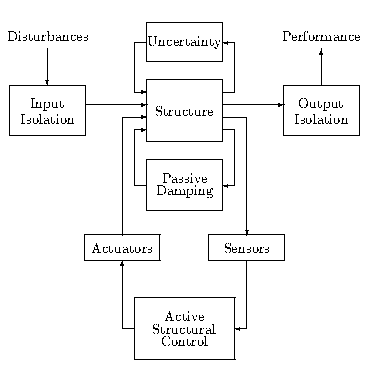
Due to the stringent pathlength and wavefront tilt requirements that interferometry imposes, technologies required by space-based instruments must be layered in order to sufficiently attenuate disturbances (Figure 3). Isolation technologies are needed to attenuate the transmission of poorly known, external disturbances into the instrument (disturbance isolation). Structural vibration suppression then inherits the responsibility for attenuating internal structural motions (transmission isolation). Finally, internal optical paths are controlled, using the steering and pathlength control optics, to make the performance insensitive to variations in the residual motion (performance isolation). Since the telescope must be less massive and more flexible than its ground-based counterpart, reactionless optical control actuators are required in order to limit self-induced disturbances within the instrument. These technologies, which are not found in ground-based interferometers, are essential to the successful operation of earth-orbiting interferometers because pathlength and wavefront tilt variations must be minimized if the central fringe is to be located and tracked.
Space flight is required in order to evaluate the technologies of isolation, vibration suppression and optical pathlength control and to validate that they enable the successful acquisition, tracking and measurement of a stellar central interference fringe. Flight enables the assessment and refinement of modeling and ground calibration tools that would then be used in the design of advanced space systems. The ability of these tools to accurately predict on-orbit performance significantly reduces the risk involved in committing to the development of such systems.
Figure 3: Controlled Structures Technology Layering Approach
Evaluation of the optical pathlength control on orbit enables characterization of gravity effects on these nanometer precision electromechanical devices. While the gravity effects may be small compared to the overall dimension of the instrument, their impact on nanometer and arcsecond control components, such as articulating optics, can be substantial and must therefore be accurately modeled. Evaluation of the performance of the various technology layers allows an assessment of the ability of models and ground calibration tests to predict the levels of disturbance attenuation that are achievable on orbit. The knowledge and experience gained from SITE will lead to the refinement of modeling and ground calibration tools for precision spacecraft and will directly impact an assessment of technology readiness for future astronomical interferometric missions.
Optical and ultraviolet space-based interferometers, in the 3 to 30 foot baseline range, are under consideration for high resolution astrometry, planetary detection, and numerous imaging missions (OSI, POINTS, etc.).5 In order to improve image clarity, these missions will directly incorporate component and system level technologies which are to be validated by SITE. These technologies -- specifically the precision isolation, vibration suppression, and optical acquisition, pointing and tracking control systems -- will in fact be relevant to other types of space-based astronomical instruments requiring extremely low vibration environments, such as segmented reflector telescopes. The low frequency isolation mount technology, evaluated through SITE, will be available for other Shuttle or Space Station mounted payloads, potentially attracting payloads which would otherwise require untended platforms. Finally, EOS-like platforms, which seek to minimize dynamic interactions between multiple payloads, will be able to utilize reactionless control techniques evaluated on orbit by SITE.
	Instrument			Angular Resolution
	SITE(l = 0.2 mm)		0.005 arcsec
	Hubble(l = 0.2 mm)		0.021 arcsec
	ROSAT (l=.06 mm)		0.026 arcsec
	EUVE (l = 0.076 mm)		0.048 arcsec
	Lyman/FUSE(l = 0.2 mm)		0.072 arcsec
	UIT (ASTRO-1)(l = 0.2 mm)	0.132 arcsec
Table 1. Resolutions of Space-Based Ultraviolet Telescopes.
The 0.005 arcsec angular resolution of SITE drives specific requirements for internal optical control. The need to interfere the same wavefront places a requirement on pathlength stability of l/20, or 10 nanometers RMS for l = 0.2 microns. The need to maintain parallel wavefronts places a requirement on wavefront tilt jitter of 0.2 arcsec. SITE's jitter requirement at l = 0.2 microns is more stringent than the jitter level attained by the ASTRO-1 Shuttle attached payload launched in December 1990. The 10 nanometer pathlength control requirement for SITE is more stringent than the surface accuracy requirement for HST. However, SITE achieves these requirements using relatively inexpensive isolation, vibration suppression, and optical pathlength control technologies, instead of relying on the integrity of high surface accuracy, precision aligned, passive optics.
The three organizations which comprise the SITE team -- the MIT Space Engineering Research Center (SERC), the Jet Propulsion Laboratory (JPL) Interferometry Group and the JPL Control Structure/Interaction (CSI) Program -- have, during the past decade, conducted engineering research in support of space-based interferometry. The JPL Interferometry Group provides guidance in extracting, from the science requirements, the critical technical issues that will have the greatest impact on the science return of a future mission.1 The SITE hardware derives from that of the successful Mark III Interferometer on Mt. Wilson.
MIT SERC is a university research center developing Controlled Structures Technology (CST): an engineering approach which unifies the various disciplines affiliated with the design of a precision structure in order to maximize the performance of the system in its operational environment. The MIT Interferometer Testbed has motivated research in active and passive structural control and isolation technologies.6 Experiments with placement of fluid damper struts and active struts with local control have yielded a 6 dB reduction in internal pathlength rms. In addition, performance isolation of 20 dB was obtained through active soft mounting of the siderostats.
Research at MIT SERC has emphasized modeling, ground testing and on-orbit testing of systems which are influenced by gravity. SITE is the direct evolution of the MIT SERC MODE 7 and MACE 8 IN-STEP experiments. MODE validated both linear and nonlinear dynamic modeling techniques which capture the effects of gravity in 1-g, and lack thereof in 0-g, in the open-loop response of structures. This modeling capability is being further evolved through the MACE program which investigates the degree of accuracy in open-loop 0-g models required for predictable high gain, closed-loop performance.
The JPL CSI Program pioneered and experimentally demonstrated a multi-layer vibration attenuation approach which achieved a factor of 5000 reduction (74 dB) in optical pathlength motion on the JPL Phase B CSI Testbed.9 The structural quieting (passive dampers/active members) layer gave a factor of 6 improvement. The disturbance isolation (active soft mount) layer gave another factor of 6 attenuation. And finally the optical control (active optical delay line) layer gave another factor of 139 reduction in internal pathlength error. The disturbance transmission was reduced to a level of 1 nanometer RMS. It should be noted that while the optical pathlength control provides the largest reduction, the other layers enabled this high bandwidth control by increasing the modal damping and reducing the dynamic range over which the optical control need be applied. Therefore, the layering of the pertinent technologies has been shown to not only achieve dramatic reductions in pathlength error, but to do so at levels that are fractions of a wavelength of near ultraviolet light. These layers included technologies identical to those which will be evaluated in SITE and are envisioned for space-based interferometry.
The experiment concept is to build an integrated structure/optical bench and operate the device while attached to an Multi-Purpose Equipment Support Structure (MPESS) pallet in the Shuttle payload bay. The optics train will include the functionality necessary for a working interferometer. The instrument specifications will be met by utilization of the three layer isolation, vibration suppression, active optical pathlength control methodology demonstrated in ground studies.6,9 The conceptual hardware manifestation of this concept is shown in Figure 1. The payload bay optical elements are contained within the Precision Optical Bench (POB). The control, command and data functions are within the Experiment Support Module (ESM), which resides in a standard locker in either the Spacelab or Spacehab pressurized modules. These two elements are interconnected by a signal and power umbilical.
Since the POB will operate in the Shuttle payload bay, the instrument specifications must be met in the presence of the significant and uncertain vibration and thermal environment of the bay. An initial vibration analysis has been conducted to find out how much the structural quieting, disturbance isolation, and optical control must do (some results presented later in this paper). Analysis of the effect of the thermal disturbances are on-going.
Figure 4: System Sensors and Actuators (left side)
In order to provide for pathlength compensation and fringe detection/tracking (phase coherence), the instrument will possess two optical delay lines (ODLs), one variable and the other fixed. The variable ODL will compensate for pathlength differences in the two optical legs due to rotations of the Shuttle and deformations within the POB. Since the former comprises the largest component of the differential pathlength error, a staged ODL is envisioned consisting of a mirror mounted to an electrostrictive (PMN) multilayer actuator with a maximum stroke of 10 microns. The PMN stack would in turn be mounted on a servoed voice coil to provide coarse adjustments up to 7 cm. Multiple reflections within the ODL increase the effective stroke. The PMN and voice coil would contain balancing elements, demonstrated at JPL, to make their operation reactionless. Using the optical/UV fringe detector, the variable ODL will employ pathlength modulation and synchronous demodulation techniques for fringe detection and tracking. White-light combining optics mix the two beams so that interference can occur at the fringe and the fine-tracking detectors. A single axis laser metrology system monitors the position of critical elements such as the variable ODL and measures the differential internal optical pathlength error. The overall design of the optics is based upon the Mark III Interferometer. The optical pathlength stabilization controllers are expected to contribute up to 43 dB of performance improvement based on demonstrations on the JPL and MIT testbeds.
The second aspect of operation involves measuring the clarity or visibility of the central interference fringe and the effectiveness of the technology layers. Once the central interference fringe is located, the ODL is dithered to provide interference intensity measurements in the vicinity of the central fringe. The other sensors, used for measuring the performance of the isolation and vibration suppression layers, are recorded in the ESM for subsequent analysis on the ground.
These procedures can be repeated for different stellar targets and with various control stages disabled to quantify the contributions of individual technologies. For example, an attempt could be made to capture and measure the central interference fringe while disabling the low frequency isolation stage. SITE can be operated during restricted, normal and excessive crew activities to measure the impact of heightened background disturbances on the instrument, and during day-to-night transitions in order to measure sensitivity to thermal transients.
Strategically placed sensors and the ability to engage and disengage the active technology layers allows measurement of the vibration reduction performance of the individual and combined technology layers. The comparison of measurements from accelerometers placed on either side of the disturbance isolation stages quantifies the performance of the soft mount isolation. Comparison of the acceleration input to the POB with the internal differential pathlength laser measurement reveals the ability of the vibration suppression control to isolate disturbance transmission within the structure. Finally, comparison of internal vibration measurements with the central fringe measurements quantifies the effectiveness of the optical pathlength control.
Data analysis at the systems level consists of capture and central fringe data analyses. The capture data is the set which is required to determine the quality of the external and internal optical capture. The coarse acquisition detector will verify that the desired stellar target was actually along the LOS of the SITE instrument thereby confirming external capture. The laser metrology and fine tracking detector directly measure pathlength stability and wavefront tilt jitter and therefore measure internal capture. The capture data will be analyzed by comparison with a detailed static structural/thermal/ gravity/optical model. This will allow confirmation of gravity sag and thermal deformation effects, and identification of any unexpected misalignment due to ground, launch or orbital operations. Capture data will also be compared with earth data in the aperture up (plus 1-g) and aperture down (minus 1-g) limiting conditions.
Central fringe data is gathered by varying the ODL by several wavelengths and measuring the interference power intensity as a function of differential pathlength. Analysis of central fringe visibility allows assessment of absolute instrument performance. The visibility measure will be compared with a priori predictions of instrument performance, generated by system level tests with known disturbance inputs at the mount locations, and by dynamic structural/control/optical disturbance rejection modeling. The effectiveness of the individual layers can be assessed directly from sensor measurements. Comparison of these measurements with a priori predictions of the model and ground tests can be used to refine modeling tools and calibration procedures.
Flight allows system validation in the actual disturbance, vacuum, thermal, radiation and contamination environments in which future inertially pointing detectors and instrument components will operate. All exogenous inputs and disturbances to the instrument cannot be accurately modeled (or in some cases even anticipated) nor can the impact on mission performance be evaluated based solely on analysis. The measurement and control strategies developed to enable SITE to adapt and compensate for these exogenous inputs can be fully evaluated only in orbit.
Finally, flight provides access to the same undistorted stellar light, throughout the optical and ultraviolet spectrum, that will be observed by advanced space-based telescopes. Since ultraviolet light does not reach the earth's surface, ground instruments cannot be used in place of flight instruments. The measurement of actual stellar light to the same precision as envisioned space-based interferometers will irrefutably validate the capabilities of the detector concept.
SITE evaluates technologies which reduce the dependency of precision instruments on passive alignment, ground calibration, and the maintenance of extremely low vibration levels in flight. SITE exploits isolation and vibration suppression technologies for disturbance attenuation, and pathlength control technology for high bandwidth compensation of residual motions. A technology layering architecture allows the rejection of large, unmodeled on-orbit disturbances. The active optical pathlength compensation relaxes the reliance on ground alignment and calibration, and reduces the susceptibility of instrument performance to ground handling and launch loads.
SITE is designed to provide a low cost flight validation of this detector concept in order to reduce the risk of committing to this technology in future space systems. SITE will subject an interferometric science detector to the same vibration, vacuum, thermal, contamination and radiation environments in which such telescopes will eventually operate. Stellar light will be measured using control accuracies identical to those required of such telescopes. As an added scientific benefit, the 0.005 arcsec angular resolution measurements that SITE will return will constitute the most precise ultraviolet observations to have been made to date by any observatory.
The technical products of SITE are threefold. First, SITE develops an experience base at MIT SERC, the JPL Interferometry Group, and the JPL CSI Office. This experience and expertise can be exploited in the design of future space-based interferometers and other discrete aperture devices. This is a nontrivial benefit since the scientific and engineering communities at MIT and JPL have participated in a large number of the major missions of scientific exploration over the last two decades.
Second, the design, analysis, calibration and test methodologies used in the development of SITE will have been verified, and the modeling tools used to predict on-orbit behavior will have been refined. These methods and models can subsequently be effectively and reliably used in the design of future precision optical systems. MIT SERC will aggressively disseminate this technology to the US community.
Finally, the hardware contribution of SITE is significant. The POB provides a state-of-the-art isolation pallet for the Shuttle payload bay, which could be adapted to Space Station Freedom. Furthermore, the SITE hardware can be evolved into a Shuttle mounted interferometer with a baseline up to 60 feet (length-wise in bay) and yielding milli-arcsecond resolution.
Some initial research has been done to make estimates of the expected open loop DPL error in the presence of an assumed disturbance environment. The usefulness of passive and active vibration isolation, and the benefits of using accelerometers to measure external DPL error (with feedforward to the optical delay line) have been explored. Results using simple beam models, which parallels the experimental research programs of JPL and MIT, are described next.
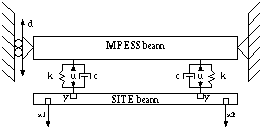
The two beams are connected by springs and dashpots that model damped struts. The mount spring stiffness (k) and damping (set with c) are adjusted to explore the isolation achieved for various mounting designs. A mount damping level of 20% can be easily achieved with viscous damper struts. In order to quantify the effects of the passive isolation, a rigid mount model was also run with the mount stiffness (k) set very high (with 1% damping). The mounting is done at locations 21% in from each end. This is approximately where the MPESS has some useful mounting locations.
Figure 5: Two beam model
	element		mass	1st frequency	damping 	no. of modes
	MPESS beam	600 kg		1 Hz	1 %		16
	SITE beam	100 kg		50 Hz	5 %		16
Table 2: Properties of two beam model elements.
The performance (z = z1 - z2) is measured as the difference between the two siderostat locations (5% of the beam length in from each end) along the line-of-sight direction. This performance metric is the external DPL error (Figure 2) caused by rigid body and flexible motion of the system. Internal DPL error and wavefront tilt require more extensive modeling of the internal optical support components of the instrument and will be explored later. As stated earlier, the interferometer operates by slewing the ODL to find the central interference fringe. The visibility, or sharpness, of this fringe is set by the RMS DPL error at time constants faster than the sampling time of the detector. The performance metric is then the RMS DPL error integrated above a certain frequency. Provided that this metric is below 10 nanometers, the central fringe will be visible, and pathlength motions below this frequency will be tracked by the fringe tracker. The sampling frequency of the detector is governed by the brightness of the observed star.
The disturbance (d) is represented by an assumed motion spectrum in the line of sight (LOS) direction at the left pin of the MPESS beam. The vibration spectrum in the 1-100 Hz frequency range was derived from acceleration data measured in the payload bay by the ACAP experiment in October, 1992 and in the middeck by MODE in September, 1991. At frequencies below 1 Hz, the forcing is impulsive (thrusters, crew push-offs) and the resulting motion is the Shuttle attitude error. This prescribed displacement comes from the fact that the two sides are differenced in the performance metric. Assuming a baseline of 4 meters, and a one degree deadband Shuttle attitude control, the resulting motion is 7 cm peak to peak. A disturbance PSD of 1 milli-g (9.81x10³ m/s2) with a low-frequency corner at (0.085 Hz) matches the predicted high frequency acceleration level and low frequency displacement level.
A measurement (y) of acceleration in the line of sight direction is made at the mount attach points on the SITE beam side. An input (u) force is made, acting across the mounts, to be used in active control.
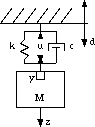
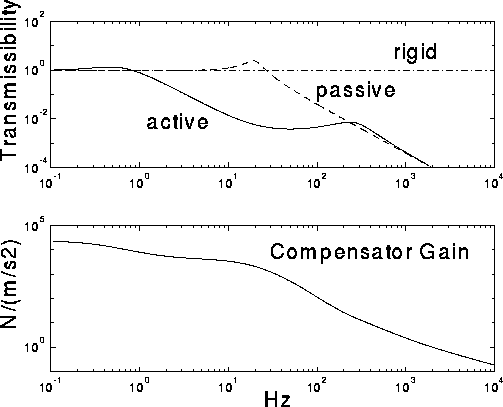
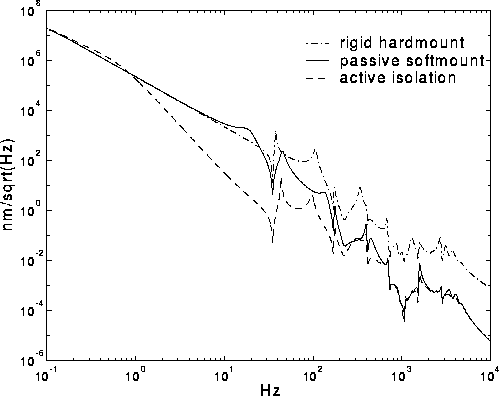
Figure 7 shows the effects of passive and active isolation on a simple one mass, one spring system (Figure 6). A rigid mount would transmit all motion from the base (transmissibility, z/d, equal to unity). A passive mount attenuates the motion in frequencies above 1.414 times the mount resonance, and amplifies the motion below. The damping of the passive isolator can be adjusted to trade off the amplification of the resonant peak for the rate of roll-off past the corner (a damping of 50% is optimal for broadband disturbance and performance measures). An active isolation system can do as little as increase the damping in the passive resonance, or as much as active shaping of the transmissibility. When using accelerometers (or load cells) as feedback variables, the active control effectively enhances the mass of the isolated payload. To actively move the resonant corner frequency down by a factor of 10 requires a gain of 102 times the payload mass.
Figure 6: Simple (one mass, one spring ) model.
Figure 7: Passive and active isolation on simple model.
The compensator shown in Figure 7 was designed using Linear Quadratic Gaussian methods on the simple (mass, spring, dashpot) system (Figure 6) with acceleration feedback. A frequency dependent control weight was used to account for the noise in the accelerometers. Low frequency accelerometer noise is a limiting factor on the gain of an isolation loop since this noise is multiplied by the large compensator gain and fed directly to the instrument through the mount force (u). Also, a frequency dependent performance weight is used to increase the loop gain (and thereby reduce the transmissibility) in the region where the active isolation does some good (around the 20 Hz passive resonance).
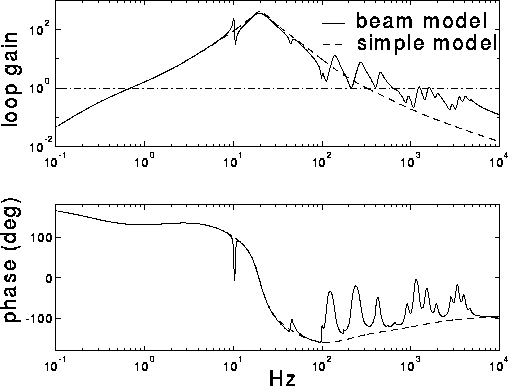
The same compensator applied to the simple model in Figures 6 and 7 is used in each mount of the two beam model. Each of the two mounts uses only its local, collocated accelerometers, mount force actuators, and the SISO LQG compensator designed on the rigid base/rigid payload simple model. The effects of the flexibility of the base (MPESS beam) and the payload (SITE beam) can be seen in the loop transfer function of one of the mounts. Figure 8 shows that the flexible modes of both the MPESS and SITE beams effect the magnitude and phase of the loop transfer function. Note that phase excursions are always stabilizing; this is due to the collocated nature of the loop. This collocated property allows the same compensator that was designed for the rigid system to work on the flexible system. The higher magnitude seen in the beam model over the simple model is due to the impedance of the beam as seen from the attach point, the typical beam pole-zero spacing is such that the average roll-off is s1/2 less than that of a pure mass. Note that the model loses fidelity after about 6000 Hz (higher modes were not modeled, but the trend can be seen).
Figure 8: Active isolation loop transfer function, magnitude and phase of compensator in series with the plant.
One should note that the base (MPESS) modes (11 Hz, etc.) are observable mostly in the frequency range below 20 Hz. Blackwood and VonFlotow10 showed that the flexibility effects in the force to payload acceleration plant transfer functions die out as 1/w2 past the passive resonance. The modes from the SITE beam (equipment flexibility), however, are directly coupled to the accelerometer and are therefore fully observable at all frequencies. A load cell measurement would reduce this modal observability, but may have higher noise at low frequencies. Accelerometer/load cell trades are ongoing. Note also that the first bending mode of the SITE beam around 50 Hz is not observable since the attach points are very close to the nodes of that mode. Attempts would be made to do similar structural tailoring for the real POB design.
Figure 9: Passive and active isolation on two beam model, external DPL error PSD, showing hardmount, softmount, and active softmount cases
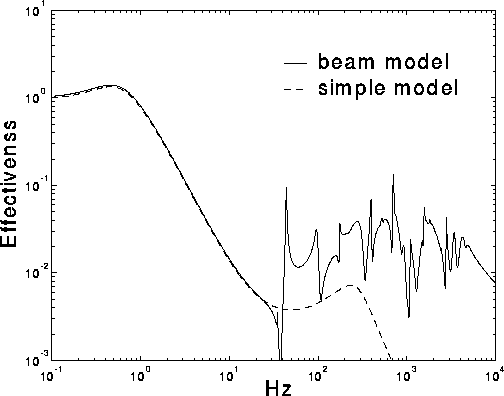
A useful measure of the effectiveness of an isolation design is the ratio of the disturbance to performance transfer function of the isolated design to the same transfer function of the rigid mount design. This is called isolation effectiveness and is plotted in Figure 10 for both the simple model and the two beam model. Note that they match quite well until the first structural resonance, and then, in the two beam model, a 30 dB average attenuation is observed for all higher frequencies.
Figure 10: Active isolation effectiveness: z/d with active mount divided by z/d with rigid mount
In order to reduce the DPL error further, a measurement of the external DPL error is taken using accelerometers collocated with the siderostats and oriented along the line of sight. The measurement could also be taken with an appropriately located and oriented rate gyro, or by using the attitude information from the shuttle (and relative displacement sensors). A study of these options, or combinations, is ongoing. Assuming the use of accelerometers, an estimate of external DPL is made by differencing the accelerometers and integrating twice. The low frequency integrator corner was set at 0.001 Hz; potentially large initial transients could be zeroed with attitude information. The resulting estimate of the error is then fed forward to the optical delay line, where it is taken out. The optical delay line (a light mirror on staged voice coil and PMN actuator) was given a bandwidth of 500 Hz for realism.
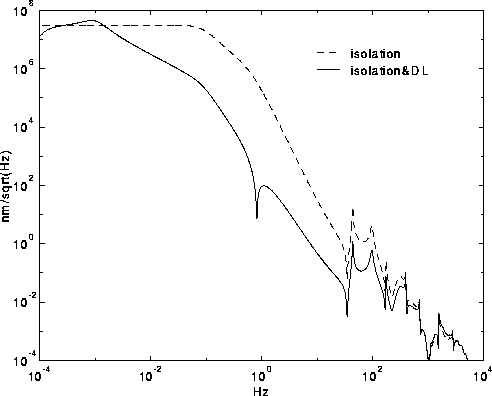
The effect of adding this accelerometer feedforward to delay line control is to further isolate the performance metric from the disturbance. Figure 11 shows the resulting PSDs and the improvement that the delay line compensation gives in the region from 0.001 Hz to 500 Hz. The low frequency corner was chosen to reduce the effects of low frequency accelerometer noise (bias). The low frequency roll-up and the 500 Hz roll-off (bandwidth) cause pure cancellation only at one frequency (the noticeable zero near 1 Hz).
Figure 11: External DPL error PSD, with and without accelerometer feedforward to ODL compensation.
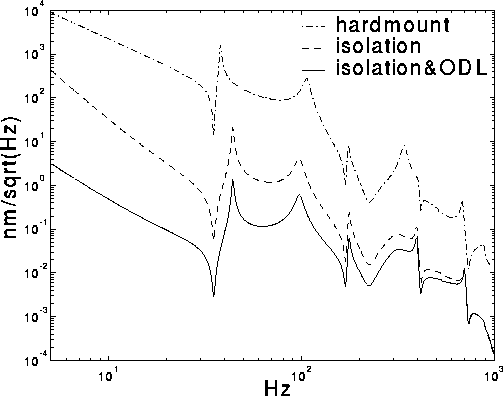
By layering the delay line compensation with the active isolation design, the frequency above which the DPL error is sufficiently small moves from 50 Hz to 5 Hz. Integrating the external DPL error from 5 to 1000 Hz yields just 7 nanometers (below the 10 nanometer requirement). The accelerometer noise, remember, is also being integrated and fed forward to the delay line. Using the measured noise from Sundstrand QA-1400s, a 4 nanometer RMS noise contribution was found in the range from 5 to 1000 Hz. Table 3 shows the RMS DPL error found when the PSD were integrated from 5 to 1000 Hz. Figure 12 shows this frequency range and the performance improvement gained from isolation and isolation plus delay line compensation. The combination of isolation and feedforward pathlength compensation yield an acceptable level of performance when integrated above 5 Hz. The fringe tracking control will handle the motion below 5 Hz for reasonably bright stars.
	Configuration		DPL error   5-1000 Hz
	rigid mounted		190 microns
	passive mounted 	220 microns
	active isolation	720 nanometers (29 dB)
	delay line alone	300 nanometers (36 dB)
	isolation & delay line	  7 nanometers (70 dB)
	accel. noise contrib.	  4 nanometers
Table 3: RMS external DPL error taken 5-1000 Hz
Figure 12: Beam model results, external DPL error PSDs after various layers closed.
The need for higher angular resolution observations on orbit, as stated in the Bahcall report, can only be realized through the use of discrete aperture interferometric telescopes. Space-based interferometric telescopes must exploit isolation, vibration suppression and optical pathlength control technologies in order to achieve the requisite nanometer pathlength and arcsecond jitter performance. These technologies have undergone significant development in recent years, and the need for testing, in the operational environment is clear. Before committing this technology to the development of an expensive space telescope, development risk can be minimized through an on-orbit science detector validation and technology evaluation program. In addition to a technology demonstration, even a short duration Shuttle mission can produce significant astrophysical results by measuring in the ultraviolet.
2 Shao, M., Colavita, M. M., Hines, B. E., Staelin, D. H.,Hutter, D. J., et al., "The Mark III Stellar Interferometer," J. Astron. Astrophys. 193, 357-371, 1988.
3 OSSA Technology Needs, NASA, 1991.
4 OAST Integrated Technology Plan, NASA, 1991.
5 Shao, M., Colavita, M. M., "Long-Baseline Optical and Infrared Stellar Interferometry," Annu. Rev. Astron. Astrophys., 30: 457-498, 1992.
6 Blackwood, G. H., Jacques, R., Miller, D. W., "The MIT Multipoint Alignment Testbed: Technology Development for Optical Interferometry," Proceedings of the 1991 SPIE Conference, 1991.
7 Crawley, E. F., Barlow, M. S., vanSchoor, M. C., Masters, B., Bicos, A. S., "Middeck 0-gravity Dynamics Experiment: Comparison of Ground and Flight Test Data," presented to the 43rd Congress of the International Astronautical Federation, 1992.
8 Miller, D. W., Sepe, R. B., Rey, D., Saarmaa, E., Crawley, E.F., "The Middeck Active Control Experiment," presented at the 5th NASA/DOD CSI Technology Conference, 1992.
9 Spanos, J., Rahman, C., Chu, C., Obrien, J., "Control Structure Interaction in Long Baseline Space Interferometers," 12th IFAC Symposium on Automatic Control in Aerospace, 1992.
10 Blackwood, G. H., vonFlotow, A. H., "Active Control Of Vibration Isolation Despite Resonant Structureal Dynamics: A Trade Study of Sensors, Actuators and Configurations," 2nd Conference on Recent Advances in Active Control of Sound and Vibration, 482-494, 1993.
SERC Home Page
Aero/Astro Home Page