things to learn the hard way
In no particular order, these are some things that (almost) caught me at
some point or another, and will be useful to remember and hopefully useful
to pass on to others...
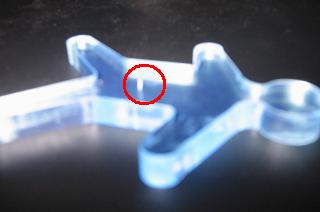
- This is by far the funniest.
I have a hard time getting CorelDraw to do what I want it to, and started
modeling things in Solidworks (SLDPRT → SLDDRW → DXF → CDR).
When you tell it to "print," you'll find the origin from Solidworks has
travelled through all of these formats and will be printed by the
machine. Here is a gingerbread man for vacuum molding with an aptly placed
navel. Delete or hide your origin in Solidworks.
- Relevant to CorelDraw and anything imported into it. Really really watch
the order in which the drawings/pieces were modified, this caught me a couple
times with screwholes on the clasp assignment. I haven't found a good way
yet to determine the order of things, though I think the alt+click for
"digging" through layered objects cycles in the order they were drawn.
- Check out the screw bins before designing things that need to be screwed
together. Consider acrylic glue. Two things happened here: a) there are no
6-32 x 3/8" set screws. b) I have not yet found an Allen wrench to deal with
the tiny 2-56 set screws.
- This leads to another discovery: Reconsider your materials/design/tool
selection before resorting to things like Dremeling screws. I went
through many cutting wheels before giving up and using binder screws.
- Acrylic is brittle. Drop kick it just once into a table leg in 054
and watch all your work shatter 10 minutes before class. Use experience to
improve design either by changing structure or material.
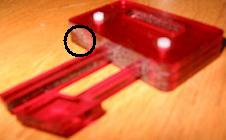
- In most cases here, it seems the tolerances are optimized by the
manufacturer and are accurate only on the second Tuesday of the month if
there's a half-moon and you've spun in circles on the lab chair three times
before pressing the "start" button. Consider ways to make design less reliant
on exact tolerances and easy to amend (filing, adhesives, etc.) if they don't
work out right.
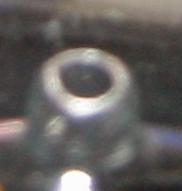
- Vacuum forming may look easy, but it is an art form. Consider the examples
of the uncovered suction hole and the too-saggy or too-warm plastic (below,
where when suctioned it folded over the rim of the plate, requiring brute
force and destruction for removal).
Temperature does not need to be on full, 4 will do. Further, for the 12 x 12
squares, only heat zones 1 and 2 are needed.
- There is some great funky foam now living in the drawer labeled
"foam cutter"
that is great for sticking under non-porous objects in the vacuum former.
Doesn't stick, either! Also, thinner PET hides in the rack by the acrylic.
PET is recyclable - they use it to make soda bottles. Hint, hint.
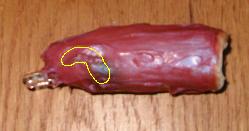
- Among the many materials used for molding is Poly Latex 60, a brush on
latex. It seems to shrink quite a bit when drying. For example the wires
and battery at right were originally well embedded, but were nearly protruding
when the latex dried.