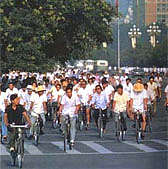
an idea
After hemming and hawing on the final project for a while, I finally settled on approaching the problem of renewable energy, which can be applied in both developing and developed countries, and in particular where the paradox exists that those who can't necessarily afford exstraneous material goods have them anyway. Many of these countries employ bicycles as the main mode of transportation because of cost or space constraints.
the challenge
The challenge became to design a battery charger that worked off the energy being used to pedal a bicycle. Some products exist already that can be used similarly to power blinkers and other accessories, but few practical applications have come to market.
design: electronics
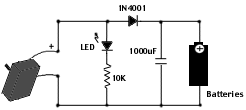
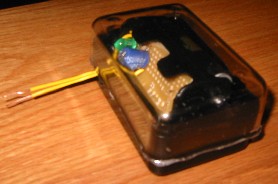
The battery charger itself is a relatively simple circuit which drives current through the batteries, reversing the reaction that occurs inside. To make this more apparent to a user, an LED indicates when the battery is charged. Instead of being connected to a wall wart, the circuit is connected to a motor which can be driven as an induction generator. One major drawback to the current prototype is the use of a motor which does this, but very inefficiently. The moral, order early, order correctly, so as not to use parts insufficient for their intended use.
design: mechanics & casings
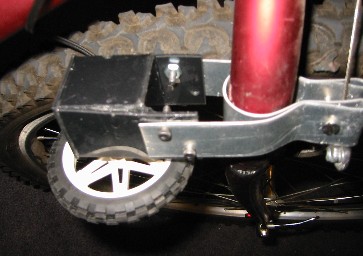
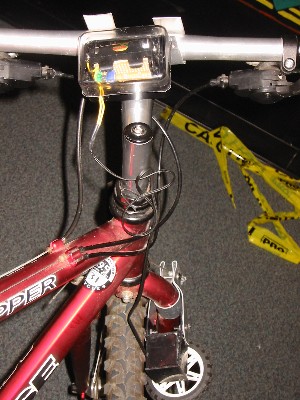
A good place had to be found from which to take the rotational energy of the wheel. The pedals and center of the wheel were not chosen because of possible lack of standardization among bicycles. Although the size of wheels may vary, the clamp attachment allows flexiblity, and led to the choice of the top of the front wheel.
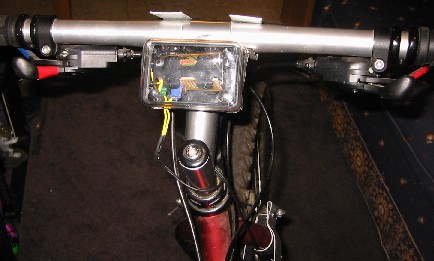
The case for the batteries and circuit has to be small, lightweight, durable, and well-sealed. A combination of ABS and PET parts was used to make the battery storage housing, which is attached to the center of the handlebars.
The motor also needs a durable case that will protect it from water and other muck that might get kicekd up into it. The current housing is made of ABS, though a more durable solution could have been found had the proper motor been chosen the first time.
To keep them simple, flexible, and easily produced, the attachments to the bike frame are made of cut metal and clamped together with screws.
functions
It seems to work, as I've been able to get enough to play a walkman for at least a few minutes - didn't want to run down my first success =). Although I have yet to make the charge indicator glow exclusively under bicycle power, it works when tested on a wall wart and when charging a nearly full battery.
improvements
As it is, the system is very inefficient, and it would take a long time to fully charge a battery. This can be improved with the use of a more appropriate motor, lower friction between the motor and bicycle wheels, and improved placement of the motor. The design of the casings can be improved to be more durable, steadfastly attached, and able to deal with mud, rocks, and other spray and dirt. Sporadic contact with the wheel is also a problem, although this might be a more difficult one to overcome, a balance between high friction and lost contact.
appropriateness for developing countries
With the improvements listed above, this product could make it in any developed country where bicycling and renewable energy are marketable industries. In order to make it in developing countries, particularly in Asia and Africa, some further changes would have to be made. I've tried to keep these in mind while designing the prototype, but think they could be useful yet. Some improvements which must be made include: