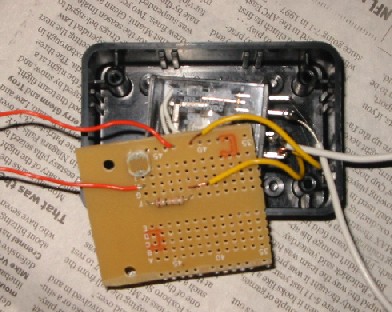
practically
I admit to being completely unsure what to do with a final project at the point the sensor assignment came up - so many ideas, but... So I decided instead to make something fun, somewhat practical, and not-impossible -for-a-first-circuit-design circuit for the sensor assignment. Here, a photocell is used in conjunction with a relay to turn the lights out when the sun goes down and to turn them on again at dawn.
technically
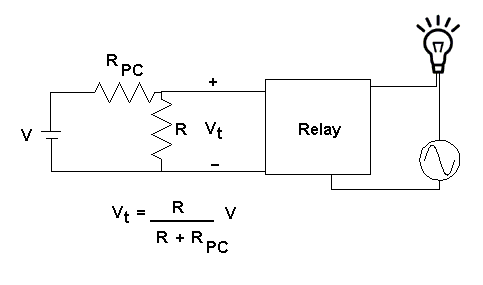
The schematic at left shows everything there is to the circuit. The photocell has a very high (several MΩ) resistance when there is no ambient light, and a relatively low resistance (2 kΩ) in daylight at room temperature. When there is no light detected, the voltage across the relay passes the trip threshold, going from "normally open" (as wired, not tripped) to closed. As you can see, it works pretty well. (Video poorly lit, but definitely visible)
functions & improvements
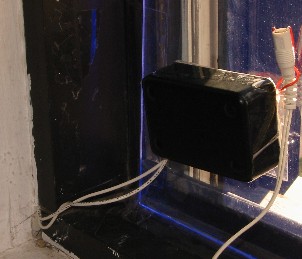
Such a device is not only useful to the lazy mit student burning the midnight oil, but also for other situations where constant lighting is appropriate. The antiday could be used at art museums to keep special pieces under constant light, or in a home, hotel, or nursing home to provide nighttime lighting for the safety of residents.
A few simple changes can make this even more useful and increase the number of possible applications. Adding a switch to the circuit would make it so the antiday could work with a manual override (aka, a regular light switch). Being able to adjust the light over different brightnesses as the amount of light from outside changed would make the transition from natural to artificial more gradual and more pleasant. Exchanging the cheap lights here for some of the fancy full spectrum light bulbs, which most resemble daylight, would also be an improvement in ambience, if not in function.