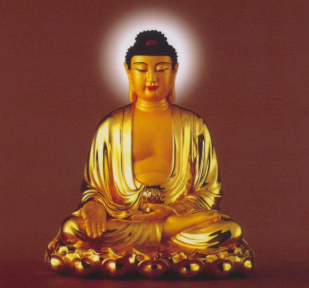
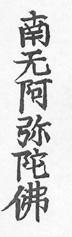
NAMU AMIDA BUTSU
I entrust myself to
Amida Buddha
Thank you, Amida Buddha, for your unconditional care,
For looking upon me as your own son,
And showing me the way out of calculation and self-judgement
Into the light of Diamondlike Faith and Assurance of
Buddhahood.
You hold back nothing from me that I need:
Even in the deepest darkness of my blind passions
You are there, leading me onward and forward,
Out of the desert of delusion and ignorance
Into the everlasting blessedness of Nirvana at this life's
end.
Thank you for your great gift each and every day:
For by it, when I ultimately go to your Pure Land
And I too become Buddha through your Vow Power
I will then foreverafter help others as you have helped me,
To see Your Light of truly Boundless Wisdom and Compassion
As revealed in the great Sutra of Your Limitless Life.
May I honor and bless you forever, Amida my savior!
Namu Amida Butsu
--Richard St. Clair (Shaku Egen)
For comments or inquiries,
E-mail to 
| The editorial policy of this
website is to present only the pristine and
original teachings of Jodo Shinshu (Shin)
Buddhism. Before we link to any other website,
we investigate that website to make sure that they
do the same. We reject any website that
presents false or divergent teachings, or that links
to other websites that present false or divergent
teachings. |
SMALLER SUTRA ON AMIDA BUDDHA |
LARGER
SUTRA ON AMIDA BUDDHA
|
SUTRA
ON THE CONTEMPLATION OF BUDDHA AMITAYUS
|
Jodo Shinshu Buddhism, or Shin Buddhism, is based upon
the teachings and writings of Shinran
Shonin (1173-1262) and Rennyo
Shonin (1415-1499). "Shonin" is a Japanese term that
means "sage" or "master." "Jodo Shinshu" means literally
"True Pure Land Sect."
Master Shinran wrote as follows:
How joyous I am, Gutoku Shinran, disciple of Sakyamuni!
Rare is it to come upon the sacred scriptures from the
westward land of India and the commentaries of the masters
of China and Japan, but now I have been able to encounter
them. Rare is it to hear them, but already I have been
able to hear. Reverently entrusting myself to the
teaching, practice and realization that are the true
essence of the Pure Land way, I am especially aware of the
profundity of [Amida] Tathagata's benevolence. Here I
rejoice in what I have heard and extol what I have
attained.
Master Shinran expounded the "
Then who is Amida Buddha? Amida Buddha is a "samboghakaya"
buddha or "transcendental" buddha, who was revealed to the
world in three great Mahayana sutras expounded by the
historical Buddha, Shakyamuni, who lived and taught in India
ca. 563-483 BCE.
Amida Buddha began as a mortal, a king, who sought
enlightenment under the then-living Buddha of his world,
named Buddha Lokeshvararaja, whom we read about in the
Larger Pure Land Sutra (The Larger Sutra on the Buddha of
Eternal Life).
This king
relinquished his rule and began to earnestly study the
Buddha Dharma, and he took the Dharma name of Dharmakara.
After many years of difficult practices he became a
bodhisattva. (A bodhisattva is a person on the brink of
buddhahood who brings the Dharma to suffering beings in
advance of his own enlightenment.) His name, Dharmakara,
means "Dharma-storehouse."
Bodhisattva Dharmakara asked Buddha Lokeshvararaja to show
him all the billions of buddha-lands of the cosmos. When he
was granted this request, Bodhisattva Dharmakara determined
to create a Pure Land of his own, containing all the virtues
of the other buddhas' buddha-lands but without any of the
evils in those buddha-lands. He then became moved to make 48 Vows detailing the attributes of
his Pure Land which he intended and vowed to create.
The outstanding vow of these is presented in the Larger Pure
Land Sutra as Vow 18, otherwise called the Primal Vow, which
reads as follows:
"If, when I attain Buddhahood, sentient beings in the
lands of the ten quarters who sincerely and joyfully
entrust themselves to me, desire to be born in my land,
and call my Name, even ten times, should not be born
there, may I not attain perfect Enlightenment. Excluded,
however, are those who commit the five gravest offences
and abuse the right Dharma."
Other Buddhas vow to save all beings but through their
performing various difficult practices that only talented
people can successfully perform and only through very many
lives. Bodhisattva Dharmakara wished to create a special
buddha-land where ALL beings can IMMEDIATELY be saved and
become fully enlightened buddhas, whether male or female,
young or old, good or evil, educated or illiterate.
According to the
Larger Sutra, Dharmakara vowed that he would not allow
himself to be enlightened until this Buddha land (the Pure
Land) and all its powers were thus created. After five kalpas (many billions
of years) of deep contemplation, Bodhisattva Dharmakara
fulfilled all of his 48 Vows and as a result he became the
Buddha known as Amida and his Pure Land came into being.
In Amida's buddha-land
(what
we call the Pure Land or Sukhavati), the sincere petitioner
who takes singleminded refuge in Amida Buddha - including
the most evil reprobates - are saved and will, after death,
be reborn and attain enlightenment (Buddhahood) without the
confusing and conflicting pains and distractions of mortal
existence and bypassing what would, without Amida's saving
grace, be countless rebirths in the lower realms of
suffering.
The other 47 vows of Dharmakara Bodhisattva, now Amida
Buddha, are about the special features of his Pure Land and
the powers of Amida Buddha once Dharmakara attained
buddhahood through the fulfillment of all 48 vows.
The Primal Vow offers salvation to any person in any
circumstances. In this age of Declining Dharma, or Mappo* in
Japanese, the Buddha Shakyamuni (the World-Honored One)
explained in the Larger Pure Land Sutra the way of salvation
through faith in Amida Buddha. As Master Shinran said in his
SHOSHINGE (Poem of Nembutsu-Faith),
Why did the World-honored One come into this world?
To expound the ocean of Amida's Primal Vow;
In this evil world of five defilements
We should believe the Buddha's true words.
Thus Amida Buddha must be considered the greatest of all
buddhas because He extends salvation from the world of
suffering to all - whether good or evil, young or old, male
or female - who simply take refuge in Him and attain that
state of settled faith known as SHINJIN or "the mind of
faith." Amida Buddha's work of saving suffering beings will
not be completed until ALL BEINGS are Buddhas. This is why
Amida goes by two names, AMITABHA (Limitless Light =
Infinite Wisdom) and AMITAYUS (Limitless Life = Boundless
Compassion).
True Shin Buddhism
teaches that there is no calling greater than attaining
SHINJIN, and moreover, that attaining SHINJIN is the sole
objective of the Nembutsu path, reciting "Namu Amida Butsu"
(I take refuge in Amida Buddha) singlemindedly and with
simple gratitude for the benevolent salvation that we
receive in this life with the promise of Buddhahood at the
end of this life when we go to the Pure Land (jodo) of Amida
Buddha.
By "attaining SHINJIN" is meant receiving
the blessed gift of SHINJIN from Amida Buddha through His
transferred merit to all beings who take singleminded refuge
in Him. The transferred merit is through the OTHER POWER
(Jp. "tariki") of Amida.
It is through
SHINJIN that we are guaranteed Birth in Amida's Pure Land
when this life comes to an end. Once born in Amida's Pure
Land, we attain buddhahood, we become buddhas ourselves.
No self-power or
calculation by the aspirant is necessary to attaining
SHINJIN. In fact, self-power (Jp. "jiriki") and calculation
only get in the way
of Amida's saving Other Power. To receive Amida's gift of
SHINJIN one must acknowledge completely that one
is incapable of achieving buddhahood through one's own
self-power, and then one must take singleminded refuge in
Amida Buddha.
SHINJIN therefore is attained by placing one's ENTIRE KARMIC
DESTINY in the care of Amida Buddha. It is as simple as
that. But people are filled with doubts, delusions, and
obscurations that make it hard to believe attaining SHINJIN
can be so easy. This is where it is important to have a good
teacher; further, one's karmic connection to Amida Buddha
must be ripening to the point where one can accept this
teaching in complete faith.
The NEMBUTSU,
which is pronounced "Namu Amida Butsu" in Japanese, is
simply an expression of faith and an expression of gratitude
to Amida Buddha. It is not a "practice" in the sense that it
accomplishes any spiritual goal. It, itself, does not cause
birth in Amida's Pure Land. It is simply an outflowing of
thankfulness to Amida for His gift of salvation through His
blessed gift of SHINJIN.
The Nembutsu, for its
practicers, is not a practice or a good act.
Since it is not performed
out of one's own designs, it is not a practice.
Since it is not good done
through one's own calculation, it is not a good act.
Because it arises wholly
from Other Power and is free of self-power,
for the practicer, it is
not a practice or a good act.
[Tannisho, Part One, Section 8]
and he
went on to say,
The Collected Works
of Shinran include poems, letters, and his monumental
treatise, KyoGyoShinSho ("Teaching, Practice,
Faith, and Attainment of the Pure Land Way"). For a summary
of some of Master Shinran's core teachings, see the Tannisho,
a short book composed by his follower Yuienbo with key
quotes directly from Master Shinran. Tannisho represents
Jodo Shinshu Buddhism in terms of refuting specific
deviations from Master Shinran's teaching which arose after
his death in 1262.
The of deviations from Master Shinran's teachings is still a
problem today, expressed in terms of doubt - and often
resolute DISBELIEF - about the reality of Amida Buddha and
His Pure Land. Master Shinran was completely clear and
unambiguous about the true reality of Amida and His Pure
Land, for he devoted an entire chapter (Chapter 5) of his KyoGyoShinSho to "TRUE
BUDDHA AND LAND."
Such doubt and
disbelief is simply an expression of ego and ignorance.
Unfortunately it has been expressed by some of the leading
Shin scholars, and even leading Shin ministers, of our time
and represents a threat to the vitality of the greater
Sangha of True Shin Buddhism as set forth originally by
Master Shinran and later revived by Master Rennyo.
In order for a Shin Buddhist to be a true teacher of the
path of Nembutsu-faith, one must be a person of settled
SHINJIN. Unless one has himself or herself already attained
SHINJIN, he/she cannot understand the process of awakening
to Amida's Primal Vow. And attaining SHINJIN depends upon
singleminded belief and refuge in the REAL AND TRUE BUDDHA
AMIDA.
It is as though a
person who has intellectually studied music wanted to teach
someone how to play a musical instrument. Without the
experience of actually knowing how to play the instrument, it would be
impossible to teach someone else how to play it. The same is
true of SHINJIN. It is an experience that cannot be attained
or described intellectually, no matter how many books on
Buddhism one might read.
Master Rennyo wrote about the importance of understanding
this attainment of faith as follows:
From today, ... seriously start to inquire into the
meaning of the
Great Faith of the Other-Power and obtain the
determination
of rebirth into the Land of Recompense. To receive this
Faith of our sect, nothing need to be done but simply
place
deep reliance on Amida Tathagata single-heartedly.
Note Master Rennyo's exhortation to
"seriously...inquire into the meaning of the Great Faith of
Other-Power." Master Rennyo clearly and straightforwardly
advocates understanding the meaning of this faith in Other
Power. A mere simple recitation of the Nembutsu without
understanding its meaning is pointless.
In order to "obtain the determination of rebirth", that is,
SHINJIN, "into the Land of Recompense," that is, the PURE
LAND OF AMIDA, one needs to understand that Amida Buddha
made his great Primal Vow which embraces and does not
forsake anyone, young or old, male or female, good or evil,
who takes singleminded refuge in His Other Power.
And, in accord with the teachings of Master Shinran and
Master Rennyo, one must believe, as these masters believed,
in the reality of the true and real Amida Buddha and His
true and real Pure Land, otherwise birth will not be
possible.
Further, this
belief can only come about through LISTENING DEEPLY to the
Dharma of Amida Buddha to determine for oneself that the
true teaching of Jodo Shinshu is indeed true. Having a
teacher of settled SHINJIN is very important to helping one
overcome their doubts, delusions, and obscurations.
However, the Path
of Nembutsu Faith - Jodo Shinshu Buddhism - cannot be forced
upon anyone. As Master Shinran, who spread Faith in Amida
Buddha to countless aspirants and led them to settled
SHINJIN, said, as recorded in the Tannisho:
If Amida's Primal Vow is true,
Shakyamuni's teaching cannot be false.
If the Buddha's teaching
is true, Shan-tao's commentaries cannot be false.
If Shan-tao's commentaries
are true can Honen's words be lies?
If Honen's words are true,
then surely what I say cannot be empty.
Such, in the end, is how
this foolish person [namely Shinran] entrusts himself [to the
Vow].
Beyond this, whether you
take up the nembutsu
or whether you abandon it
is for each of you to determine.
Master Shinran
traced the tradition of Pure Land Buddhism from the the
Three Pure Land Sutras (link above) which were expounded
by Shakyamuni Buddha 2500 years ago, through the seven
masters whom he called the Seven Patriarchs of Jodo
Shinshu over a period of a thousand years from Master
Nagarjuna to his own mentor, Master Honen.
Equally
interesting are the more informal quotations of Master
Rennyo in the "Goichidaiki
Kikigaki", a compilation of thoughts and statements by and
about Master Rennyo collected during and after his lifetime.
The compilation is considered to be the work of his son
Jitsugo (b. 1492) and contains a total of 314 statements in
two volumes.
An anonymous
treatise called "On the Attainment of Faith" or Anjin
Ketsujo Sho, dating from perhaps 13-14th century
Permission
is hereby granted to clone, translate and/or publish this
website into any language, no additional permission is
required.
For comments
or inquiries, E-mail to