Acknowledgments Work reported herein has been supported,
in part, by MIT's Total Data Quality Management (TDQM) Research
Program, MIT's International Financial Services Research Center
(IFSRC), Fujitsu Personal Systems, Inc. and Bull-HN.
ABSTRACT: Poor data quality problems have been experienced by many organizations. Some are aware of the problem, others ignore it and still other organizations are unaware of its existence. But very few organizations take steps to prevent poor data quality from becoming a major problem.
This thesis presents a case study from an airline, experiencing poor data quality problem in their inventory recording system. Data quality awareness was triggered twice in this case, first by technology during implementation of a new computer system. Second, by a conflict between maintenance and sales because of delay in maintenance release.
This study analyzes the flow of operation and data handling, used to keep record of aircraft spare parts, and in conclusion we present possible solutions to overcome the problem of poor data quality. Our study showed that using the solutions offered, it could give the airline savings of U$ 378,000/year after three years.
Competitiveness in the airline industry depends critically on the quality of the services provided. The "product" of the industry is air transportation. Demand for this product is driven by factors virtually outside the control of the airline, and competition is strong because the product is offered by many airlines. The product and services of an airline cannot be stored -- they are produced and consumed simultaneously. This characteristic adds to the importance of quality as a player in the competition for market share.
Airline deregulation has forced prices down, and the variations in price among airlines are now negligible. Competition has shifted sharply to focus on services; airlines are now competing to deliver the very best quality of services possible in order to attract customers.
Airlines offer a variety of services, e.g. safety, on-time departures and arrivals, cleanliness of aircraft, well-trained flight attendants, and quality in-flight food. In order to remain competitive, airlines look for a niche market to differentiate their product. They create their services accordingly, thereby gaining market share. The product is perceived by the customer very much on the grounds of the services that goes with it -- services not only create the market for the product, they are perceived to create the product itself.
The intense competition among airlines and the growing size of the wide-body fleets increase the pressure on airlines to develop methods by which to operate more efficiently. One important field for improvement is that of logistics, or the handling of materials. Replacement of defective parts, for example, must be done quickly and effectively. Manual control of 100,000 spare parts is a cumbersome operation, and if streamlined can greatly increase cost-effectiveness. For this reason many airlines are installing computer systems that enable electronic control of every aspect of the handling of materials, from warehouse to aircraft to workshop, and this loop includes even third-party maintenance centres. High quality data provided by computer-based systems can help increase cost effectiveness and increase services delivered by the airline.
Garuda Indonesia, the country's national flag carrier, was established as an airline in 1948, and in 1978 began receiving wide-body aircraft with the arrival of their first DC-10. Today they operate six B747-200s, six DC10-30s, nine A300B4s, eight B737-300s, eighteen DC9-30s, and thirty-four Fokker 28s. They are dependent for aircraft on manufacturers in the US and Europe, and delivery can take up to twenty hours of flight time. Lead times for new purchases average from one to six months, and turn-around time for repair items takes from as little as three months to up to one year. This situation of course leads to high inventory and costs. For this reason, Garuda Indonesia has installed an information system capable of managing a range of spare parts for many types of aircraft.
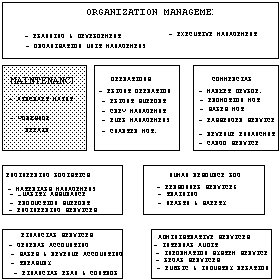
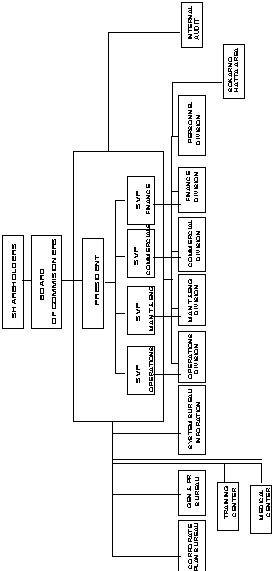
The airline functional model is comprised of four levels, as follows [DRT Consulting, 1991]:
1. Organization management: applicable across the whole of Garuda; applies to staff supervision in any size unit or location.
2. Airline business life cycle: this concept highlights those functions which contribute directly to the main revenue earning business of Garuda. The commercial function (provides passengers and cargo) is the spearhead, while the operations function (provides crew) and maintenance function (provides aircraft) completes the cycle.
3. Engineering logistics: the functions of materials management, maintenance and production support, engineering services, and quality assurance are to make sure that maintenance gets the support necessary to keep the aircraft flying.
4. Human resource logistics: supports the whole business life cycle with personnel services, training, health care, and safety.
5. Financial and administrative services of various types, together with information systems, support the whole business cycle.
This functional model ensures that each function appears only once, irrespective of how many places in the organizational chart or geographically around the world it is actually performed (see Figure 1). This thesis focuses on the maintenance function of the airline business life cycle.
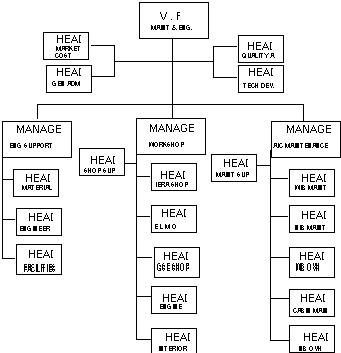
The Maintenance Division itself includes the following functional departments:
a. Aircraft maintenance, responsible for the actual work of maintaining the aircraft.
b. Workshop repairs, responsible for the maintenance of components and other spare parts.
c. Materials management, responsible for supplying all spare parts needed for the workshop and aircraft maintenance work.
d. Quality assurance, ensures compliance with regulations in completing all maintenance work.
e. Engineering support, provides technical expertise.
f. Maintenance and production support, provide the production (aircraft maintenance and workshop) with technical support in planning for manpower and material.
g. Fixed assets and property management,
responsible for property, equipment, and maintenance of facilities.
Aircraft maintenance is based on scheduled and unscheduled inspections. The scheduled maintenance is basically determined by the aircraft manufacturer with some changes done by the airline for easier implementation or own experience in doing maintenance. Every aircraft type has their own maintenance schedule but usually it consists of several inspections depending on how many hours or cycles the aircraft has been flown, like :
1. Preflight check, accomplished before every flight, duration of work is approx. 45 minutes.
2. A Check after 200 flight hours, duration of work is approx. one day.
3. B Check after 400 flight hours, duration of work is approx. 3 days.
4. C Check after 1200 flight hours, duration of work is approx. 10 days.
5. E Check after 12000 flight hours,
is a major overhaul and the duration is around 45 days.
All inspections, except preflight, must be accomplish inside the hangar, and cannot be done at the airport gate.
Besides the inspection for the aircraft airframe itself that was mentioned above, there are also components time limits that might or might not coincide with the aircraft scheduled inspections. All these scheduled inspection is given based on the recommendation by the aircraft manufacturer and component vendor. After the aircraft is delivered it becomes the responsibility of the airline to change and update all time limits as necessary.
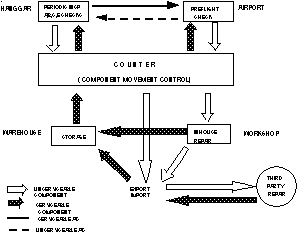
The maintenance flow for components and aircraft can be seen in figure 2 below.
A. Aircraft Maintenance
All aircraft have scheduled maintenance checks that are based on their flight hours or based on the many landings that they have accumulated. If an aircraft is due for maintenance, it will be scheduled and a replacement aircraft must be serviceable. Maintenance planner are responsible, in order to see that no aircraft which is due for maintenance is allowed to fly. If this happens it can get serious consequences by the airworthiness authorities.
B. Component Repair
All components that comes from or goes into the aircraft because of scheduled or unscheduled removal/installation, gets through the counter or component movement control (CMC) to be recorded into the computer. Aircraft registration, part number, serial number on/off are the main information that has to be conveyed by the mechanic to the counter in order to put it into the computer. Counter will sent the unserviceable component to the workshop for repair or to the export division if the own workshop has no capability for repair. Workshop will sent all serviceable component back to warehouse or to third party if it encounters problems in repairing it.
Warehouse will sent serviceable components
to the counter upon request by the counter for replacement on
the aircraft.
The production support will issue
a "maintenance checks list" describing aircrafts that
are due for maintenance and a "serialized items removal list"
describing any components that are due to be removed from the
aircraft. Both these lists are issued by Amega based on the flow
described in figure 3 (Limit Analysis). Limits
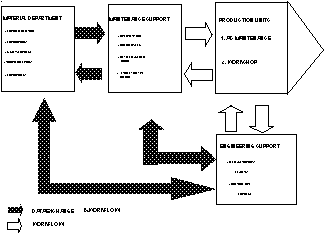
data entry are the first requirement which determines how many hours or cycle a component may be used on the aircraft. Another information that is needed are actual aircraft hours flown and material availability to inform production support on the spare parts situation, in order to be able to plan ahead. The printing of both these lists should be done ahead of time by production support and is usually done ranging from a week to a couple of month before the actual maintenance is done depending on how big maintenance work is. This will be the basis for issuing jobcards to the mechanics and after a jobcard has been accomplished, it should be filled out by the mechanic and returned to production support for updating of data.
An information system which is a key factor for efficient maintenance operation was installed in 1978 in the Maintenance Division, in anticipation of the arrival of the new wide-body aircraft. The focus of this system was material management for the thousands of spare parts required to support one wide-body aircraft. Before the present era, manual card catalogues were used to control spare parts, a system which proved inadequate for the large number of transactions required by the new wide-body aircraft.
Implementing a new technology can infiltrate every stage of a company, and motivations such as increased efficiency, speed, and accuracy are often used to justify the cost of a new system. But technological change can also present challenges. In many instances we see that company resources are invested in the purchase or development of the technology, but very little is put into its implementation [Barton & Kraus, 1985].
Implementation is a dynamic process of mutual adaptation between the technology and its environment. The process requires adaptation because a technology almost never fits perfectly into a user environment. Misalignments (poor fits) can be categorized as follows [Barton, 1988]:
a. Technology: The technology with its original specification or with the production process into which it is introduced. Time constraints and miscalculation sometimes conspire to push technologies out of the nest before they can fly, that is, before their creators have solved all of the basic problems.
b. Delivery System: Technology with user organization infrastructure (supporting hardware, software, or educational programs). Misalignment between the technology and the system through which it is delivered is a complex maintenance issue. Inadequacies for which the developers of the technology have no direct responsibility, but for which users nonetheless attach blame, can lead users to reject, under-utilize, or even sabotage the innovation.
c. Value: Technology with job performance criterion in the user organization. Performance criteria at numerous levels in the user organization may interact with technology, as with (i) individual operators, (ii) operations management, (iii) management of the business unit, and even (iv) corporate management. Lack of interest in the new technology can occur on any of these four levels due to lack of clarity about its usefulness.
Following the decision to implement an information system for material management, the company created a development group with responsibilities to prepare anything needed and transfer it to the user at a later date. The development group consists of software engineers and engineers from the materials and production planning departments. Many visits were made to other companies using similar systems, to get a feeling of how a new system looks in a real environment. There was little discussion about the implementation process and difficulties therewith, but more on the new features that can be used with the system.
Training was next on the list, and was done extensively by sending the development group to a training centre for several weeks in order to learn the new transactions and to observe how the system interacts with other departments. The development group will in turn teach other employees (users). This of course has a negative side -- the development group members were not yet expert.
Following training, the new software was installed in a "test system," apart from the live system, to be tested by the development group and key personnel from the user organization. During this phase the system underwent some modification to the software, adapting it to fit the existing environment. This occurred because the supplier had offered a package software from another airline, one that was not necessarily suitable to the organizational structure. After all transactions had been tested by the user, all historical data was entered into the database and the development group then transferred the new system to the live environment.
Automated Maintenance and Engineering Garuda (AMEGA) is a large and complex, externally-developed package computer system, first introduced at Garuda in 1978. This software was developed by a European airline and is currently used by approximately ten different airlines in the world as a materials management system. It is the existing information system running in Garuda's Maintenance Division, and serves the following functions:
* Material demand forecasting
* Material purchasing
* Inventory management
* Repairable item tracking
* Material receiving
* Spare parts requests
* Fleet activity management
* Aircraft and component limit analysis
* Component reliability monitoring
* Workshop and hangar activities
* Warranty management
* Accounting
* Historical data management
A work-flow diagram, including the AMEGA function that is responsible for the Maintenance Division, is shown in
Figure 4.
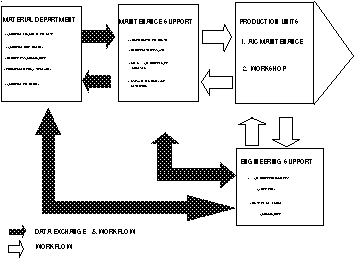
The system considered here is the materials management information system, which handles the acquisition, storage, issue, distribution, and historical records of aircraft and non-aircraft spare-parts.
The spare parts supplied to an airline are critical because of the direct influence of parts on the operation of the airline. Spare parts inventory normally requires a major investment of current assets on an airline balance sheet, which is why it must be managed scrupulously. A large inventory usually develops because of long turn-around times for repairs, long lead times for new purchases, high removals, or unpredictable demand for spare parts.
The goals of material supply include the following [Leenders, Fearon, & England, 1989]:
1. To provide an uninterrupted flow of the materials, supplies, and services required to operate an organization. Stockouts of material and parts would be prohibitive in terms of operating cost because of fixed costs and inability to satisfy commitments to customers. This is especially true when we consider an airline operation, where an aircraft cannot depart when there is a shortage of spare parts.
2. To keep inventory investment and loss at a minimum. One way to ensure an uninterrupted material flow is to maintain a large inventory. But inventory assets require tying up capital which then cannot be invested elsewhere.
3. To maintain quality standard. To produce the desired product or service a certain quality level is required for each material input. Especially when we consider the safety of an aircraft, here the parts that are required must pass a specific quality standard.
4. To find or develop competent vendors. The success of the purchasing department depends on its skill in locating or developing reliable vendors, analyzing vendor capabilities, and then selecting the best vendor.
5. To standardize, where possible, the items purchased. If Purchasing can buy one item in quantity to do a job that previously required two or three different items, the organization may gain efficiency advantages through a lower initial price resulting from quantity discount, lower total inventory without lowering service levels, reduced cost of training, and reduced equipment maintenance cost.
Three types of spare parts are used by aircraft:
a. repairable serialized items (Class A),
b. repairable non-serialized items (Class B), and
c. consumable items (Class C).
All three types are handled using the information system, and a more detailed tracking of each serialized component is done for Class A items only, which include recording of flight hours, location of the item, and maintenance tasks performed on each component. For Class B and C components only total consumption is recorded; this can be used to forecast future demand.
The main functions of the system are:
1. Materials demand forecast: this analysis uses a history of parts which it relates to a mathematical pattern to predict future usage. To collect historical data the system checks the reliability parameter and replacement rate.
2. Purchase of materials: this function relates to the acquisition of aircraft as well as non-aircraft equipment (tools, raw materials).
3. Receipt and inspection of materials: involves the receipt, inspection, and storage of materials received from both purchase and repair orders.
4. Management and control of materials: involves the management and control of a materials inventory level, with emphasis on the timely and economical acquisition of materials.
5. Component Tracking: keeps track of all components, especially Class A parts, in order to control and distribute in an efficient manner.
6. Maintenance of a history: records total flight hours and maintenance action of Class A parts.
In a 1990 report to Senator Sam Nunn (D-Ga), the US General Accounting Office reported that at a single agency more than US$ 2B in federal loan money had been lost because of poor data quality. Social Security recipients complain about mistakes in data management [Government Computer News, January 18, 1993]. The problem is severe and pervasive, in many cases. Sixty percent of IS managers have dirty data, and the most common response is to replace the equipment. The second most common solution is sampling and analyzing data, followed by forming a task force. It isn't until the fifth place that anyone even talks about addressing data quality [Computerworld December 7, 1992].
According to Wang & Kon [1993], there are social and managerial impacts that result from data quality problems. Organizations are increasingly integrating their processes across functional, product, and geographical lines, but the Wall Street Journal [May 26, 1992] reported that huge databases may be full of junk -- in a world where people are moving to total quality management, accurate and accessible data is critical.
The social impact of data quality can be very sensitive to individuals and organizations, for example where there are problems with medical historical records that are inaccurately recorded, or with financial, employment, or legal matters. Errors in these areas can easily create huge problems and embarrassment to those affected.
The managerial impact involves areas such as the following:
°customer service: high data quality prevents companies from making faulty decisions, resulting in improved customer service.
°managerial support: managerial decision-making processes which rely on the data available can have substantial effect on the bottom line.
°productivity:
low-quality data can create un-productive re-works, down time,
redundant data entry, that cause loss of revenues.
There are several conditions that can lead to an emerging awareness of data quality in an organization:
1. Technology Push: client/server or any data-sharing environment pushes the need for an organization to acquire a higher degree of data quality. This is because when many users are employing the same data, quality becomes more important.
2. Management Push: total Quality Management, Zero Defect, QCC: all of these programs increase the awareness of employees and management alike to deliver good quality of product or services. This situation triggers the need for a high quality of data to be used to deliver those product/services.
3. The Customer-Driven Process: if customers cannot use data because of poor quality, then the process cannot be continued. The customer could also be your company superior or even top management, which needs a high quality of data and usually triggers the awareness very quickly.
4. The Event-Driven Process:
certain events that occur because of a data quality problem, especially
one that involves considerable costs or reputation, frequently
trigger the organization to do something about it.
There are certain characteristics of information systems that tend to have either a good or poor data quality. This seems to be an inherent characteristic although we might find exceptions.
a. Data that must be updated from many different sources tend to present more quality problems, because updating from different sources increases the possibility of error.
b. The more often a body of data is used, the more likely it is to be of good quality. This is because people who are using it are observant and update the information.
c. Package programs, as opposed to custom-designed, do not necessarily reflect organizational working procedure and tend to have data quality problems. This is because working procedures that have already been established are the norm in the organization and software packages procedure tend to be neglected.
d. Information systems that were
developed by transferring from a manual to a computer system
tend to encounter problems, compared to a system that was early
to develop a computer environment. This is because initial data
might not be correct or personnel discipline not attentive when
dealing with the manual system.
Why Data Quality is Important to an Organization
Data quality can affect the bottom line and customer satisfaction of an organization. Delivering high quality products and/or services is a competitive advantage, and data quality problems can affect decision-making and product/service delivery that will in turn influence the ability to compete. The biggest problem concerning data quality is that we cannot know when it is affecting our information system, or how severe. The best way to deal with it is by correcting the problem early on, when it can still be fixed with minimal cost.
The Maintenance Division which is responsible for aircraft maintenance faces tough questions from the sales division when aircraft are delayed for maintenance before being released for operation (see Appendix 3 for Maintenance delay data). The two main reason for maintenance work postponement were shortage of manpower and lack of spare parts to replace defective ones. Approximately 80% of all maintenance delays were due to spare parts problems, such as:
a. zero stock at the moment,
b. spare never existed in stock,
c. computer indicates spare part is in stock, but it does not exist on the shelf.
This study focuses on the problems of spare parts, because the problem is important and difficult to solve, and its consequences severe for the entire operation of the airline. One main reason for deferred maintenance work, for example, was lack of spare parts. Maintenance releases have been delayed and aircraft cannot be dispatched due to unavailability of spare parts. Spare parts must sometimes be taken (cannibalized) from other aircraft so that a ready-to-fly aircraft can depart. The maintenance supervisor usually decides that, because of the delay that a departing aircraft will experience otherwise, it would be better to take a particular spare part from another aircraft, one that is undergoing maintenance work. The mechanic fills out a "cannibalize" form and submits it to the production support, who then will do the recording. This situation of course worsens the inventory management system, but it is a necessary stop-gap measure.
Much has been done to improve the situation, such as heavily stocking spare parts, especially high-moving items, and setting up ad-hoc teams to counter the problem.
Improved communication between production and all supporting units (Materials Department, engineering support, and quality assurance) has been accomplished by daily meetings at the production site. A decision was made by the Vice President of Maintenance and Engineering to control the high delay rate. The meetings begin at 8:00 am every morning and are chaired by the manager of aircraft maintenance; they are attended by all the supporting units. All aircraft undergoing maintenance work for any kind of problem that would delay their work is assessed. The meetings have been very helpful. Problems that were spotted by the maintenance night-shift crew are handled by early morning. Many maintenance problems are discussed, but most of the time lack of spare parts is still the dominant topic. By the end of the meeting, the representative for the Materials Department has a very good idea of the list of priority materials that are needed for maintenance. This process helps to shorten the lead time for material requests by deciding early which spare parts need to be purchased. Spare parts that are needed very urgently, but are not now available in stock and cannot be cannibalized from another aircraft, should be borrowed from another airline, which is more expensive than stocking the part.
Computer-trained personnel who are able to communicate were elected by the management to be key users to act as liaison between the Maintenance Division and the main computer centre, to smoothen communications and for problem solving. These key users solve any problem that users have with the system. Software bugs, screen displays that were not user-friendly, and transactions procedures were the day-to-day problems of key users.
In 1986 the new International Airport was ready for operation and our maintenance facility moved to the new location. At that time the computer facility was not finished, and it remained in the old location 30 km (15 miles) distant from the new airport. New communication lines were installed to support operations from the new airport using the old computer centre. During this period, problems of system-down and low response time increased. In order to cope, a manual back-up procedure was introduced; this procedure was to be used only when the system was down, in order not to distract the requests for spare parts by Production. This method requires the use of forms to be filled out and later updated by the computer when it is up.
The lines of communication between the computer centre and the airport was used not only for the use of the maintenance facility but also for the reservations system. Company policy is to the give priority to reservations system in the event the communications line is down, in order not to disturb smooth operations at the airport. This of course is detrimental to the maintenance facility, as a reliable computer system is very important to the accomplishment of maintenance work.
In April 1991 the government controller conducted a full warehouse inventory count, in order to discover how pervasive a problem this inaccuracy of data was, by getting an idea of the present percentage of difference. This job is especially difficulty because the warehouse cannot be shut down but must remain in operation during the count. The count would involve 100,000 types of spare parts, e.g. big airframe parts, electronic components, oil, grease, and tires, down to nuts and bolts, from six different aircraft types, and should take about five months to complete, with several more months required to finish the paperwork. Computer data will be adjusted to reflect existing stocked components. The plan is to update the actual count, by accepting any losses and gains that result from the inventory count.
Although many steps have been taken to solve the problem, these have offered only temporary relief of the larger problem. Difficulties still face the Maintenance Division in delivering the aircraft on time. New MD-11 aircraft delivered in 1992 even worsened the situation, because they required more attention with new spare parts coming in. The burden to maintain these aircraft has increased.
The Materials Department cannot supply the spare parts as needed, primarily because the parts that should, according to the computer, be in a particular location, cannot be found. In one instance a particular spare part was, according the computer, out of stock in the warehouse but existed in the workshop. A check of the workshop revealed that the component was no longer there, but had been returned to the warehouse to support a departing aircraft. A manual back-up procedure had been used to send the unit out during the time the computer was down. This manual back-up procedure was used mainly to cover during system-down, although the information should be updated directly into the computer when the system is up again. It seems that the information had not yet been updated to the computer, because time is needed to update all the data in the computer.
In another situation we found a spare part in the workshop, which according to the computer was still installed on an aircraft. Our investigation found out that the production support had not updated a removal of the component from the aircraft because of lack of information (serial number on/off, reason of removal, date, aircraft registration) given by the mechanic about that particular removal. As can be seen in Figure 2, the maintenance support should do all the recording, based on information given by the mechanic who did the actual work on the aircraft. The mechanic himself works under a time constraint to finish work on the aircraft, and is happy as long as he can finish his work on time. He is not usually interested in following through with the administrative work necessary to complete the job. As one mechanic stated, "As long as the aircraft takes off on time, that is what we should be concerned with. The administrative work that comes later is secondary." This situation illustrates the priority that the mechanics must apply under their working conditions: extreme environment, hard work, and pressure of time to solve a problem which involves high-tech equipment and the safety of the customer. "Would you blame them, if they sometimes forgot to fill out a number or so, on a form? Be happy that he finished his work on time," explained a maintenance supervisor about the circumstances of his subordinates.
This situation explains why establishing a secure stock level is complex -- accurate data on how many actual floating spare parts we have is difficult to maintain.
Because information on how many spare parts are actually on hand is important and faulty information obscures the system, it was decided to move all spare parts not in the warehouse but showing up in the system to a fictitious "Warehouse 99." This "warehouse" was created in the computer system, and did not exist in fact. It was created to hold components for only a limited time. In this way we could collect them artificially in order not to obscure the system, and then do a search for those components.
"Warehouse 99" was introduced during the transfer from the manual system to the new computer system. This transfer work was done by personnel from both I/S and Maintenance & Engineering. Many discrepancies were found between the card system and the actual stock on the shelf. All gains found during the transfer were updated directly into the computer and all losses were transferred to a warehouse. To avoid confusion in the new computer system, the project team put them temporarily into the fictitious storage called "Warehouse 99." The plan is to scrap all components in that warehouse in the future, by putting it into a data segment in the computer system. Using this method, we will still be able to compare all incoming components and to recognise any of our own components that show up again in the future.
There are several causes for this situation:
a. Delayed input into the computer due to frequent system downage.
b. Historical problem: the old manual system had some discrepancies that were inherited by the new computer system.
c. Educational problem: with a certain amount of employee turnover, the transfer of knowledge is not always smooth. Manuals are not known for being user-friendly, and there is an additional language problem.
d. The package software that was installed does not always reflect the actual organizational structure.
To define the problem more precisely, we will use a framework for analysis. This will be done in the following chapter.
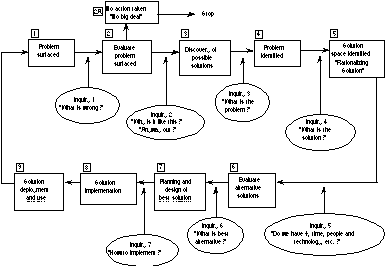
The analysis used here to identify and resolve data quality problems is based on a framework devised by Wang, Strong, & Lee [1993]. This framework was chosen because it goes through the basic decision-making process, which can be applied to many other problems besides that of data quality. It is simple to apply and the basic concept is straightforward. The framework is based on organizational learning which started from basic decision-making and problem-solving models. This provides the steps by which organizations can identify problems, search for possible solutions, select solutions for implementation, and implement these solutions. Although this model does not explain why some organizations fail while others succeed in overcoming data quality problems, this question is outside scope of this thesis.
The framework (schematized in Figure 5) has three basic components:
a. the basic problem-solving model, represented by the boxes;
b. enquiries, which are the questions that organizations ask in order to move to the next step;
c. and triggers, those things that make organizations raise enquiries.
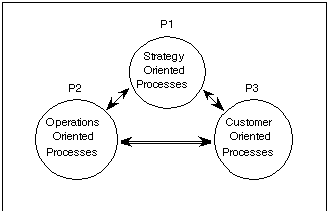
The triggers that makes organizations
aware of data quality problems are shown in Figure 6.
There are three processes that interact inside an organization, which are as follows:
a. strategy-oriented processes, which involve upper/middle management responsibility for deciding the organization's future.
b. customer-oriented processes, which involve means to satisfy customers who are interested in our product.
c. operation-oriented processes, which involve the operational side of producing the end-product.
Conflicts can exist within or among those processes, and can trigger an awareness of the data quality problem. For example, an upper-management decision to cut the organizational budget creates a conflict with the operational side, which established the need to have correct data on expenses.
Using the Strong, Wang & Lee framework, we apply it to the early stage of information systems implementation to analyze the problems.
1. Problem Surfaces
The first problem surfaced during
implementation of the new computer system, while replacing the
old manual recording system. Many components that were recorded
on the manual inventory card did not reflect the actual warehouse
inventory.
2. Evaluate the problem
Because many Class A components are missing, it was important to resolve the problem. It was not a problem that could be disregarded or considered trivial.
3. Possible solutions
a. search for missing components;
b. scrap the faulty data on missing components, and enter the actual number of components into the new system.
4. Problem Identified
The manual system is weak for maintaining accurate records.
5. Solutions
a. Store the missing components into the fictitious "Warehouse 99," while we locate the missing components.
b. Establish a key user group to
act as a liaison between end users and I/S group in order to speed
up the computer system implementation.
With this solution in place some problems were resolved: the warehouse has access to correct data, spare parts could be located easily when needed, and the information system was no longer hampered by inaccurate data. This was an early data quality awareness, triggered by a conflict within the "operational oriented process," where implementation of the new information system created the necessity for good data.
After several years of solution deployment, the old problem resurfaced: data stored in the computer were still not in accordance with the actual stock. The Maintenance Division faced serious problems to finish maintenance schedules on time, as outlined in Section 3.1, above. This is identified as a second round analysis in our framework (Figure 3) but this time the problem is recognized at a higher managerial level, the Maintenance and Engineering Division. It was triggered by a customer-oriented process, where the Maintenance Division should be able to deliver aircraft to the Sales Division for operation, serviceable and on time. When we follow our framework we will recognise the following:
1. Problem Surfaced
Aircraft delays increased due to maintenance delays. This was expressed by the Sales Division because of customer complaints.
2. Problem Evaluated
Spare parts shortages led to difficulties for the maintenance crew to do their job in a defined time period. Warehouse could not supply the required parts because many of them were unavailable, although according to the computer system they exist.
3. Possible Solutions
a. Upgrade discipline in data collecting and updating the computer.
b. Shorten the geographical distance between the location of the parts and the computer record.
c. Keep the flow of data as short as possible, which means minimizing transferring of data between people or departments before the data is actually entered.
4. Problems Identified
a. A manual transfer of information occurs before the data is actually being into the computer. Mechanics, after completing their work, give data to the production support, to be entered into the computer.
b. Mechanics have work that takes priority over supplying accurate information to the Production support.
c. There is a bottleneck flow at the counter, where all serviceable and unserviceable components are circulated. This creates a huge burden on data entry, which leads to delay in updating the data.
In pointing to solutions, I prefer to define possible solutions, which I categorise as either long-term or short-term.
Short-Term Solutions and Benefits:
1. First I would like to explore ways for mechanics to input the data directly into the computer, rather than the counter doing the work. The reason is because data updating, should be as near as possible to the actual data source, to reduce possibilities of loosing part of the data. There are some other advantages :
a. Reduces paperwork for the mechanics, before they have to perform paperwork and submit it to the counter.
b. No data transfer between personnel, which exist previously between mechanics and counter.
c. Faster updating into the computer, because we do not have to wait for the counter to update it into the computer.
d. Reduce the workload of the counter,
because most of the work is done by the mechanics.
For practical purposes, and for faster and reliable input, mechanics can use technology that is available, such as scanners or bar code readers. The data entry would preferably be done at the field, near the actual location of the work performed, thereby preventing the possibility of losing data, due to manual transporting of information. Portable hand-held equipment can be used for this purpose.
2. The second point would be to present incentives for mechanics or other data entry personnel to strive to maintain an acceptable quality of data. The incentives should be not only financial, but there should be an understanding that a good quality of data makes work significantly faster and easier. Mechanics and warehouse personnel would not need to waste time chasing non-existent spare parts because of faulty computer records. Another incentive for maintaining good quality data would be faster maintenance, because a reliable supply of spare parts leads to more aircraft being maintained, which in turn leads to increased profits for the airline.
These short term solutions could be implemented in three years.
Long-Term Solutions and Benefits:
After having implemented Points 1 and 2 (above), it is advisable to review the spare parts on hand, to determine whether the stock is sufficient to support the maintenance activities. This step can now be carried out, because we now have an accurate stock record
Some real benefits can be expected with the implementation of these solutions.
a. Reduce ground time, because of faster maintenance turn around due to spare parts availability. The ground time could be reduced as much as one hour per aircraft doing major maintenance (C check).
b. Reduce spare parts inventory, because of better recording data of spare parts quantity in stock. This could be reduced as much as 0.5%, which is a value of $ 1 Million, from the total inventory in stock.
c. Dispatch reliability rate can be increased, because delay due to lack of spare parts can be decreased. If we assume a decrease of 50% in material problems in supporting maintenance work, and we know that 80% of maintenance delay was caused by material problems (see chapter 3.1), it will induce to an increase in dispatch reliability of 0.5 to 3 %, depending on the aircraft type. On average it would be an increase in dispatch reliability of 1.3 %. This will of course, lead to an improvement in service quality, which directly affect the bottom line.
Calculations for business impacts, due to the solutions offered is laid out in appendix 4.
The implementation process of the solution that is given in Section 4.3 above should be done step-by-step. We understand that it is not an easy assignment; it would also not be advisable to order the mechanics directly to do the work of updating data into the computer. This could create a problem and lead to tension between units and departments.
What can be done is to introduce the system into the production environment where time pressure is not as hectic as at the airport. For the first step as a trial, the update using bar code reader or hand-held computer should be carried out in the warehouse, at the hangar during heavy maintenance, or in workshop areas. In these areas more time can be allocated for data entry, and trial of the system can be observed in more detail. If everything goes well at this location, the we can try to apply it with the mechanics at the apron, where everything is under pressure and time is strictly constrained.
Incentives to do the work must be made obvious, because mechanics at line maintenance already feel overworked and data entry is definitely considered an unimportant detail which could easily be ignored by them. This brings incentives forward as an important feature that must be made clear to all employees.
The method we use to analyze data quality problems at this organization is to examine at the process of the work being done. We analyze the work flow and how data is transferred and updated from one department to another. This method is used with the assumption that if the process of work is managed and controlled, then the data produced will be of high quality. This assumption can of course be true or not, but at least we should try to manage the process before we control the data, using such tools as statistical control.
The advantage of using this method lies in the fact that once the process is under control, the likelihood is high that the data coming out of it will be of good quality, whereas if we do not manage the process by consistently updating the data, there will be chaos. The obvious disadvantage is that the process requires effort, and its implementation means changes in the organization. Change is always met with some resistance inside an organization, which means that the implementation process is difficult to achieve. The crucial question for the recommendation given in this analysis is whether management can convince the production units to do their own data entry, an additional responsibility which they have never before had. This will require explanation, persuasion, and time allotment, and unless Production can see the incentives for it, their units will not easily agree to the change.
There is quite a significant business impact for the company implementing the solution. The project which need some capital investment will have a payback period of three years, with additional savings of $ 378,000 per year after that.
1. Improvement of data quality is a continuous process that is needed to be done to keep the quality at a high level. There is almost no end solution for the problem, which makes control and improvement continuously very important.
The company in this case, recognise data quality problem due to a technology trigger. It implements a solution but did not fully implement the continuous process improvement, which lead them to experience a different problem that is of a bigger magnitude and was triggered by customer needs.
2. Another problem we saw in this case, is that there exists a bottleneck in the maintenance division work flow. This was found at the maintenance support department, which had too much responsibility for updating information and transferring spare parts, this makes it a very critical point and eventually could not handle the situation.
Updating of data at the maintenance support department also let to another difficulty, because it is done in a quite distance place than the actual data source. It is more susceptible to missing information and the time needed to do the updating will be longer.
AIRCRAFT TYPE | DISPATCH RELIABILITY (%) |
| BOEING 747 | 96 |
| DOUGLAS DC-10 | 92 |
| AIRBUS A-300 | 97 |
| DOUGLAS DC-9 | 98 |
| FOKKER F-28 | 98 |
| BOEING B737 | 99 |
| DOUGLAS MD-11 | 96 |
Source: Garuda Indonesia Reliability Report 1992
Dispatch reliability is a figure that shows the percentage of on-time departures (delay less than 15 minutes).
Assumptions made:
This cost & benefit analysis is applied to the short term
solutions that was presented in chapter 4.3. The time horizon
is three years, which time we expect all the system to be running
and used by most of the mechanics in the maintenance division.
1. PREVENTION COST
| A. Capital expenditure for scanners and new interface to existing system :
* Hardware and software | $ 500,000 |
| B. Re-engineering cost
Systems development : * Hire systems analyst (6 persons, 6 mo) Process control (to monitor instant transaction, efficiency of scanners, defect rates of scanners, statistical analysis, etc). | $ 180,000 |
| C. Extra costs due to new system
Additional labours to make bar code tags 15 labour x $1,000/mo x 6 mo = | $ 90,000 |
| D. Training cost : 120 staffs in a one week session of introducing the new method:
* Mechanics, 72 persons * Warehouse staff, 12 persons * Supervisors, 36 persons | $ 30,000 |
| E. Auditing performed by 4 staff managers, approx 20% of their time:
4 x $18,000/yr x 3 yrs x 20% = | $ 43,200 |
| F. Other overhead cost:
Trips, fax, telephone, mail, etc.: $75,000/yrs x 3 yrs = | $ 225,000 |
| TOTAL PREVENTION COST | $ 1,068,200 |
2. APPRAISAL COST
| A. Test & inspection of incoming data, before making the bar code tag and check if the right tag is on the right parts.
6 person x $12,000/yr x 3 yrs = | $ 216,000 |
| B. In-process inspection, performed by some staff managers, to control/monitor and do spot checks during 20% of their time.
3 person x $18,000/yr x 3 yrs x 20 % = | $ 32,400 |
| TOTAL APPRAISAL COST | $ 248,400 |
| TOTAL APPRAISAL & PREVENTION COST | $ 1,316,600 |
3. BENEFITS
3.1 TANGIBLE BENEFITS
| A. A decrease in maintenance ground time of 1 hour per aircraft for 33 wide body aircrafts that experience major maintenance (C check) in one year. Opportunity cost :
33 x $2,000 x 1 hr x 3 years = | $ 198,000 |
| B. Reduce spare parts stock inventory by 0.5% in year three :
0.5% x $200 M = | $ 1,000,000 |
| C. Reduce paper work by mechanics and maintenance support by 10 % :
50 people x $12,000/yr x 10% x 3 yrs = | $ 180,000 |
| D. Reduce of manpower at the maintenance support function by 10 persons at year three :
10 persons x $12,000/yr = | $ 120,000 |
| TOTAL BENEFITS | $ 1,498,000 |
At year three, the cost and benefit of this project would be as follows:
Total cost = $ 1,316,600
Total Benefit = $ 1,498,00
The cost and benefit are approximately the same after three years, which means that the project would be paid back after three years.
After that benefit will come only
from item A and C, which will give savings of $ 378,000 per year.
3.2 INTANGIBLE BENEFITS
a. Improved quality of maintenance due to better spare part record, which leads to the safety of passengers.
b. Increase in dispatch reliability that will give a better image for the passengers, which can lead to increase in future sales.
c. Better working environment for employees due to improved facilities, which will lead to increase productivity and loyalty.
d. Improvement in strategic decision making process can be exercised, due to better information available to management.
This appendix is intended to give a detailed explanation on how to implement a modification of data entry for aircraft spare parts recording system. The data entry that exists currently, is done using keyboard operators by one central organization. The change proposed is to do it directly in the "field" using hand held remote equipment like bar code readers, which has the advantage of improved data quality and faster data update.
The changes that has to be done are in three different areas:
1. Data entry, eliminate previous manual keyboard operator by using bar code readers to speed up updating and enhance quality of data.
2. Interface software at the terminal level, has to be modified to accommodate the data entry using bar code reader.
3. Organizational procedure to secure that the new way of entering data, which now will involve more responsibilities by other departments, will be implemented accordingly.
4. Training which will involve all the areas mentioned above, to give the operators a good understanding of the system.
At this stage we anticipate no changes
to be done at the mainframe level, as only the way data is being
imputed is changed. All other handling of data is kept the same.
A. DATA ENTRY
To change from a manual keyboard entry system, to a system that uses bar code reading, involves allot of modification especially at the data entry level. A bar code has to be develop explaining the necessary data to be read from each spare part. A bar code should have the following basic information:
a. on which aircraft model this type of spare part can be used.
b. part number of this type of spare part.
c. serial number of this particular spare part.
Each spare part should have this bar code sticker installed that will be read by a bar code reader. The preparation to use this system will involve producing this kind of sticker and have it installed on each and every spare part.
The next step is to equip production
department with bar code scanners, that is able to "read"
and understand what kind of spare part is being handled. This
will involved all levels in the production department, where data
entry will be performed.
B. INTERFACE SOFTWARE
Changes in the interface software has to be done especially at the end user level. To receive the input from a bar code reader the software should be able to receive both type of option ( manual keyboard and bar code reader) just in case the bar code reader does not function, which will then act as a back-up procedure. System analyst and programmer should do a preliminary study of changes to be implemented at the front end level, in order to develop a user-friendly environment. This will be a crucial point, because production personnel which have usually little time to spend on data entry, should not be bothered by complicated data entry procedure.
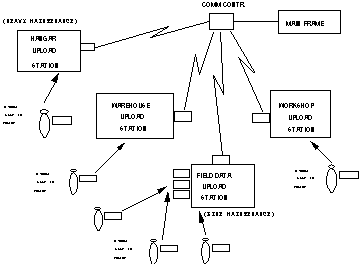
The interface software should be installed in a "NotePad" computer, that can be carried by mechanics to the aircraft. The "NotePad" will become the interface between the Bar code reader and the computer terminal. Before the mechanic used the Bar code reader, it should make some inputs into the "NotePad" like: Aircraft registration, removal/installation, reason of removal/installation, etc. After making those inputs, the mechanic can use his bar code reader to input all the components. The "NotePad" will then be brought to a " Field Data Upload Centre" which upload all the data recorded in the "NotePad" into the mainframe computer.
(See figure 1.).
The same procedure will also be applicable
at the warehouse area for employees to record incoming as well
as out going spare parts. In the workshop area mechanics can record
components that are being repaired and in the hangar recording
will be used for removal/installation of spare parts during heavy
maintenance of an aircraft.
C. ORGANIZATIONAL PROCEDURE
The responsibility of updating data has been changed from only one supporting department to all production department. Essentially data updating will be done at the location where the work has occurred. There will be no manual transporting of data from one location to the other, to avoid any missing information. The best advice will always be to update information at the nearest place where the work has been accomplished. This idea will be implemented here, and that is the reason why production department should do updating of data after they have done their job. The responsibilities of updating will now rest on the production department and not on the supporting department any more.
This change of responsibilities needs
to be reflected in the organization manual.
D. TRAINING
Intensive training for production employees that are responsible for data entry using bar code reader becomes essential. Not only because it will be the first time that they are responsible for updating, but also it involves delicate technology that needs precision and discipline to be used correctly.
At least 900 manhours of training
for data entry is expected, involving 60 employees through the
entire production department.
IMPLEMENTATION
The production department essentially consists of three different areas which are:
a. Heavy aircraft maintenance,
which is responsible for overhaul and other major aircraft maintenance.
This department has eight maintenance crew, which work in three
shifts of eight hours a day. Each maintenance crew consists of
40 people.
b. Line aircraft maintenance, which is responsible for minor maintenance of the aircraft. Usually done at the apron side of an airport. This department has sixteen maintenance crew working also in three shifts of eight hours a day. each maintenance crew consists of 20 people.
c. Workshop is responsible for component repair at the workshop area, consists of a total of twelve maintenance crew working in two shifts of eight hour a day. Each maintenance crew consists of 25 people.
Each of theses maintenance crew should have at least two people who are responsible for updating the data into the computer. Those two people responsible for it, should monitor the work done by each mechanic in the maintenance crew and then do the updating of data into the computer. The responsibility for updating data after the work has been accomplished rest with each and every maintenance crew and the crew chief will be held responsible. The crew chief should see that all the work done by his mechanic has been updated into the computer in a correct and timely manner.
Two bar code reader equipment should
be provided to each maintenance crew at the production department.
These equipment will be used by the two personnel that are responsible
for updating the data.
COST CALCULATIONS
The cost calculated here are mainly
the capital that should be laid out by the company to implement
this new procedure.
1. DATA ENTRY
| A. Bar code development :
* 4 Engineers, 2 months Bar code installation :
* 20 persons, 3 months B. Bar code scanner : A similar type of Fujitsu PoqetPad with Bar code reader (PQ-3109). 100 units x $ 2,500 | $ 16,000
$ 60,000 $200,500 |
| SUBTOTAL COST | $276,500 |
2. INTERFACE SOFTWARE
| A. Systems development :
* Hire systems analyst (6 persons, 6 mo) * Hire programmer ( 6 person, 6 mo) | $ 90,000 $ 72,000 |
| SUBTOTAL COST | $162,000 |
3. ORGANIZATIONAL PROCEDURE
| A. Organizational procedure and manual updating:
* 6 person x 3 months | $ 27,000 |
| SUBTOTAL COST | $ 27,000 |
4. TRAINING
| A. Training cost : 120 personnel in a one week session :
* Mechanics, 72 persons * Warehouse staff, 12 persons * Supervisors, 36 persons | |
| SUBTOTAL COST | $ 24,000 |
| TOTAL COST (1+2+3+4) | $ 489,500 |
CONCLUSIONS
The total capital that must be spent
calculated above comes to $ 489,500 . This appendix only defines
a more detailed explanation of the implementation process and
capital outlay, but is not going into the detail of the benefits
calculations which has been done in appendix 4. above.
1. Barton, L.D., "Implementation as mutual adaptation of technology and organization," Harvard Graduate School of Business, Cambridge, Ma, 1988.
2. Barton, L.D. & William A. Kraus, "Implementing New Technology," Harvard Business Review, Nov-Dec 1985.
3. Computerworld, December 7, 1992.
4. DRT Consulting Asia Pacific, Consultant Report, "Information Systems Strategic Masterplan," July 1991.
5. Garuda Indonesia, Reliability Report, 1992.
6. Government Computer News, January 18, 1993.
7. Hansen, M., "Zero Defect Data," Computerworld, September 28, 1992.
8. Leenders M., H.E. Fearon, & W.B. England, Purchasing and Materials Management," 9th Edn., Irwin, 1989.
9. Garuda Indonesia, "Reliability report 1992"
10. Government Computer News, January 18, 1993.
11. Strong D., Lee Y. & Wang R., "Identification and Resolution of Data Quality Problems: An Organizational Learning Perspective," April 1993.
12. The Wall Street Journal, May 26, 1992.
13. Wang, Richard, Information Technology in Action, Yourdan Press Computing Series, 1993.
14. Wang R., Kon H, "Towards Total Data Quality Management", Chapter 10 from Information Technology in Action, Yourdan Press Computing Series, 1993.