
Introduction
Three months ago I chose to study Central Square because ever since I first visited the site three years ago, I have been fascinated by what it is. However, during the course of this investigation, I realized that the place I visited my freshman year is not the same place I have been visiting so repeatedly this term. Neither is the site that I visited for this assignment the same one I studied at the beginning of the term, when I was first starting to unravel its mysteries. Central Square changes dynamically from day to day, in an ongoing process that started the day it was first settled and that shows no signs of stopping or slowing down. The "present" Central Square, if one can speak of such a thing, is the outcome of decades of complex changes caused by the interactions of countless variables and individuals. We can only attempt to scrutinize with a trained eye in order to understand what Central Square once was, and try to guess what it will be.
Glimpses of What Once Was
Looking Back to the Origins
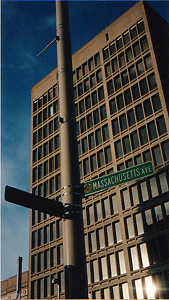
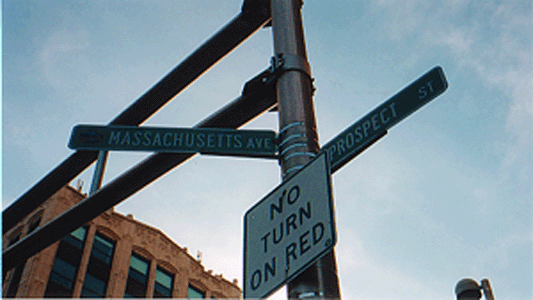
If we take a look back at the now familiar Hale's 1830 map of Cambridge, we can see that the group of streets that connect the heart of the Cambridgeport settlement to the surrounding points of interest are, in effect, the same streets that now characterize Central Square (mainly Massachusetts Ave, Magazine St, Prospect St. and the surrounding grid of side streets.)
The streets built when the Central Square area was first settled are still the main streets in the site.
No actual artifacts remain that can hint us to the true nature of the site as it was during the period of it's initial settlement. However, the structure of the site itself has not changed much since then, making this the period that has left the most noticeable mark on Central Square.
The reason for this deserves considerable attention, as it is rare for a site to remain structurally unchanged for such a long time. Being now acquainted with the history of the site, I can analyze this situation and present a suitable theory.
The main streets were built to connect the city to points of interest, thus increasing the value of the owners' properties. The fact that the chosen design was effective in doing so has allowed the structure to remain mainly unchanged. Central Square has always been a mainly commercial area. The points that the streets connect the site to have remained to be areas of great importance within the city (especially in the case of Massachusetts Ave.) Therefore, these streets continue to serve their purpose of making the site a profitable area for commerce.
The overall situation has not changed, but the magnitude of the traffic has obviously increased tremendously. The infrastructure of busy areas within a city is seldom able to support the increase in traffic loads for too long. This is the reason for projects such as the Big Dig. However, as mentioned earlier, Central Square remains unchanged. We can assume that the opening of the Central Square Subway Station in 1912 is greatly responsible for this. The subway linked the site to Downtown Boston and other centers of commerce and activity, quite in the same way that the streets had been designed to do. The effect was a 'split' in the transportation load between the streets and the subway, which allowed the streets to survive this period of urban renewal.
A similar situation arose decades later (starting in the 1950's), when the government proposed the building of the Inner Belt directly through Central Square. The resulting opposition from the community proved so strong that the government eventually decided to implement another alternative. This had not been possible had the structure of the site not fomented and supported such strong feelings of community within the area (a process in which the side streets doubtlessly had great importance). This is expectable if we take into account the fact that Central Square, throughout its history, has always fit the model of a successful community presented by author Jane Jacobs in her book The Death and Life of Great American Cities (a topic which I have already discussed in detail in the midterm exam, and which I can not discuss here without digressing.)
We can therefore conclude that the structure of Central Square has remained untouched all these decades because it was planned so well (probably unknowingly) that it has been able to adapt to the changes in the times and has fostered a community with strong ties to the structure itself.
The Site Around the Turn of the Century
Buildings comprise almost exclusively the traces left from what was the Central Square of the late nineteenth / early twentieth centuries. Although some of the buildings, like the City Hall, still perform the same function they did back then, most of the buildings have changed identities by now. However, they bear upon themselves marks and scars that point to their original functions.
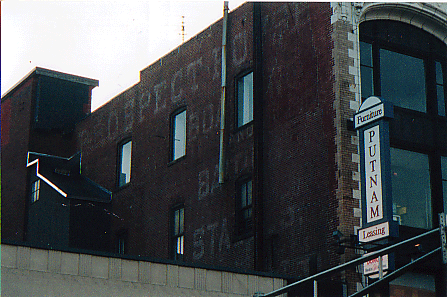
The old Prospect House Hotel building. It is no longer a hotel, but the side of the building still reads, in faded letters: PROSPECT HOUSE; BOARDING, BATHROOMS, STABLES.
Several buildings show traces of different sub periods within this general late nineteenth / early twentieth centuries era. The Prospect House building and the building that today houses Payless Shoe Source, for example, both have terracota facades that were clearly added to the brick buildings as part of remodelations during the early twentieth century. Some buildings, like the two previously mentioned, bear the name of the person who built or remodeled them, as well as the year when this was done. Others, like the Guaranty Trust building, which today has several commercial uses, still bear the sign of the original businesses they housed. The Cambridge Gas-Light Company building is another example of this.
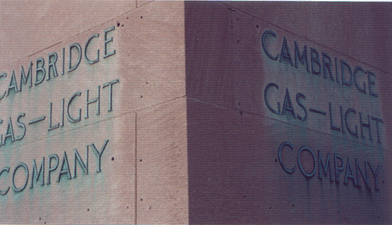
This building now houses a Fleet Bank and a convenience store, but its facade still bears the sign for its original occupant.
Other buildings can simply be dated by their architectural style. This is the case of the monumental building once shared by the Cambridgeport Savings Bank and the Harvard Trust Company, whose style brings to mind the influence of the World Columbian Exposition of Chicago in 1893.
Although the 1888 and 1930 maps from assignment two were used to verify the identity of these buildings, this turned out to be really unnecessary, since the buildings can be so easily dated without the use of external references.
These buildings have survived the passage of time because they were well built and their size has allowed them to adapt to different kinds of uses throughout the years. There has not been any reason to demolish them, since it is much more profitable to keep using them and remodel them if necessary. Smaller buildings, however, are not so flexible, and have therefore not survived.
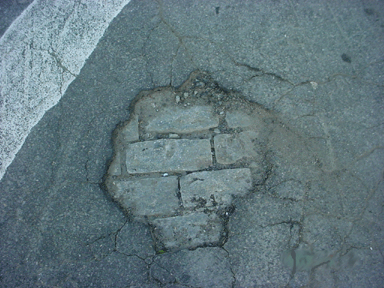
A miscellaneous, but interesting, observation: this spot, a couple of blocks from my site, shows that the streets in the area were paved without removing the sand-laid brick first. We can literally see the layers that point to the site's history.
The Last Decades of the Twentieth Century
In the last few decades, Central Square has been marked mainly by the actions of the latest wave of immigrants to arrive in the site: mainly people from Central and South America, the Caribbean and Asia. The strong sense of community felt by these immigrants in Central Square is actually visibly present in the site by means of public art.
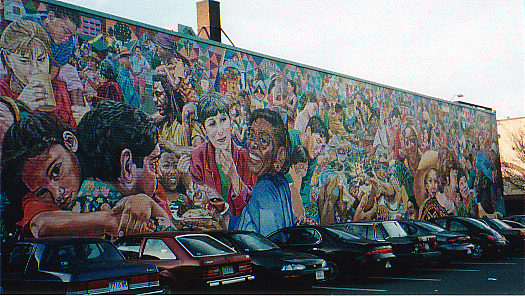
The mural "Potluck" by David Fichter represents the importance of community in the area, and the pride that the members feel for the diversity of the site.
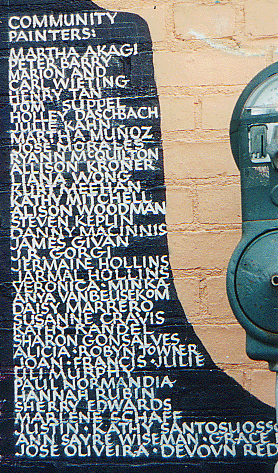
The active involvement of so many community members of different ethnicities shows that the mural does not portray an idealistic picture far from the reality of the community.
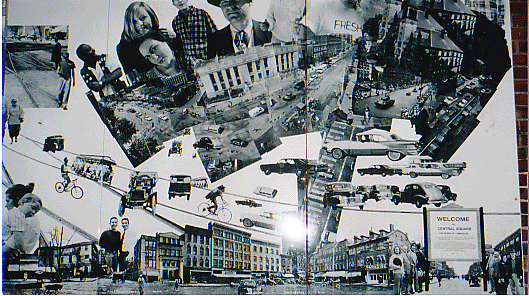
This mural (only a section is shown here) shows the pride that the community feels for the history of Central Square. Other sections emphasize the diversity of the community and their struggles to ensure its integrity. The pictures used in the collage were provided by members of the community.
While some buildings in the site show signs of vandalism, these public art pieces have remained untouched for years. This is due to the fact that the community recognizes them as a sign of their strength, and has thus great respect for them.
What Is...And What Might Be
Central Square is currently undergoing very significant changes at a fast pace. The character of the site, which had become that of a rather rundown part of town after the decrease in commercial activity during the 1970's, is definitely changing. Large chain stores such as GAP and CVS have pushed out smaller businesses in the area. More importantly, the lack of rent control by the city and the desire for "urban renewal" of the area has started to push the immigrant community out.
The future of Central Square is perhaps best represented by the new Holmes Building right in the middle of the Square. The six-story mixed commercial and residential building opened its doors in 2001, but sadly not to the members of the immigrant community, who obviously cannot afford it. Many of them also lost their homes when the old buildings were torn down before construction.
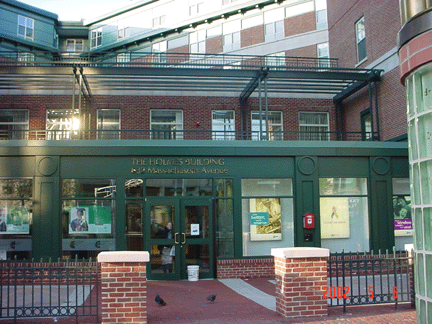
My guess is that in the nearby future, similar developments will completely push the immigrant community out of Central Square. The area will become a rather exclusive commercial and residential site. The public community art will disappear, just as the traces of earlier immigrants communities like the Irish can no longer be found. The old buildings that have so far survived will probably be remodeled and occupied by the new developments, but they will survive, as they have until now. The strong sense of community will be lost, and it is probable that Central Square will not survive another "Inner Belt" proposal. With time, even the structure of the site will change.
On Prospect Street there is a small, old, barber shop called Jack's Barber Shop. A sign saying "Se habla español" hangs from the door. Jack's current neighbor is now a Starbucks. Within a few years, Jack's Barber shop will have disappeared. With it will have gone the colors and the diversity, the sounds and the singing, and all that drew me to Central Square in the first place. My site will be no more.
Sources
1. Rotch Library Map Collection. MIT.
2. Boyer, Sarah. Crossroads: Stories of Central Square.2001. Cambridge Historical Commission.
3. Jacobs, Jane.The Death and Life of Great American Cities. 1961. Vintage Books.

