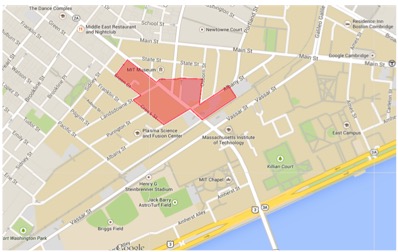
 Site Overview – This figure shows the location of my site in the greater MIT- Cambridge area. Image from Google Maps, February 2015.
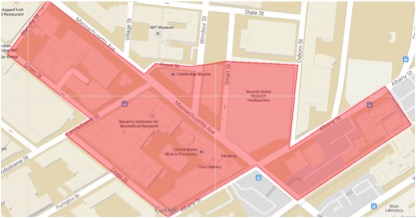 Site- This figure shows a more detailed view of the site under study. Image from Google Maps, February 2015.
 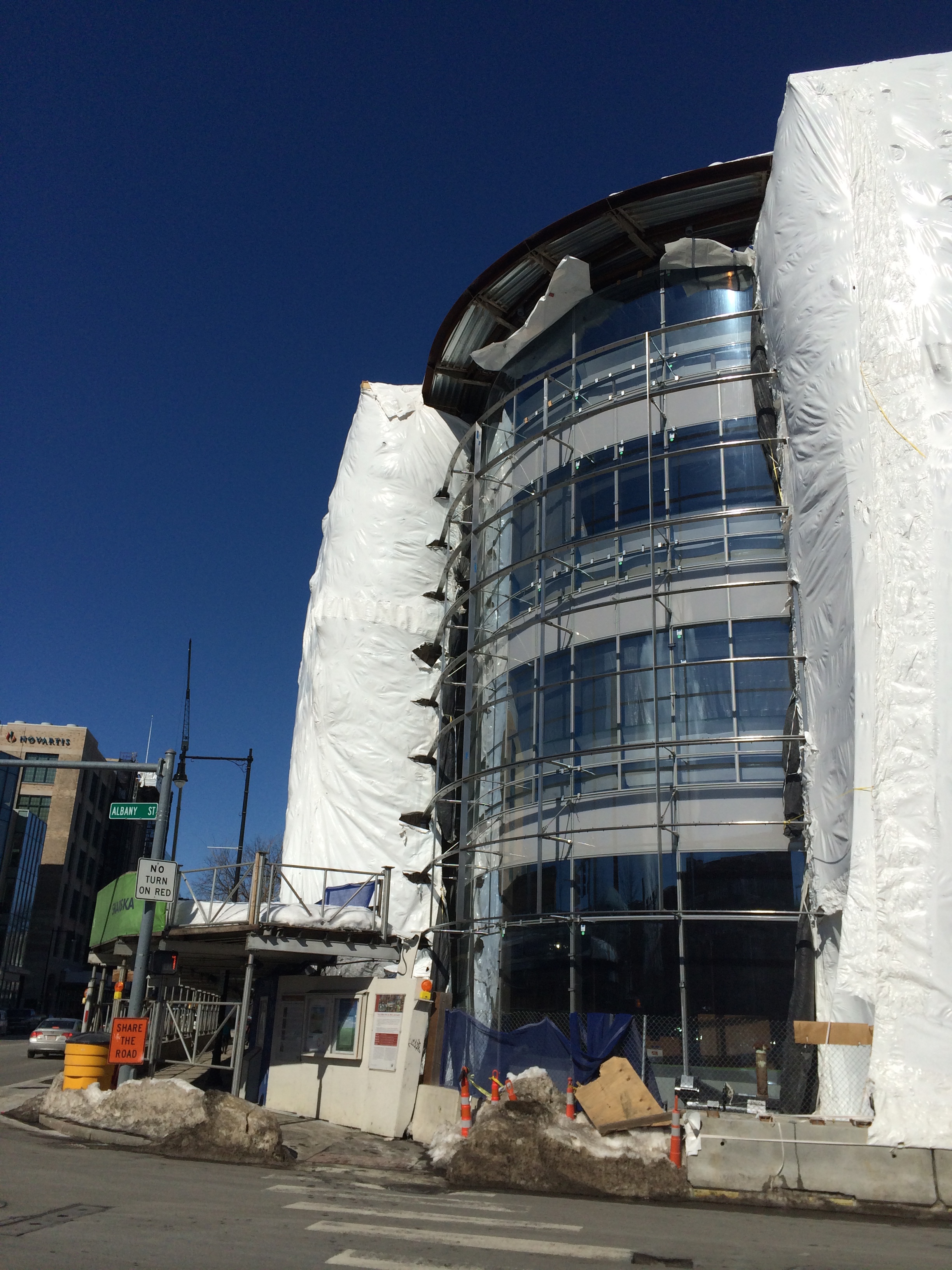 Main enterance to new Novartis building under construction.
 I am interested in transitions. Whether that is at the junction of two disparate fields of study where innovation is born, or the moment of silence between two movements of one of Brahms sonatas, I have always felt that at the crossroads of two distinctly different bodies, the most interesting development takes place. I am extremely interested in the area where MIT meets the rest of Cambridge for this exact reason. This transition from academia to consumerism is not abrupt; rather it is an interesting interplay between academic buildings, research institutes, industrial areas, and finally consumer shops. This makes for an area that is extremely conducive to development and new construction that grows in harmony around its old backbone of rail lines and stone buildings.
Seeing the effects of large construction projects on the existing neighborhood is very interesting and informative. The New Novartis construction site has been a key area of focus for me because it shows just how great an effect a large project like this can have on an area and how the introduction of a daily influx of construction workers can alter the human dynamic of a neighborhood. This building is not yet complete, so the everyday city traveler does not interact with it in the way that he or she would when the building is finished, but it still plays a large role in the way the neighborhood operates. Grady Clay writes of “epitome districts” which are areas that encapsulate the essence of a city, and I believe that the Novartis construction site is a type of epitome district in itself. It is not an epitome district in the same sense as Clay’s use of the term, meaning it does not give a condensed representation of the city at large. However, it epitomizes exactly what it means to have a large-scale modern construction project in an old city.
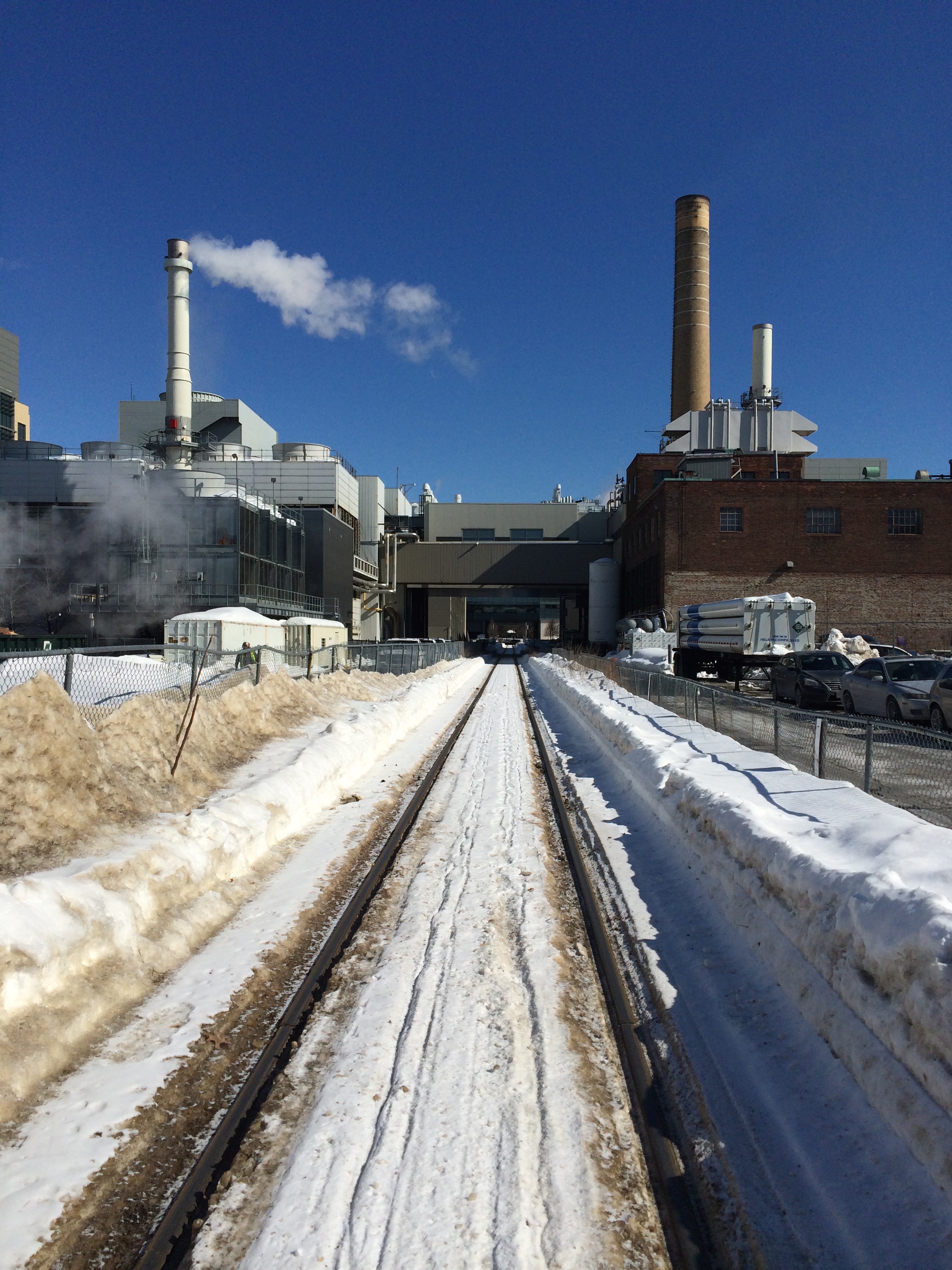 Railroad tracks threading through power plant.
 Perhaps the oldest feature in my site is the set of railroad tracks that thread like a spine through Cambridge. Just east of Massachusetts Ave., there is a power plant and industrial sector that the rail road tracks actually thread through. I am very interested in industry and industrial operations and the area raised some stimulating questions for me. Were the tracks built through the building, or was the building built around the tracks? What industrial buildings may have existed around the rail line in the past?
Throughout my exploration, a common theme of questions surfaced. This theme I kept finding myself touching on was what had been built first. Not only did I have this question with the rail line and the power plant, but also with some other interesting features I came across later. I came across a narrow graffiti-covered alley that led to the backs of several multi story houses. It seemed like a strange place for those houses, and I found myself wondering whether they were there before the surrounding large buildings, or if they were built tucked into that space to provide more housing in an ever-growing urban environment. The last strange anomaly I found to my site was perhaps the most puzzling. Right next to the nuclear reactor on Mass. Ave., there was what on first glance appeared to be a gentleman’s club. After looking into it, I discovered that it was actually a gay nightclub. This seemed like a very strange location for such a business to me, nestled between a nuclear reactor and Flour bakery. For a third time I began to wonder as to the sequence of development in that area. When MIT moved to Cambridge, what surrounded it, and in the 100 years the campus has been here, how have its immediate environs changed?
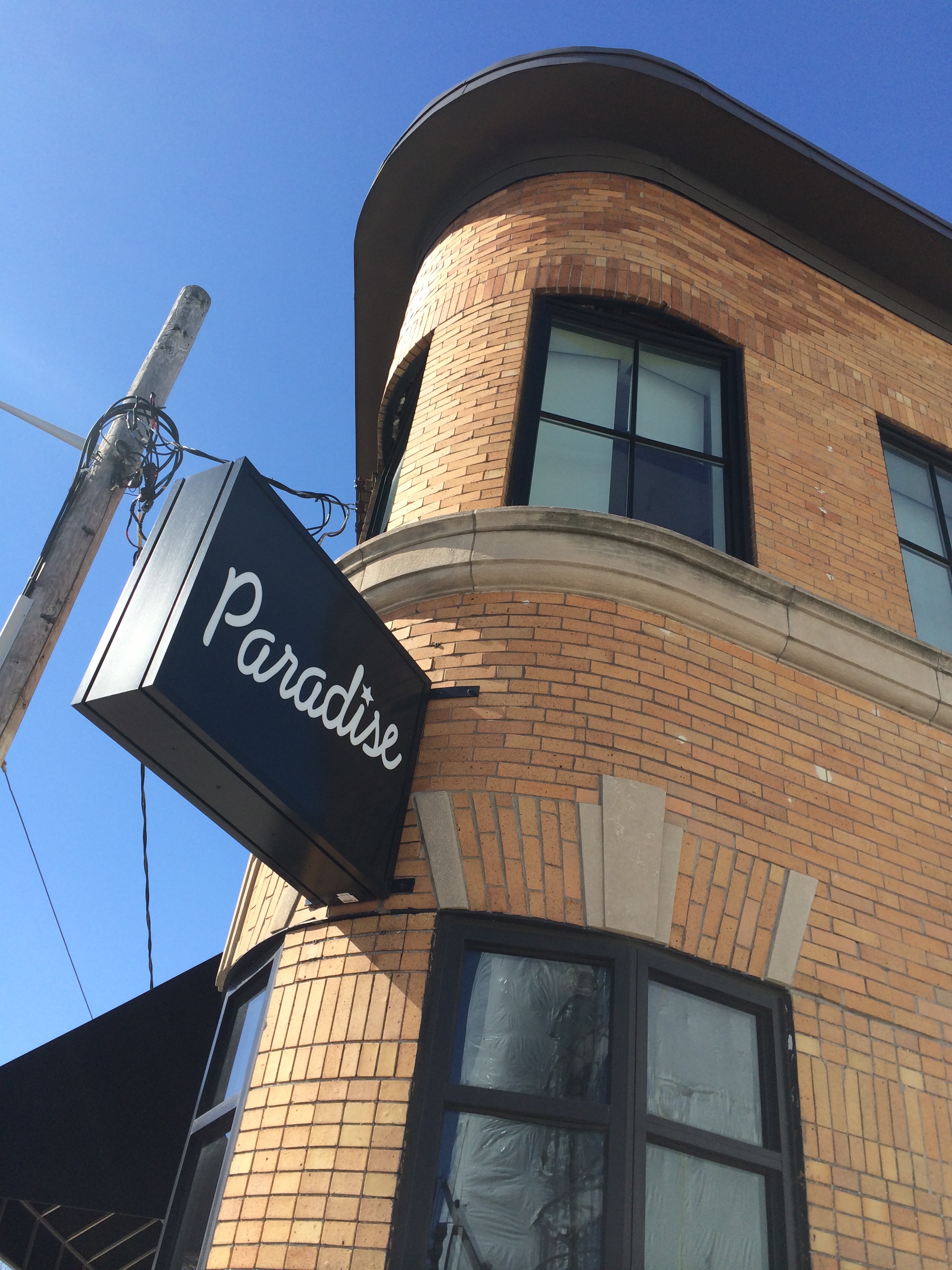 Paradise Club, Corner of Mass. Ave. and Main Street.
 After reading Grady Clay’s Close Up: How to Read the American City, I had a new lens through which to view my site. Clay writes of the “venturi,” a term he aptly coined for a street or area through which information, business deals, and progress is accelerated. I observed my site around 4 o’clock two days in a row and noticed that there was a steady stream of construction workers flowing from the Novartis site across Mass. Ave. and down Landsdowne street. Many would stop at the gas station to pick up a drink or snack, and many would travel in groups laughing and conversing. Were they accelerating business deals, or changing local politics? Most likely not. However, I had hit upon a physical rout traveled regularly by a group of people in which they interacted with the neighborhood. I consider this a venturi and intend to observe closer how this rout is traveled and where its travelers actually go.
My site is at the interesting intersection between an institution and a city and is home to an environment of progress, evolution, and growth. It embodies my passion for industry and construction, as well as my interest for urban evolution. Through this case study I aim to delve deeper into the fabric of my site and learn how its layers came into existence over time.