
Treatment for end stage lung disease has failed to benefit from advances in medical technology that have produced new treatments for cardiovascular disease, cancer, and other major illnesses in recent years. As a result, end stage lung disease remains a devastating condition with few therapeutic options. To address the need for improved methods of respiratory life support, we are developing a novel technology with our collaborators that is capable of generating oxygen directly from water present in blood plasma. This technology is intended to provide a self-contained, mobile oxygen supply suitable for implantation or extracorporeal oxygenation in support of an acute or chronically disabled lung. The core technology couples an optoelectronic metal oxide film with a microfluidic capillary network to facilitate oxygen exchange with flowing blood and replicate pulmonary capillary respiration.
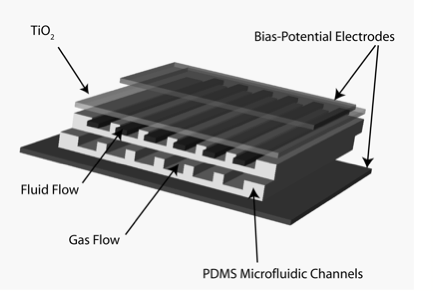
Concept model for integrated microfluidic photolytic oxygenation module. Multi-layer PDMS microfluidic channels are sandwiched between photolytic elements. The total thickness of the structure is on the order of several millimeters, meaning that multiple elements could be stacked back to back, achieving extremely high channel densities. |
The first stage of this project has focused on the optimization of this microfluidic capillary network with respect to hemocompatibility, mass transfer, and dissolved oxygen detection. Microfluidic capillary devices were fabricated from silicone rubber using multilayer soft lithography to create dense 2D networks of bifurcating channels. To quantify the effectiveness of mass transfer in various channel geometries under differing experimental conditions, a mathematical model of oxygen convection and diffusion was generated. A novel integrated optical oxygen sensor based on an oxygen-quenched luminescent dye was developed to detect oxygen concentrations within the microfluidic device. Mass transfer within the microfluidic oxygenator was characterized experimentally, employing the integrated optical sensor, and analytically, using the convective model. Excellent agreement was found between experimental and analytical results.
Present Post-Doctoral Fellows
Dr. Marco Rasponi |
Present Graduate Students
 |
Hyesung Park (Doctoral Student) |
Present Undergraduate Students
 |
Erin Koksal, Course 2 |
Visitors
Alumni
 |
Adam Vollmer (Masters, S.M., June 2005) Thesis Title: "Development of an integrated microfluidic platform for oxygen sensing and delivery" |
Collaborators
Richard Gilbert, M.D., Dept. of Mechanical Engineering, M.I.T.
Prof. Ronald Probstein, Dept. of Mechanical Engineering, MIT
Prof. Alberto Redaelli, Politecnico Milano
Sponsors
National Institutes of Health (1-RO1-HL086652-01)
MIT-Milan Politecnico Alliance (Progetto Roberto Rocca)
MIT-Singapore Alliance
Refereed Publications and Conference Proceedings
1. A.P. Vollmer, R.F. Probstein, R. Gilbert and T. Thorsen. Development of an integrated microfluidic platform for dynamic oxygen sensing and delivery in a flowing medium. Lab Chip 5: 1059-1066 (2005) (PDF)
2. A. Vollmer, T. Snyder, M. Kameneva, B. Monzyk, E. Burckle, K. Dasse, P. Martin, H. Borovetz, W. Wagner, R. Gilbert, and T. Thorsen. Development Of A 2D Microfluidic Oxygenation Device. American Society for Artificial Internal Organs (ASAIO) (2005)
3. R.J. Gilbert, A. Vollmer, T.A. Thorsen, P.M. Martin, K.A. Dasse, T.A. Snyder, H.S. Borovetz and B.F. Monzyk. Microfluidic Artificial Respiratory Device Incorporating Photolytic Auto-Oxygenation Of Whole Blood. Biomedical Engineering Society (BMES) (2005)
4. H. Park. M.A. Rasponi, K.A. Dasse, B. Gelman, B.F. Monzyk, P.M. Martin, R. Gilbert and T. Thorsen. Microfluidic respiratory device based on photolytic oxygen generation from whole blood. Biomedical Engineering Society (BMES) Annual Fall Meeting. Chicago, IL October 13, 2006.
5. R.H.W. Lam, M.-C. Kim, and T. Thorsen. A Microfluidic Oxygenator for Biological Cell Culture. Transducers 2007. 14th International Conference on Solid-State Sensors, Actuators, and Microsystems. Lyon, France. June 10-14, 2007.
6. R.J. Gilbert, H. Park, M. Rasponi, A. Redaelli, B. Gellman, K.A. Dasse and T. Thorsen. Computational and functional evaluation of a microfluidic blood flow device. ASAIO J. 53: 447-455 (2007) (PDF)