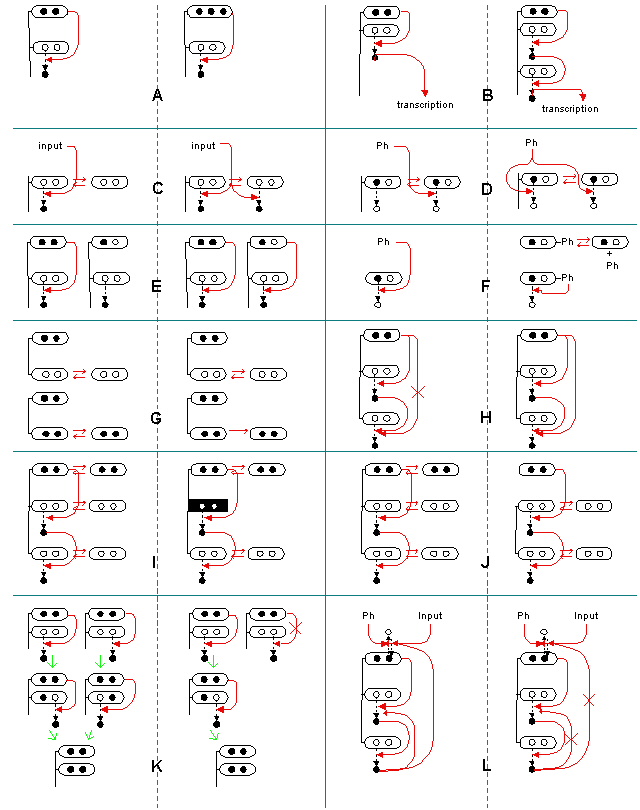
To understand MAP kinase networks, we posed the problem as a multiple-objective optimization with embedded dynamics. The dynamics of MAP kinase is modeled as a biochemical network, with dynamic equations expressing mass-action kinetics and other relationships. Optimization was applied to a set of network structures, the optimal networks were examined to elucidate underlying design principles, and multiple objectives were imposed to discover inherent trade-offs. The optimization probes structures and dynamics to understand the effectiveness of networks in producing specific signal-processing characteristics such as signal amplification, response time, and noise filtering.
We have developed computational methods to optimize the dynamics of biological networks represented by differential algebraic equations, to analyze the optimal results in the presence of local degeneracy, and to extract trade-offs among multiple objectives.
Implementation of the methods to MAP kinase networks reveals multiple strategies that the networks may operate. Furthermore, we discovered the signifcant differences in functiaonl properties of networks with varying circuitry, and significant perfornace advantages in noise reduction and responsiveness that non-linear components of biological networks can produce as compared to reaction networks with linear components.
In the algorithm development, we would like to extend the algorithm to optimize simultaneously the network structure and kinetic parameters of the dynamic models of biological networks. In the application development, we would like to apply the methods to larger sized networks to produce more insights which may be useful for identification of therapeutic targets.
Figure 1: The search space of MAP kinase network structure being probed in this research.
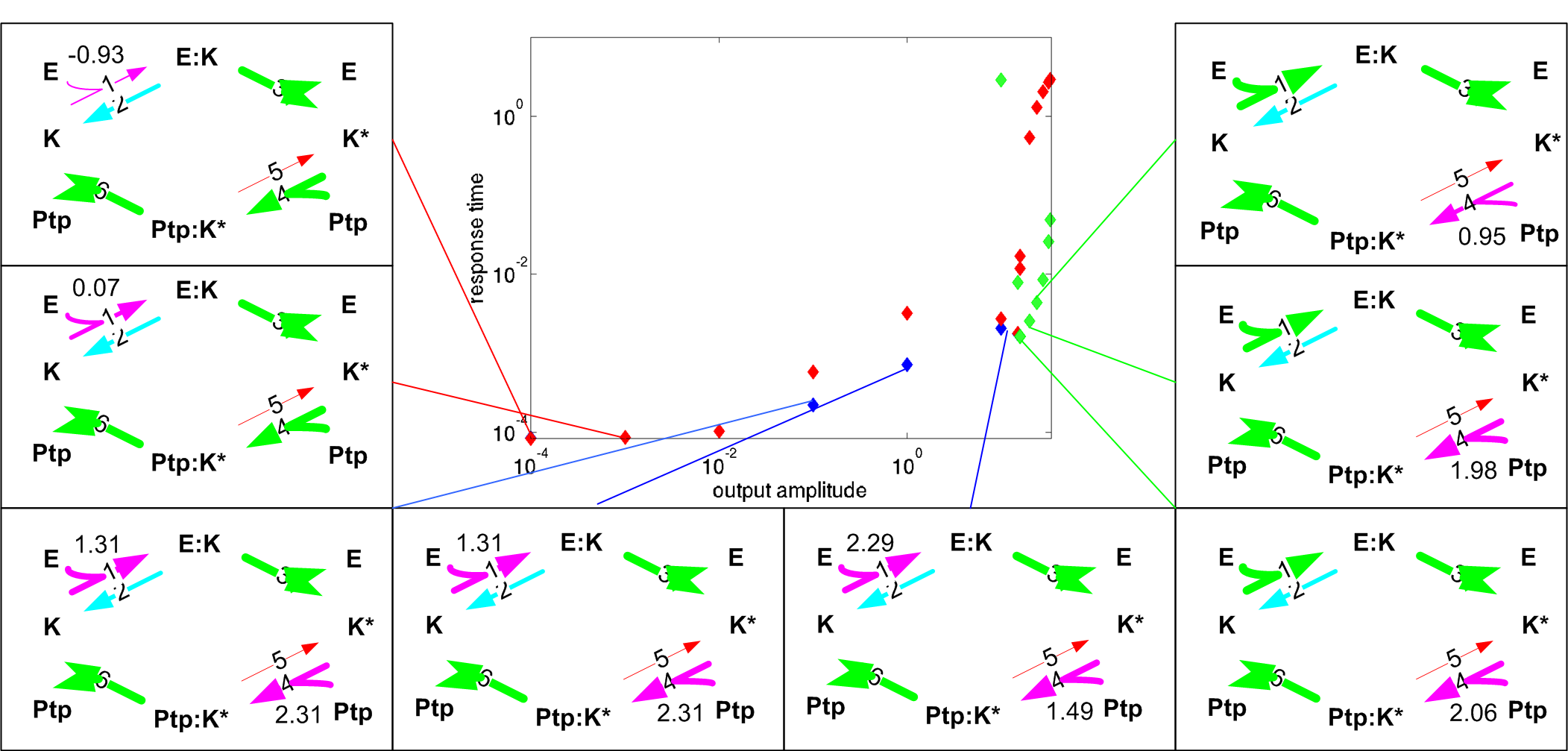
Figure 2: Network optimization Pareto set reveals organization to multiple strategies where the network may operate.