SECTION 7 - The Qualitative Jump
This section concerns the discussion of argued qualitative jump in new developments of information technology and its consequences.
|
1. Introduction |
|
2. The Nature of the Problem |
|
3. The Decision Model Implications |
|
|
|
1. Thesis Introduction 2. Hypothesis and Method 3. Assumptions and Foundation 4. Designing an Experiment |
5. The Experiment 6. Discussing the Experiment 7. The Qualitative Jump 8. Thesis Conclusions |
7. The Qualitative Jump
Introduction; The Nature of the Problem; The Decision Model Implications
7.1. Introduction
In this section I proceed to argue, through analytical reasoning, the fourth component of my thesis :
T.5). Does "the current stage of development of information technologies correspond to a qualitative jump in the technology substructure of society, as compared with the time when "modern" decision-making consolidated into current commonly used procedures within democracies" ?
After a brief discussion of the nature of the problem, in order to provide a solid foundation to this thesis, I question what makes current information technology a qualitative jump compared with past stages of IT? I discuss IT attributes (reach, added processing, equity, transaction costs) for different kinds of IT, and introduce a historical classification based on this criteria, which allows to argue towards a correlation between IT attributes with enabling/constraint factors regarding decision making and public participation.
7.2. The Nature of the Problem
Aristotle wrote that the good functioning of the state affairs implied that a city’s population should not expand beyond the ability of the citizens to take it into one view, since democracy implied the need for citizens to know each other’s character well. To be able to make use of this knowledge, any forum where the state affairs were conducted, should be kept to a dimension within the reach of human sight, in order for citizens to recognize each other . Naturally, they also had to be able to hear each other. In this he was not far from his mentor, Plato, who wrote that democracy cannot extend beyond the reach of a man's voice.
This thought captures well the inescapable duality of process (sight, voice) and technology (reach) that is inherent to any decision system.
Without communication there is no definition of problems, expression of interests, evaluation of alternative solutions, or enforcement of a decision. Democracy is particularly demanding, since it claims to be the decision system that empowers more people than any other system. With the available communication technology in Plato's Era, and a social system with the dimension of "city-states", democratic debate and decision making implied citizens together in one place, within each other's voice reach. Residuals of this form of "direct democracy" can still be found nowadays in places like the Swiss "Cantons" and some USA town meetings.
Since then, things changed in both facets of the duality, process and technology. On one hand, information technology evolved, with printed press but especially with radio and TV broadcast, extending considerably the original reach of the human voice. On the other hand, in ancient Greek Democracy not everyone was a citizen -- like the slaves for instance. Discounting ideological factors, it is not feasible to have the whole population meet in one place, thus, the new technologies enable more alternatives. But if the new IT allowed everyone to read (for those who new how...), and then to listen and see, only a few had their voices' reach extended. Discounting again other factors, the best one could do (with broadcast IT) was to arrange for those few to represent many others. Representative democracy was found in this sense to be an improvement over direct democracy, since it allowed voicing the interests and opinions of many more people, and in nations wider than a city. Increased interdependency of vital components of society, above all the economy, posed demands in coordination and centralization that further weakened the forms of direct democracy (Djugashvili 1938) (Ostrovitianov 1955).
These have been the basic premises of our so-called modern democratic societies, born with the industrial revolution. In this context, public participation is still largely viewed as the exercise of voting rights by citizens, particularly in electing every 4 or 5 years their government -- or their representatives with a delegated right to elect a government and legislate. Any other form of public participation as a source of enforceable decisions (if existing at all) is usually institutionalized as an exception, with multiple restrictions, and almost always may be overruled by the "core" representative system.
In the past twenty years, however, a different trend is gaining strength. In the USA, some state referendums on specific measures, programs or policies have more participation than traditional elections; maybe even more significant is that their initiative is frequently independent of political parties (Naisbitt 1984). In Europe, USA, and many other countries, NGOs play an increasing role in decision making (Ferreira, Joseph Jr. 1998), and not only as lobbying or advisory groups, but as a matter of fact. The number of spontaneous movements of local populations blocking legal government decisions is multiplying, either forcing a reversal of the decision, or imposing added costs. The NIMBY phenomenon is just one example. Step by (small) step, more countries are legislating mandatory periods of public consultation as part of impact assessment studies -- even if in a non-binding fashion -- in a clear recognition that "pure" representative democratic mechanisms are no longer enough to legitimate (at the eyes of the people) all government decisions. We are entering the realm of participatory democracy (Prieur 1984) (Bradley 1989) (Borja 1993).
Why this trend, and why now? This is a complex question that is being addressed in many different ways. It can be argued that it is an inevitable side-effect of the prevailing theories towards minimizing the role of government, even if these theories were mainly intended to free economic agents, such as corporations, from the burden of state regulation, and allow market forces to prevail (Wriston 1992). It can also be argued that environmental problems became more acute, their effects more visible, and thus people are more motivated to take direct action (Vlachos 1993); etc. However, these events are as much cause as consequence, and this class of arguments only address parts of the issue. A far more convincing and in-depth argument relates this trend with the Information Revolution (Lussato 1982) (Castells 1989) (Rebordao 1989) (Brown 1990) (Builder 1992) (Wriston 1992) (Sassen 1994).
Information technology is far from being simply a tool, that planners can master and use; it is also a powerful driving force transforming our society, that planners must understand and find the means to influence, where and when it is possible and convenient (some even argue that planners should assume a more political role (Albrechts 1991). Information was always a source of power; now it is also an increasingly important source of wealth, a commodity with unique attributes, a form of capital with different laws of consumption and reproduction. The Industrial Revolution, brought about by the steam machine era technology, dramatically changed social systems, the mode of production, and the nature of the nation-state, expanding its regulatory power and its means to control resources and territory (Wriston 1992). The Information Revolution is introducing no less dramatic changes, from the mode and organization of production to the form and function of government.
It is therefore consistent with my hypothesis to assume that new developments of IT, such as the mass production of low-cost-yet-powerful microcomputers, and computer networks connecting millions of users through fiber optics and satellite, have a lot to do with this new trend. As Walter Wriston wrote, "The dissemination of once closely held information to huge numbers of people who didn't have it before upsets existing power structures"... although he goes further: "In many areas of economic and social life in which the government once credibly professed to be the only party both sufficiently qualified and disinterested to lay down the rules, 'knowledge workers' will rightly feel themselves better informed than government regulators (Wriston 1992)". Together with the more generalized than ever access to radio, TV, phone and fax machines, these new IT did not only enabled a more participatory democracy; they are building up the pressure towards it (Brown 1990) (Ferté 1993).
But is it true - as Wriston asserts - that many people are becoming better informed and qualified for decision-making than government, in many areas? And if so, which, and what decision model should then prevail to keep society governable as a whole? It is unarguable that more and more frequently government faces people that think of themselves in that fashion, but perception is not evidence. Instead of trying to prove or disprove Wriston's statement, I will focus on one subset of these questions, with the two facets (limitations and potential of both process and technology), and its context (relationship between IT and public participation).
7.3. The Decision Model Implications
The broader grouping of IT landmarks; The IT "enabling" function
7.3.1. The broader grouping of IT landmarks
If we consider the IT landmarks (from the table in the chapter on IT review), it is possible to group them in three large categories:
a) The period before IT developments that brought radio broadcast of human voice with large reach;
b) The period between radio broadcast ability and the emergence of microcomputer and world wide communication infrastructure (cable, satellite);
c) The period since the development of the microcomputer and such infrastructure.
Tables 7.3.1.-1 to 3 are a subset of the IT landmarks table presented before, and summarizes these periods
Table 7.3.1.-1
- Period before broadcasting|
>600 BC |
The abacus (=arithmetic unit of CPU) is invented in China |
|
387 BC |
Foundation of Plato’s Academy |
|
1450 |
Printing press invented (Johannes Gutenberg) |
|
1876 |
First telephone patent (Alexander Bell) |
Table 7.3.1.-2
- Period between broadcasting and microcomputer + world wide network|
1906 |
First broadcast of human voice, AM radio (Reginald Fessenden) |
|
1930 |
18 million radios owned by 60% USA households |
|
1936 |
Regular TV broadcast begins in UK |
|
1956 |
72 % USA households own a TV |
|
1968 |
First ARPANET (IMP), installed at UCLA (precursor to INTERNET) |
Table 7.3.1.-3
- Period after microcomputer + world wide communications network|
1971First microcomputer in USA |
|
|
1972 |
Created the InterNetwork Working Group, creating the INTERNET |
|
1975 |
First Personal Computer (PC) introduced |
|
1991 |
First Internet Web Server and Web Browser (CERN) |
|
2001 |
529 million people on-line (Internet) |
7.3.2. The IT "enabling" function
I suggest it is useful to group the IT developments this way, because it emphasizes what I call the "enabling" function of IT, in what concerns decision models in society.
In the early days, at the mentioned times of Plato and Aristotle, the available technology to communicate was essentially the human organs that generated voice and allowed to hear it. Naturally, there was other IT (from manuscripts to signaling with drums and mirrors and light, etc.), but in what concerns technology that allows effective communication for decision-making, these IT were cumbersome and ineffective, for other than conveying eventually information or decisions, but not for effective dialog in real-time.
This argument is nicely presented by Aristotle, when discussing the ideal dimensions of a governable state:
"Similarly a state (pólis) consisting of to few people will not be self-sufficing (which is an essential quality of a state; and one consisting of too many, though self-sufficing in the mere necessaries, will be so in the way in which a nation (ethnos) is, and not as a state, since it will not be easy for it to possess constitutional government – for who will command (stratêgion=general) its over-swollen (lían=exceedingly) multitude in war? Or who will serve as its herald unless he have the lungs of a Stentor? It follows that the lowest limit for the existence of a state is when it consists of a population that reaches the minimum number that is self sufficient for the purpose of living the good life after the manner of a political community (politikên koinonían)."
3Aristotle asks:
Who will serve as its herald unless he have the lungs of a Stentor?
Since the ability to speak and hear is a generalized human feature, it follows that the intrinsic nature of the "technology" did not introduce, or enforce, other limitations to the communication process within decision-making, than the referred dimension (to not extend beyond the reach of human voice). Naturally, exceptions exist, and externally imposed constraints can be put in place (no slaves, no foreigners, no women, etc.). But these constraints are not derived from the communication "technology" support, they rather imply some effort to enforce such constraints (guards, etc.).
This is why with the emergence of broadcast-like IT, such as radio, then TV, we have a significant jump, in which we have developed the means to amplify the reach of the human voice considerably. But at the same time, we have a inequality introduced: only a few have their voice amplified, the others are put in the category of receivers. If we add to this the fact that the costs (in that period, 1900-1970) of broadcasting technology were very large (for a significant reach), it is further emphasized that only a few large entities (such as corporations or states) had conditions for controlling access to this IT.
So in this case, we have a constraint that is intrinsic to the nature of the IT. The restrictions to the communication process within the decision-making are not on the "reach" facet, but on the "equal access" facet.
I suggest that Aristotle argument on the governability is not rendered obsolete; what changes is that leaders don’t need anymore to have the "lungs of a Stentor", since the voice of leaders can be amplified thanks to the new IT, and reach larger audiences in real-time. I further suggest that there is at least some relationship between this new found voice reach, and the broader boundaries of modern states, as compared with city-states (in line with arguments presented by Morgan, or Wriston, referred in the previous chapter). But what is more interesting is to note that the emergence and consolidation of forms of representative democracy, came in step with the emergence of the broadcasting technologies.
That this argument is relevant is shown by the history of all power struggles in this period. The first thing any "coup d’etat" has to secure is the control of the broadcasting stations. This was the common tactic, as recent as the democratic revolution in Portugal, 25 April 1974: the first military objective was to gain control of a broadcast station with auto-sufficient power supply (generator). This emphasizes the notion that broadcasting centers are at the strategic core of political power.
One simple form of expressing this is to say that human voice without amplification enabled, at best, a form of direct democracy; broadcasting IT, by enlarging the boundaries of the state reach renders difficult those forms of direct democracy, but enables the new forms of consolidated, institutional, representative democracy.
This is consistent with the intrinsic limitations of the new broadcasting IT of this period. If only a few can have their voices amplified, relegating the vast majority to the condition of receivers of the amplified voice, then one can symbolically express that, at best, we can have those few voices that are amplified somehow representing the voices of the others (without their voice amplified).
Naturally, this reasoning is only suggested as an expressive way of emphasizing the qualitative difference of the IT in question; from one IT (human organs of voice and hearing) that has no "built-in" inequality in the rapport of communication, to other IT (broadcasting), that introduce this inequality in the same rapport.
This is not to say that IT determines in any way the political and decision models of society. Evidence of the contrary is ample, given the wide variety of contemporaneous political systems. What it suggests is that, without a certain qualitative level of development (broadcasting IT), it was difficult, if not impossible, to consolidate modern systems based on representative democracy, at the scale of larger countries and populations.
In the same line of reasoning, we can see how the combined development of a world wide communication infrastructure (satellite, cable) and the relatively cheap and powerful microcomputer, potentially accessible to each individual citizen (as opposed to the mainframe-kind of computer stages of development, requiring a whole set of professionals to even access simple computer functions), brings home a new potential.
If we observe the nature of Internet-based communication (and web publication), and its differences with broadcast-like IT, one factor surfaces: on the Internet, any user can be a producer of content as well as a consumer of content; any user can be a publisher and broadcaster of content, as well as a reader of other publications, and the receiver of other’s broadcasts. Again, we are talking about the potential of the IT, and its intrinsic nature; many other factors may determine (just as with the time of Aristotle, for so simple IT as human voice) the way it is implemented and ultimately acceded by citizens.
The challenge is that this intrinsic potential, may allow new forms of citizen participation in political institutions, and in particular decision-making. Hence the emergence of the phenomena of participatory democracy, complementing and sometimes challenging representative democracy old frameworks. Peter Oakley says that "it could be argued that, in terms of thinking and practice about development, we are currently in the age of ‘participation’" (Oakley 1991)
Other interesting aspects can be incorporated in this analysis, and suggest further research. For instance, if we consider the nature of the communication that takes place, and the way it is processed from the origin to its destination, it is interesting to note that in broad terms, human voice is interchanged without any other processing but the one occurring in biological phenomena and brain cognitive processes.
When we move to broadcasting technologies, the tendency was to have the information being processed at the source, by whatever means (one simple is the pre-recorded emissions, or combination and overlapping of sounds and images collected at different places and / or times). By contrast, processing at the receiver end is typically restricted to simple devices able to convert signals into human perceptible forms.
With the development of IT like Internet, we have typically information being processed at the source, but it can be processed as well at the destination, because the terminals are usually devices with such capacity: computers. This further emphasizes the intrinsic non-distinction between the role of sender and the receiver in this new IT generation.
Table 7.3.2.-1 Summarizes and illustrates this concepts.
Table 7.3.2.-1 - Evolution of Information Technology and its impact on decision models
|
Information Technology |
Features / Attributes |
Decision Models |
|
Voice
Manuscript |
• from "few" to "few" • limited reach • without auxiliary processing • cheap, potentially universal access (low cost to enter the market) • low control / regulatory costs |
Direct Democracy
Heterogeneous Empires |
|
Press
Radio
TV |
• from "few" to "many" • non-limited reach • with processing in source • expensive, restricted access (high cost to enter the market) • average control / regulatory costs |
Representative Democracy
Homogeneous Dictatorships |
|
Satellite network
Fiber optics net
µcomputer
Internet |
• from "many" to "many" • non-limited reach • with processing in source and destination • moderate access cost, potentially universal (low cost to enter the market) • high control / regulatory costs |
Participatory Democracy
Technocrat Dictatorships |
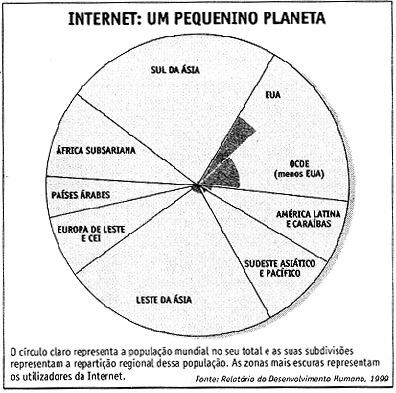
Another important attribute, is the difference on accessibility. While broadcasting IT from the period 1900-1970 was expensive and usually implied some large apparatus or organization, the cost of access to Internet is much lower, bringing within reach of individual citizens, and potentially, for the first time in the history of human kind, within reach of all human beings.
Of course, potential is not the same as reality. Again other factors determine the way access is achieved. Fig. 7.3.2.-1 shows the data from the Institute of Human development, representing percentage of population with Internet access, per area of the globe, proportional to the population of each area.
Fig. 7.3.2.-1
- Internet access world wide, 1999. source: IDHIf nothing else, the figure is a sober reminder of the challenge brought by the new IT potential, to overcome other access constraints that are not consequence of the intrinsic nature of the IT, but of social, political and economic nature. From that point of view, such constraints are as artificial as the constraints imposed at the time of Plato and Aristotle on some human beings over others, to impede them of using their voice.
