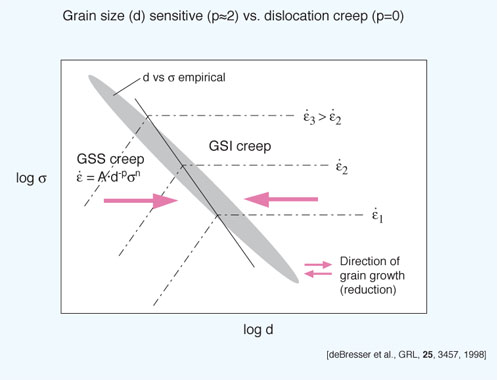
In the plastic flow of crystalline solids, there are numerous mechanisms available from the physics of deformation to affect change of shape. Two mechanisms are of particular importance to the deformation of Earth materials, one associated with the motion of dislocations that has a relatively high sensitivity to applied stress, the other associated with transport along grain boundaries that has a much lower sensitivity to stress. The former is not influenced by grain sizes in the body under stress, hence is labeled grain size-insensitive (GSI) creep; the latter is very much promoted by an increased density of grain boundaries, hence is called grain size-sensitive (GSS) creep. (Superplasticity in certain metals and ceramics is a form of GSS creep, so the application is not only geological.) The dramatically different stress sensitivity of flow GSI vs. GSS creep, and the dramatically different times scales of geological flow and laboratory simulation of that flow conspire against easy answers to geological questions in the lab. Over the past decade or so we have developed methods to make samples of very fine grain size, of order 1-10 microns, in a few kinds of geological materials (including ice), and are now able to produce measurable GSS deformation in the lab. This has led to the revelation that there may be in the geologic setting a dynamic balance between grain growth, grain size reduction, and GSS vs. GSI creep (deBresser et al. 2006). Ice I is a particularly friendly material on which to test these ideas in the lab, and there are settings from the ice shell on Europa to the ice caps of Earth and Mars where it will be very helpful to define that dynamic balance. This work is the goal of one of our NASA-funded projects. [link to Project Summary]