Water ice has a spectacular array of high-pressure polymorphic forms if it subjected to pressures
outside the stability field of its common ice I form. In particular, at about 200 MPa it becomes
ice II, a crystalline polymorph that is almost 20% denser than ice I. Ice II is surely an important mantle component
of the large icy moons of the outer solar system, and must play a key part in the convective dynamics of the
moons' interiors (they are very Earth-like in this respect). We stumbled upon a trick for creating extremely
fine-grained ice II polycrystalline samples in the lab, and we were able to go on and measure the exotic, but
highly relevant in the planetary setting, deformation mechanism called grain size-sensitive creep
(Kubo et al. 2006).
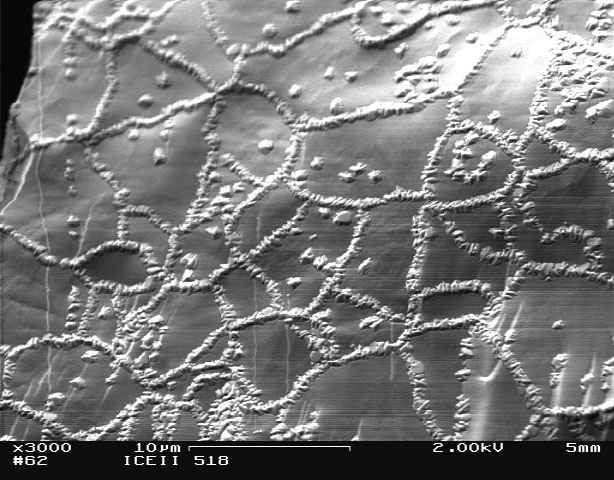
The above photomicrograph, taken with a scanning electron microscope equipped with a cryogenic sample chamber, shows an exposed interior surface of one of our fine-grained ice II samples following deformation. In order to make the grain boundaries visible, we allowed partial back transformation to ice I after the experiment. The ice I nucleated preferentially along ice II grain boundaries. Here we see ice II grain diameters of 5 - 10 μm.