STUDIO III
Mill Creek Miniature Golf Course - part I : Story,
Strategy, Site Design
LAYERS - LAYOUT
The idea for a project arises from a simple question: how to make the
mini-golf game more amusing and to avoid the player being bored.
Whenever one keeps performing his movement in a mechanical way, as putting
a ball into a series of holes, boredom can occur very easily. Thus, in order
to keep the player's mind busy, I thought of linking the game with a story,
or a folk tale, that he/she can transform or rewrite while playing. Therefore
each hole represents a different scenery and the tale can have a variety
of outcomes, according to the direction taken by the golf ball.
The ball's course traces the story.
The golfer drives the ball into a certain direction.
The golfer is to be identified with the golf ball.
I told the kids of Sulzberger Middle School a fairy tale that
served as an outline. Their task is that of continuing the narration using
their knowledge of Mill Creek, or their African-American stories, told by
grandparents and handed down from generation to generation.
The overall strategy of the game relies mainly upon layered geometric
figures.
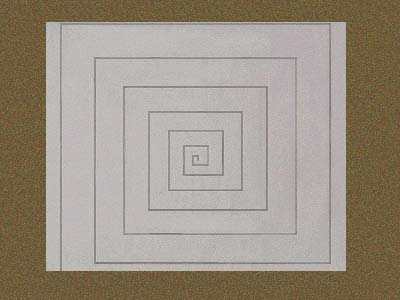 |
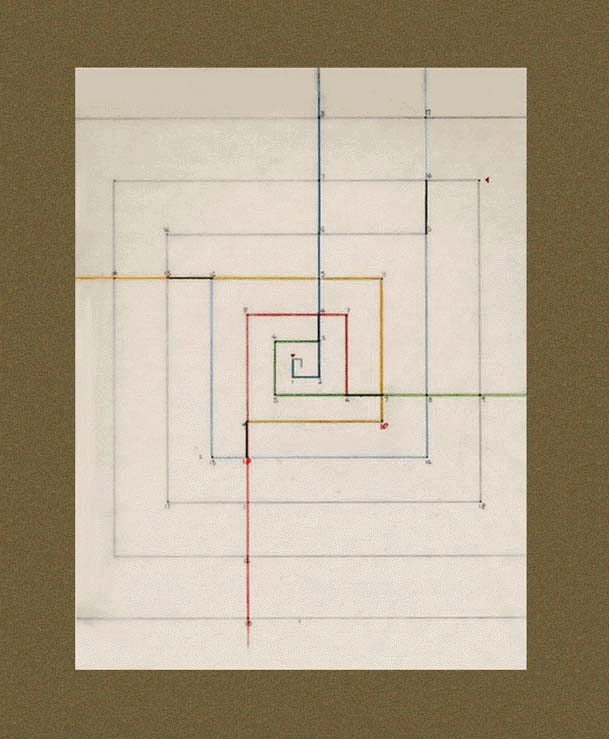
On the first layer is an increasing pitch square spiral, whose vertices
locate the main two nine-hole loops. |
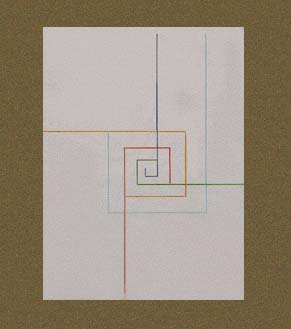 |
A four axis geometric figure, which lies on the second layer, pinwheels
around ambiguous centers.
The juxtaposition of the first two figures generates a few intersections
that allow the route to be changed. |
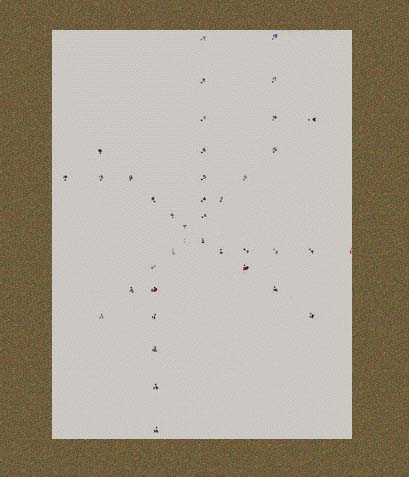 |
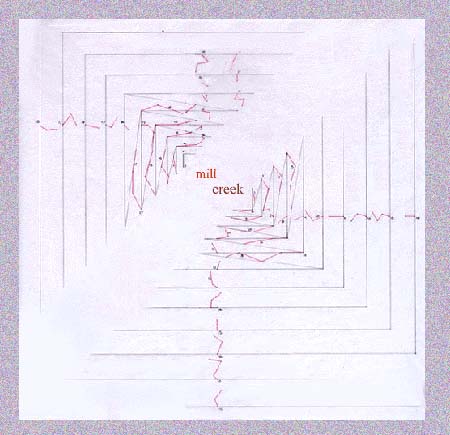
The third layer shows the layout of the holes as they would appear on
the miniature golf course.
If read without the first two layers underneath, it shows how the overall
geometric pattern, which shapes the strategy, will not be likely recognized
once it is superimposed on the land. |
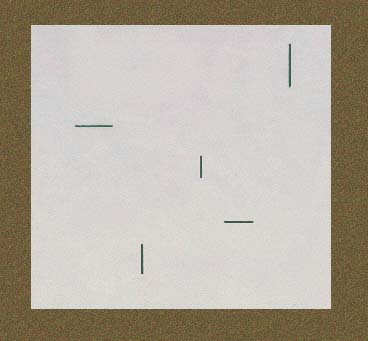 |
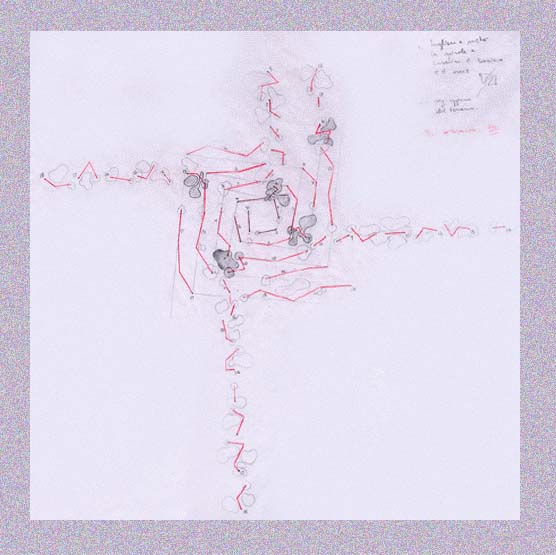
The forth layer is an abstraction which indicates some suitable locations
for hazards; these might be either mounds, reverse slopes, bunkers or water
hazards. |
 |
The layering process is also affected by a hierarchical abstraction that
increases from the first toward the last layer. The resulting game policy
allows the player to take a decision at certain strategic points.
For instance, the golfer who begins from the central tee and arrives to
the third hole, has the option of playing either the fourth blue hole or
the green one. The nearer the hole, the greater ability it will require
to the golfer.
Placing some hazards on the short routes helps to keep the course balanced.
Thus the golfer who approaches the longest forth hole is rewarded by the
safety of the shot. Basically, the same rule can be applied to the sixth
, ninth and twelfth holes.
It is to be noticed that, because of the geometrical features of the shapes
involved in the design, the player will be given the opportunity to change
the game direction every time he reaches a n-digit hole which is multiple
of three. In this way it will be easy for him to remember when he will be
able to change the plot of the folk tale.
Finally, the numerous crossings between different routes make the course
lively and suggest a variety of architectural solutions to be applied to
several places and at different scales. To avoid confusion during the game,
a different color of the marker could characterize each route.
The geometric structure which is superimposed over the site, is also to
dictate the metamorphosis of the ground. The grading process is to be studied
according to the trajectory of each single shot.
Most of all the memory of the water, which flows underground is the source
that ties the design to the place.
To strengthen this point of view, the spiral is divided into two parts.
They are split up to receive a detention and a retention basin. The latter
is a narrow scar through the ground which resembles the creek.
Some ponds are located along the first five points (3-6-9-12-15) where the
player is allowed to change the route of the game, however the central basin
is dried most of the times and will retain just the excessive water runoff.
The continuous transforming of the landscape, according to the rainfall,
will make Mill Creek alive, as if it were living and breathing underground!!!
 |
 |
The geometric structure which is superimposed over the site, is also
to dictate the metamorphosis of the ground. The grading process is to be
studied according to the trajectory of each single shot.
Most of all the memory of the water, which flows underground is the source
that ties the design to the place.
To strengthen this point of view, the spiral is divided into two parts.
They are split up to receive a detention and a retention basin. The latter
is a narrow scar through the ground which resembles the creek.
Some ponds are located along the first five points (3-6-9-12-15) where the
player is allowed to change the route of the game, however the central basin
is dried most of the times and will retain just the excessive water runoff.
The continuous transforming of the landscape, according to the rainfall,
will make Mill Creek alive, as if it were living and breathing underground!!!
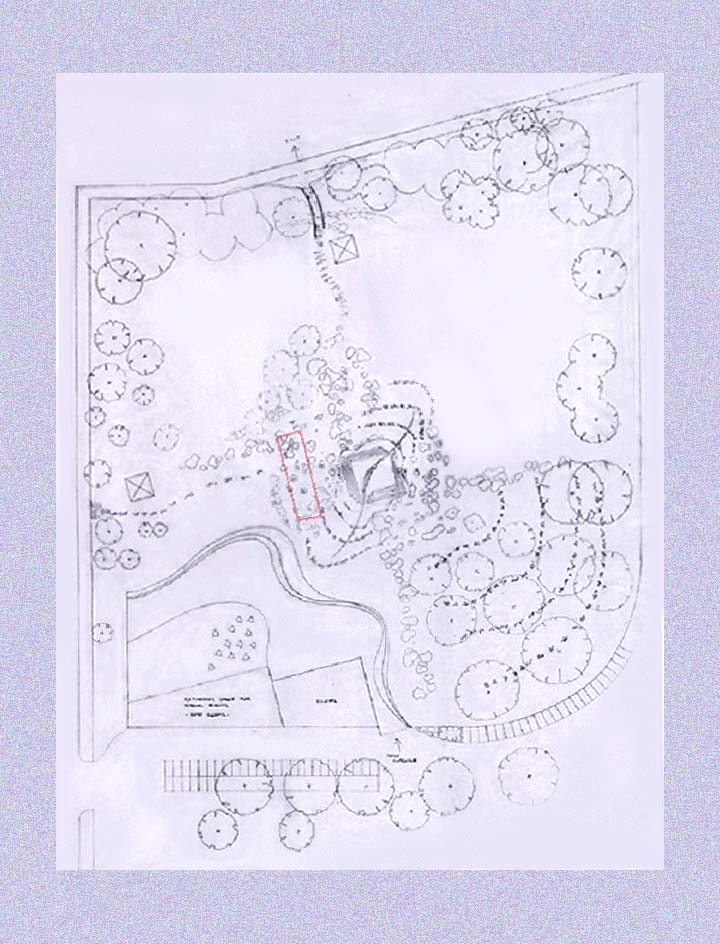 |
The three main axes which depart from the spiral,
are meant to locate and control some architectural episodes. One such aspect
are the concessions stands, just before the way out, along the north and
north-eastern sides of the lot. The main entrance, along the south side,
is flanked by an enfilade of shops and a restaurant, with an open space
devoted to receive birthday parties and special events.
Click on the red rectangle to see the 13th hole in detail. |