REVEALING
URBAN WATERS
INTRODUCTION
Many streams once flowed across West Philadelphia.
The largest of these is Mill Creek, a stream that drains nearly two-thirds
of West Philadelphia. Its headwaters are outside the city in Lower Merion,
and it flows into the Schuylkill River south of Woodland Avenue near 43rd
Street. The Mill Creek cut a deep valley across parts of West Philadelphia
and meandered and pooled in other areas. The large, grassy bowl in Clark
Park was once a mill pond. In the late 1800s, Mill Creek was buried in city
sewers. Its streambed was filled in and roads and houses were built on top,
but it still flows beneath city streets. The steep valley is clearly visible
in places like 47th to 48th Streets between Fairmount and Aspen and along
43rd Street from Walnut to Spruce Streets. Mill Creek now carries the rain
that falls on much of West Philadelphia as well as sewage from thousands
of private homes and businesses. Yet to most people the Mill Creek is invisible.
Though Mill Creek is buried in a sewer, it continues to shape landscape
and life. How can the buried river be revealed and rainwater celebrated
so people feel and know the importance of these urban waters?
PANTA
REI
"Panta Rei", that is "everything flows",
is the phrase which synthesize the belief of Eraclitus from Efeso, a greek
philosopher (lived in the first century b. C.) who has metaphorically identified
water with life. According to his thought, a flowing river shapes the continuous
becoming and transforming of life. As an emblem of birth and growth, water
is among the four substances, the one which deserves to be celebrated the
most. Moreover celebration implies man's participation, which must be recognizable
on the basis of a design. At this point I am going to think about a more
specific and realistic matter concerning Mill Creek: the buried river. Three
are the hypothesis which spring to mind.
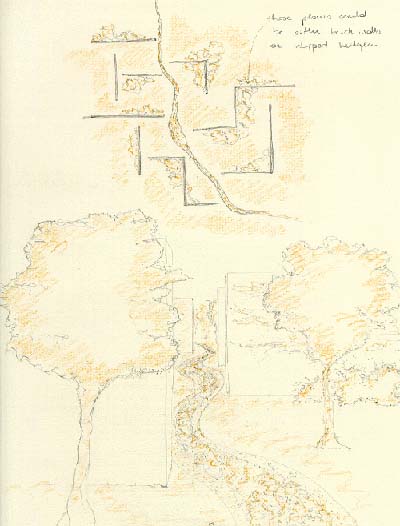 |
First of all leaving the stream where it is, underground,
and improving the system of drains; in this case just the absence of water
would be celebrated and the valley could be covered with a series of gardens
in which geometry emphasize the importance of man thought. In order to reach
the main purpose, the memory of water should be felt in each of these gardens:
there would be cascades of flowers, green pools and pebbles disposed as
they were a liquid surface. I proceed with a series of abstractions concerning
Philadelphia's urban design, whose development has ignored the presence
of the rivers. |
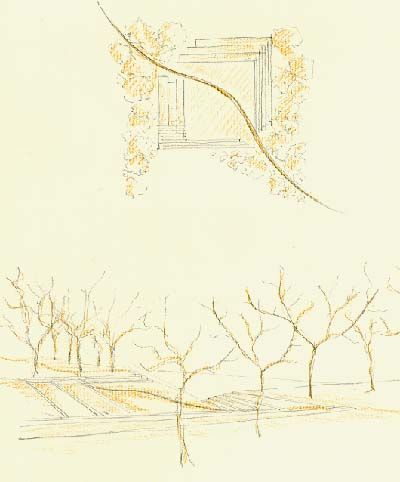
According to the second hypothesis the stream could be
separated from the sewers and brought up to the surface. In this way water
becomes a tangible and bursting presence. The idea would be that of a fluvial
park: thick vegetation flanking the river.
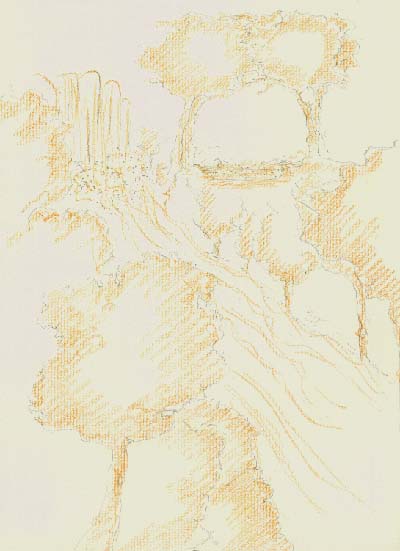
The third suggestion could be a synthesis of the first
two. Mill Creek could flow either on the surface or underneath it. Underground
water would be characterized by its constant speed , while on the surface
it would rest and fill some kinds of pond in strategic plots. In this case
there would be two different moments interpreted by two different "architectures".
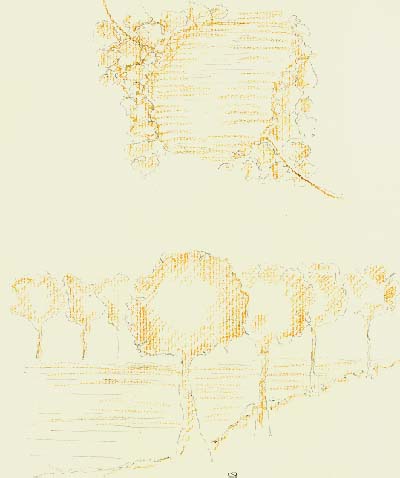
I will suppose that water flows on an artificial streambed clearly designed
by men: when it is dried , it resembles a mineral landscape where order
dominates; when it rains, and the sewer will not support the rate of flow,
water expands into designed beds so turning the environment into an informal
and organic landscape. In this way, the landscape would be characterized
by a changeable quality and it would never be monotonous: therefore celebration
of water and life would take place. |
 |
 |
 |