About WPLP
About West Philadelphia
Accomplishments
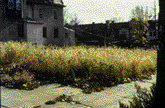

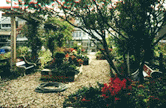

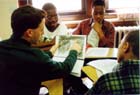
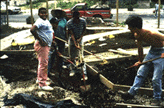
The West Philadelphia Landscape Project is an action research program integrating research, teaching, and community service. Faculty and students in Penn's Department of Landscape Architecture and Regional Planning work with community organizations, neighborhood groups, teachers and students in public schools on a wide range of activities. Design and construction of community landscape projects, maintenance of a digital database, devising stormwater management strategies, and curriculum enrichment for an inner-city junior high school are examples of recent projects.
The WPLP has been featured in newspaper articles, national public radio programs, national and international conferences, and professional journals. The goals of the project include development of strategic landscape plans to enhance environmental quality, implementation of landscape improvements to stimulate community development, and mutual strengthening of secondary public school curriculum and undergraduate and professional education at Penn.
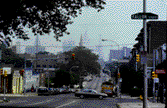
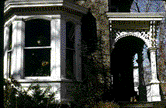
West Philadelphia has a dynamic natural and social history; its landscape has evolved over several hundred years from wooded hills and valleys, to farms and estates, to residential suburb for working- and middle-class families, to inner-city neighborhood. In its broad outlines, the story of West Philadelphia is also the story of many other urban neighborhoods across the country, part of a larger picture of city, region, and nation.
West Philadelphia is primarily a residential community, but is also home to several large institutions, including the University of Pennsylvania. West Philadelphia's population is multi-racial and multi-cultural; there are many middle-class families and many others living in poverty. The population is mostly African- American, with a large Caucasian population living near the University, and a growing Asian-American population.
The West Philadelphia Landscape Project continues work begun in 1987, when Penn's Department of Landscape Architecture and Regional Planning, Philadelphia Green, the Organization and Management Group, and the West Philadelphia Partnership received a grant from the J. N. Pew Charitable Trust to work together on the West Philadelphia Landscape Plan and Greening Project. Since 1991, when funding for the collaborative project ceased, faculty and students have continued to build upon that earlier work.
Community development:
Learning through doing:
Advancement of knowledge:
WPLP Accomplishments
West Philadelphia Landscape Plan: A Framework for Action Work since 1991 has built upon this foundation.
Plan: A Framework for Action
The West Philadelphia Landscape Plan was part of a four-year, collaborative community development and research project (1987-1991) conducted by Penn's Department of Landscape Architecture and Regional Planning, Philadelphia Green, the Organization and Management Group, and the West Philadelphia Partnership, and funded by the J.N. Pew Charitable Trust. Dozens of projects, five reports, and a digital database were all produced as part of this project:
Models of Success: Landscape Improvements and Community Development
"This Garden is a Town"
Shaping the Block: Redesigning Small Urban Neighborhoods
Vacant Land: A Resource for Reshaping Urban Neighborhoods
West Philadelphia Digital Database
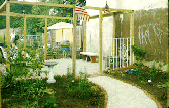
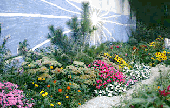
West Philadelphia Digital Database
The West Philadelphia Digital Database integrates text, statistics, maps, photographs, and drawings at multiple scales. The "nested" structure of the database makes it possible to get an overview of West Philadelphia as a whole, then zoom in, accessing progressively more detailed information, ultimately down to the scale of a single block or a single property. The database runs on a personal computer and was designed for use by government agencies and grassroots organizations, for both "top-down" and "bottom-up" planning. It makes information and analytical tools once available only to government agencies and large institutions accessible to individuals and small groups. This is a revolutionary development that has enormous potential as a model for other places; once a digital database is set up, it can be shared by many different users.
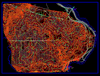
Mill Creek Watershed Study
Environmental/Community-Based Curriculum for Inner-City Schools
Projects
Since the completion of the West Philadelphia Landscape Plan and Greening Project in 1991, work has continued on the digital database, and several new projects have been launched:
Courses
The University of Pennsylvania is a leader in service-oriented academic programs that integrate teaching, practice, and research. These programs aim to educate Penn students to understand, solve, investigate, and reflect upon difficult real-world problems faced by individuals and communities surrounding the University. The courses described are part of that larger mission, which is coordinated by Penn's Center for Community Partnerships. The courses listed below are taught by Professor Anne Whiston Spirn; each draws from the resources of the project. Transforming the Urban Landscape, a graduate studio course in landscape architecture, and Power of Place, an introductory course in urban environmental design, engage Penn students with teachers and students at Sulzberger Middle School.
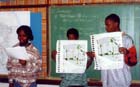
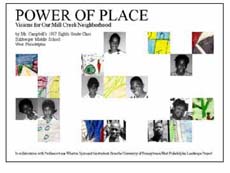
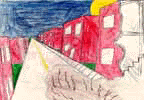
Since 1995, Penn faculty and students have been working with teachers and students at Sulzberger Middle School. The Penn-Sulzberger partnership began with several special science projects in 1995-1996. In 1996-1997, Professor Spirn and Penn students worked with teachers and students in sixth, seventh, and eighth grade classrooms to explore how a new curriculum organized around "The Urban Watershed" could combine learning, community development, and water resource management. The school year culminated with a publication of eighth-grade students' visions for the neighborhood and their presentation to a conference at the University of Pennsylvania.
In September 1997, Sulzberger launched a pilot program in two eighth-grade classes where a new curriculum focused on the theme of regional watershed and local community is integrated into all classes--science, math, social studies, computing, language, and art--in order to study problems and identify solutions to actual problems of sustainable development in the community and to bring these problems and potential solutions to public attention.
Beginning in Fall 1998, the school expanded the new curriculum to an Environment Small Learning Community composed of approximately ten teachers and 240 students.
Sulzberger Middle School
Sulzberger Middle School is in the Mill Creek neighborhood, in the heart of the West Philadelphia Empowerment Zone. The school is next to the old "floodplain" of the Mill Creek, now buried in a sewer. Many vacant lands and community gardens near the school are located on or around the sewer and afford ample opportunity for studying the processes of nature and politics at work.