D15. Two Indentical Spheres Charged by Induction
ELECTROSTATICS - Electrostatic Induction
The electrophorus disk is charged. Two small conducting spheres on insulating rods are held touching each other and brought close to the disk. Equal and opposite charge is induced in the two small spheres. When separated, they keep their induced charge. This can be demonstrated with an electroscope. This demonstration can also be done with two 4" balls on insulated stands and an amber rod.
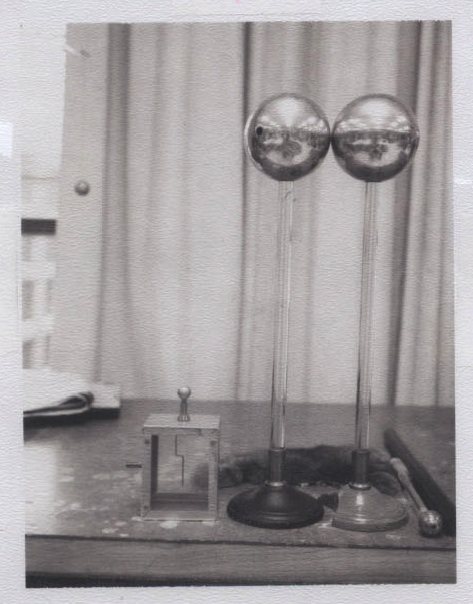
Materials:
- Two spheres on plexi rods
- Rubber rod for charging cat's fur
- Small conducting ball or charge scoop for transfer of charge to electroscope
- Leaf electroscope with projector
Electrostatic Induction
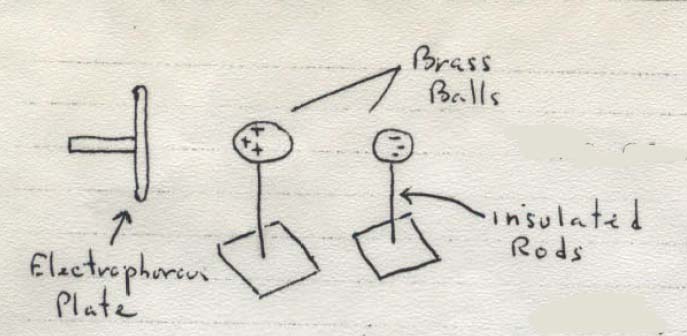
This can be demonstrated by placing the electrophorus plate near the two brass balls that are touching each other. Then move one of the balls away from the other. Then, using an electroscope or a capacitor with the electrometer arrangement* for projection, one can show the polarity of charge on the two brass balls and the equal but opposite amount on each.

ALTERNATIVE/AUXILIARY VERSION: First demonstrate the projected electroscope (rubber rod; induction). Then charge the open (hollow) metal sphere on an insulated stool on the table. Charge the sphere with the electrophorus. Hold two small metal spheres (on insulating sticks) close to the charged larger hollow sphere (while the small spheres touch each other). Now, separate the small spheres charging each one with the same but opposite charge. Next, touch the electroscope with one, then with the other; the second touch should cancel the first. Repeat the same experiment but making contact with the surface inside the sphere. The two small spheres are uncharged. (See D26)
Electrostatic Induction, Version 3
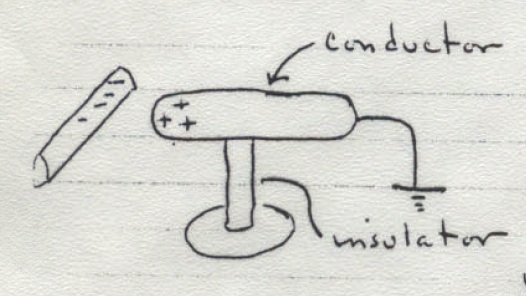
A negatively charged rod is held near the conductor while you provide a path to ground with your finger to the other end. If you remove the path to ground first, then the charged rod, you find that the conductor has become positively charged. In charging by induction the sign of the charge is opposite to tht of the inducing charge. The test plane can be used to take off an amount of charge and the electrometer with a capacitor can show the polarity of the charge.
Location: Room 4-309B, A2