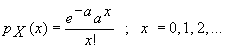
| In some situations we can imagine an experiment or natural process
that generates a very large number of Bernoulli trials, giving a binomial
random variable X with a very large n but a constant mean
a=np. It can be shown with series expansions that the probability
mass function of the resulting random variable is (in the limit as n
approaches infinity):
A random variable X with this PMF is called a Poisson random variable. The mean and variance of a Poisson random variable (or of its probability distribution) are given by:
Note that X is discrete but can take on any nonegative integer value. The distributional parameter a must be positive but need not be an integer. Poisson random variables are frequently used to define random events in time or along a one-dimensional spatial transect. In this case, X is the number of occurences of some event (e.g. a rain storm) during a time interval t and a = rt, where r is the expected event rate (number of events per unit time). A string of events with Poisson distributed occurrences is called a Poisson process. The MATLAB function prain (download here)
provided below uses a combination of Poisson and exponentially distributed
(see Class 14) random variables to simulate a series of rainfall events.
In the program, intvl is a Poisson (discrete) random variable
which gives the integer number of days between two successive storm starting
times and raindays is an array composed of all storm starting
times, measured in total days elapsed since the start of the simulation.
raindays
is constructed by summing the Poisson distributed intervals. Each
storm is assumed to last one day. The storm magnitude (in mm/day)
is assumed to behave an exponentially distributed (continuous) random variable.
Here is a typical series obtained for an average event rate (Poisson parameter r) of 2/day (0.5 days). This is sufficiently high to give a relatively large number of multi-day storms. As r becomes smaller the storms are generally more widely spaced and only one day long. The mean storm magnitude (exponential parameter a) is 10 mm/day.
The rainfall generator provided here shows how discrete and continuous random variables can be combined to provide a physically realistic (or at least plausible) description of a relatively complex physical process. |