Answer to Problem 3.3
a. While both clouds are fully visible (C >10 g/L), which cloud appears larger, and by how much ?
Hint 1: Make sketch that defines the diameter of each cloud
Since the size of the cloud increases in proportion to the diffusion coefficient, the blue cloud will grow more rapidly, and thus appear bigger, than the red cloud. Specifically, the length scale of each cloud, as defined in chapter 3, equation 26, is
 .
.
The ratio of dye cloud diameters
is then,  .
.
b. At what time and at what location will the two dye clouds first appear to touch?
Hint 2: Simplify governing equation with assumptions.
Begin with the full transport equation that governs the evolution of both dye drops.
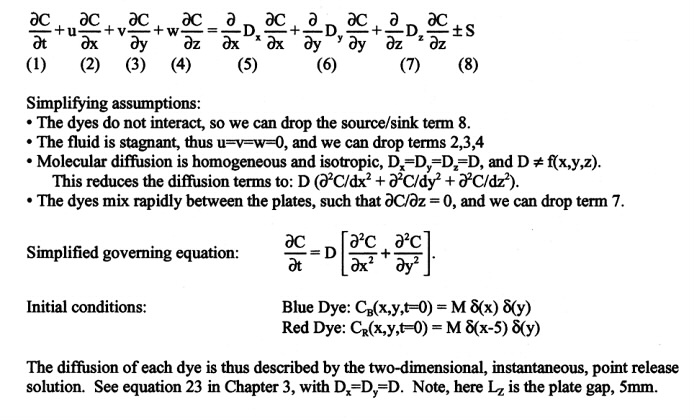


Note that the exponential is written to be one at the center of the red cloud, i.e. at (x=10,y=0), with the position given in units of centimeters.
Hint 3: Write mathematical criterion for condition when clouds first touch

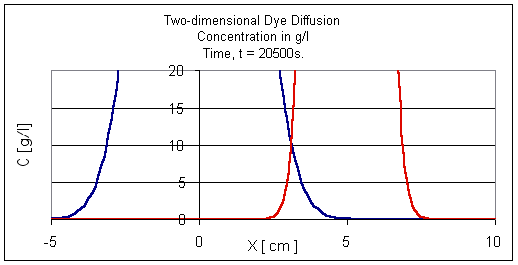
Solution: - At t = 20500s, the intersection of the blue and red concentration curves corresponds to C = 10 g/l and is located at x = 3.1 cm. The clouds will first appear to touch and x = 3.1 cm.
Make a rough estimate of the location using your result from part a.
Based on the definition used in a. and the definition sketch shown above, the two clouds first appear to touch when, (LB/2)+(LR/2) = 5. Additionally, LR = (LB/2), so the edge of the blue cloud will be at x = (LB/2) = 5/1.5=3.3cm, when it first touches the red cloud.
c. At what time will the line connecting the release points be completely purple?
Hint 4: - Define a mathematical criterion for this to occur
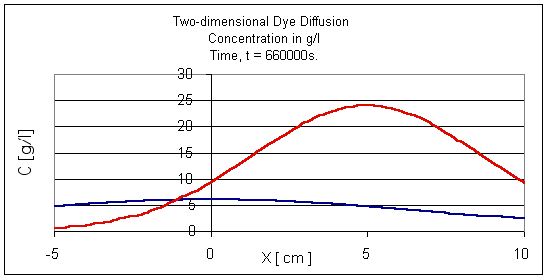
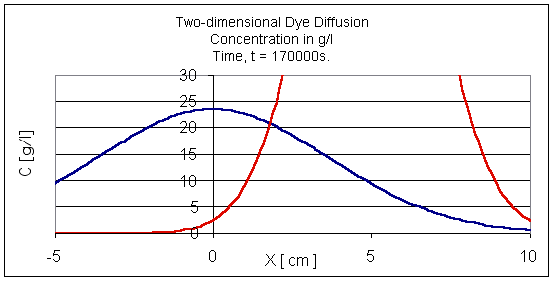
This condition requires that CB and CR > 10 g/l in the region x = 0 to 10 cm. Use the spreadsheet created in part b to interrogate the concentration field over a range of time.
Solution - Graph CB and CR in an interactive graphing package, such as Excel and vary time until the above criteria is met. You will find that the criteria is never met. Between 0<x<5 cm, when CR /= 10g/l then CB < 10 g/l, and when CB /= 10g/l, CR < 10 g/l.