Summary Notes on Muscle Motor Units
Size Principle [McMahon, 1984 and before him Henneman]
Large motor units require the greatest amplitude of stimulus to become active. The smallest and most excitable neurons are turned on at a low level of stimulus strength, with the consequence that the muscle force may be finely tuned at low levels through small adjustments in the number of muscle fibers active. The larger motor units come in only at high levels of force.
Dark Meat or White? Muscle Fiber Type Comparisons
Comparisons White "fast" Motor Units Red "slow" Motor Units Blood supply (function) <
Density of mitochondria (function) <
Resistance to fatigue (function) <
Muscle cells per motor unit <
Time required for peak tension <
Storage of glycogen >
Neuron axon diameter (size) >
Lower motor neuron diameter (size) >
Neuron discharge frequency (size) >
Neuron conduction velocity >
Excitation sensitivity (size principle) >
Tension required for reflex recruitment >
Muscle Performance Facts [McMahon, 1984]
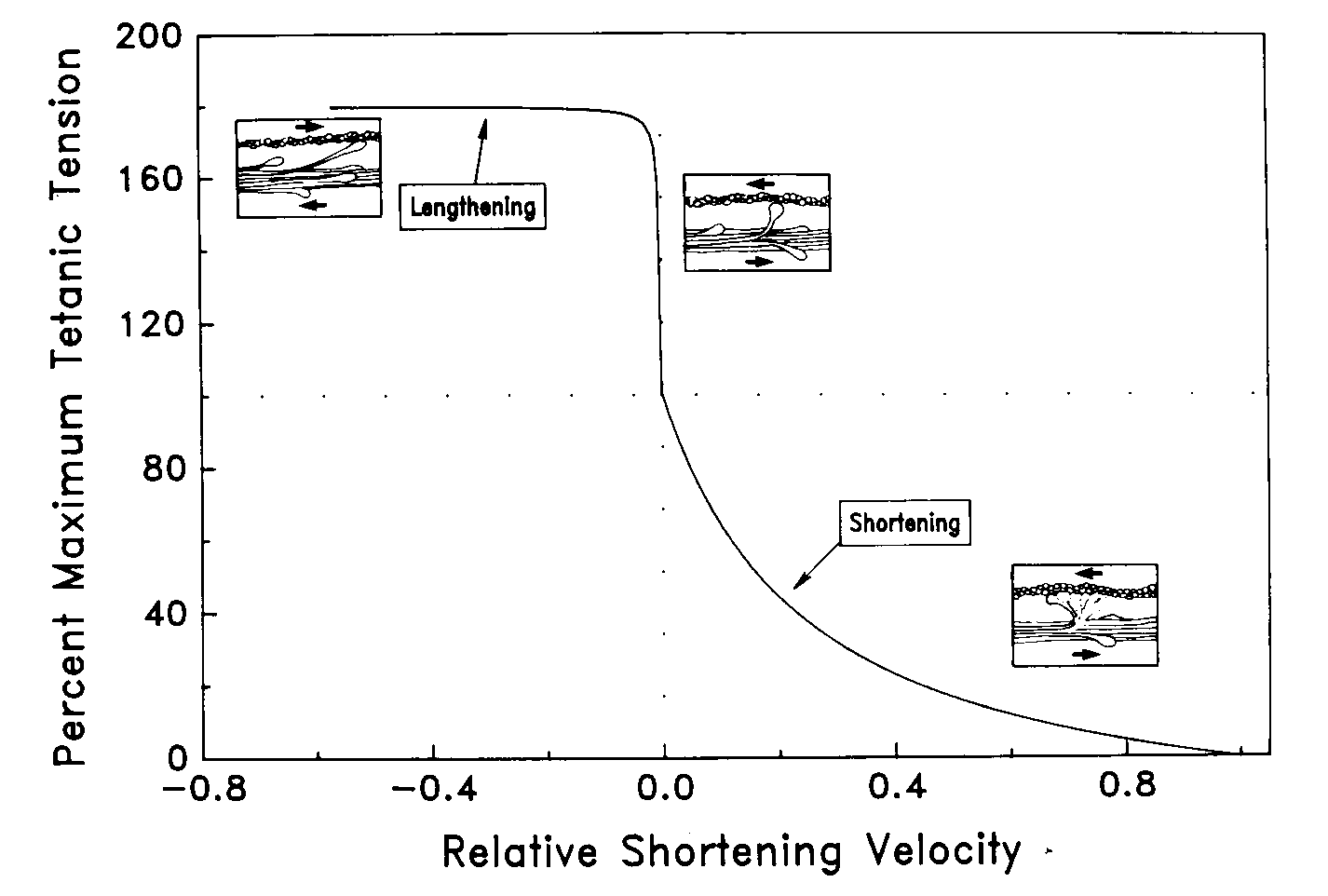
1. In shortening, the relationship between the Force and Velocity is (Hill's Curve - know this!!):
(T+a)(v+b) = (To+a)b Hyperbolic Form
2. There is a discontinuity in the slope of F-V curve at zero velocity.
3. Active muscle yields when the load exceeds about 1.8 To (To - Tetanus tension).
4. Hill's observations of the Fenn effect give a linear relation between total rate of energy liberation and tension.
Fenn = muscle produces a certain extra heat when it shortens a given distance, whether shortening velocity is fast or slow.
5. Muscle shortening should be based on the relative motion of sliding filaments because:
6. Muscular energy liberation should be based on the splitting of a high-energy phosphate as actomyosin attachments separate.
Muscle Graphics (still needs development, any takers?)
Image, In action, Detail, In action, X-ray image, Muscle movie
Muscle Tension-Length properties
Hill's Force-Velocity relationship