Today, we talked about noncausal systems, and the resulting Laplace
transforms. The neat thing we found was that two different signals
can have different Laplace transforms, if the transforms have
different regions of convergence.
(14 cards) 
-
How does the determination of causality work with the
relativity of time? (1 student)
I assume that you are referring to the fact that in either
special or general relativity, simultaneity of events at different
points in space is not well defined. That's not really an issue for
us, because (a) we don't deal with relativistic effects much in
aerospace; (b) even if we did, if the system is localized in space, we
can still define a causal system, since simultaneity is well
defined for an input and output signal that occur at the same point in
space; and (c) even if our system is distributed over space, so that
simultaneity is not well defined, causality around any loop (such as a
control loop) is still well defined.
-
Does Laplace work with logarithmic functions? (1)
I'm not sure exactly what you mean. Can you ask at office
hours?
-
So of we wanted to get a really good estimate we run
u(t) plus noise through a ``smoothing filter''
g(t) and subtract
the result from
u(t) plus noise? (1)
No. The good estimate of
u(t) comes from running
u(t) plus
noise through the smoothing filter. The output signal is the
estimate -- no need to subtract it from anything.
-
You drew the region of convergence on the complex
plane, but so far it has only been defined by the real part. Are
there any regions of convergence that are limited by the imaginary
part, say,
-1 < Im[s] < 1? (1)
No. The region of convergence is always a vertical strip, of
the form
 < Re[s] < < Re[s] <  |
|
This result is because the size of the Laplace transform integrand
depends only on the real part of
s.
-
If a system does not converge, how can it be solved?
(1)
In the context of the lecture, you question would be more
precisely posed as, ``If a system has an impulse response
g(t)
which does not have a Laplace transform, how can we find the output
y(t) for a given input
u(t)?'' The answer is that we can find
y(t), say, by using the convolution integral. We just can't use
Laplace transform techniques.
(Even my last statement is too strong. Sometimes we can use LT
techniques, by using superposition arguments, and breaking up
g(t)
into pieces that do have LTs.)
-
How do you use the region of convergence to do the
inverse Laplace transform. How does the range of
s relate to
t?
(1)
We know (because we did the LT integral) that
We know (because we did the LT integral) that
Therefore, to take the inverse LT of, say,
G(s) =  , Re[s] < 3 , Re[s] < 3 |
|
we just ``pattern match,'' and conclude that
g(t) = - 5e3t (- t) (- t) |
|
-
Why does
(1)
Just do the integral:
IF
Re[s] < a, since otherwise the integral blows up.
-
Could you repeat [here there is a drawing] from the end
of the lecture? (1)
Not sure I know which problem you are talking about. Please
see me at office hours.
-
You said that these two are equal:
u(t) = et (- t) (- t)  U(s) = U(s) =  , Re[s] < 1 , Re[s] < 1 |
|
and
 (t) = et (t) = et (t) (t)   (s) = (s) =  , Re[s] > 1 , Re[s] > 1 |
|
How can they be equal when the plots of the two signals [
u(t) and
 (t)] are different? (1)
That's the point! Two different functions can have the same
LT, but only if they have different regions of convergence. That's
why the r.o.c. is so important.
(t)] are different? (1)
That's the point! Two different functions can have the same
LT, but only if they have different regions of convergence. That's
why the r.o.c. is so important.
-
When we're talking about doing something, like applying
a smoother to a signal in non-real time, does time in this sense
represent just the variable that we do the integral with respect to,
or is it something more physical? (1)
In the convolution integral,
the time index
 refers to a real, physical time -- the time at
which the input
u occurred. The time index
t refers to a real,
physical time -- the time at which you want the best estimate of
u(t). So the time indices are not just mathematical fictions.
refers to a real, physical time -- the time at
which the input
u occurred. The time index
t refers to a real,
physical time -- the time at which you want the best estimate of
u(t). So the time indices are not just mathematical fictions.
-
No mud. (4)
To be fair, one person said that they don't understand enough
to have mud. Not good.
Steven R. Hall
2004-05-16
 [eat
[eat (t)] =
  , Re[s] > a
 [eat
[eat (- t)] =
  , Re[s] < a
 [eat
[eat (- t)] =
  , Re[s] < a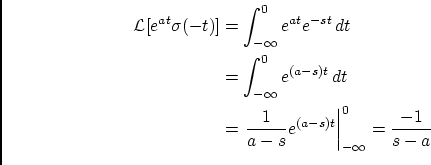
 g(t -
g(t -  )u(
)u( ) d
) d