| (a) | Show that the divergence of each is zero. |
| (b) | Devise three vector functions that have a finite
divergence and evaluate their divergences.
|


 r, r
r, r , z)
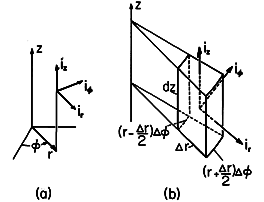
is as shown in Fig.~P2.1.4b. Determine the divergence operator by
evaluating (2), using steps analogous to those leading from (3)
to (5). Show that the result is as given in Table I at the end of
the text. (Hint: In carrying out the integrations over the surface
elements in Fig.~P2.1.4b having normals
, z)
is as shown in Fig.~P2.1.4b. Determine the divergence operator by
evaluating (2), using steps analogous to those leading from (3)
to (5). Show that the result is as given in Table I at the end of
the text. (Hint: In carrying out the integrations over the surface
elements in Fig.~P2.1.4b having normals  ir, note that not
only is Ar evaluated at r = r
ir, note that not
only is Ar evaluated at r = r  r, but so also is
r. For this
reason, it is most convenient to group Ar and r together in
manipulating the contributions from this surface.)
r, but so also is
r. For this
reason, it is most convenient to group Ar and r together in
manipulating the contributions from this surface.)


 r, r\Delta
 , r sin \Delta. Using
steps analogous to those
leading from (3) to (5), determine the divergence operator by evaluating
(2.1.2). Show that the result is as given in Table I at the end of
the text.
, r sin \Delta. Using
steps analogous to those
leading from (3) to (5), determine the divergence operator by evaluating
(2.1.2). Show that the result is as given in Table I at the end of
the text.
d, y = d, and z = d.
respectively da = ix dydz, iy dxdz, and
iz dydx.
| (a) | Show that the area elements on these surfaces are |
| (b) | Show that evaluation of the left-hand side of (4) gives
 |
| (c) | Evaluate the divergence of A and the right-hand
side of (4) and show that it gives the same result.
|
| (a) | Use Gauss' differential |
| (b) | Obtain the same result by
evaluating Gauss' law using E as given by (1.3.13) and the
divergence operator from Table I in cylindrical coordinates.
|
 as given respectively
by (b) and (a) of Prob. 1.3.3 are consistent with Gauss'
differential law.
as given respectively
by (b) and (a) of Prob. 1.3.3 are consistent with Gauss'
differential law.
 f to be independent of S, (2) must
hold. Return to Prob. 1.6.6 and check to see that this condition was
indeed satisfied by the magnetic flux density.
f to be independent of S, (2) must
hold. Return to Prob. 1.6.6 and check to see that this condition was
indeed satisfied by the magnetic flux density.
are found for a one-dimensional
configuration using the integral charge conservation law. Show that
the differential form of this law is satisfied at each position
-  s < z < 1\over 2 s.
as found in Prob. 1.5.1, show that the
differential form of charge conservation, (3), is satisfied.
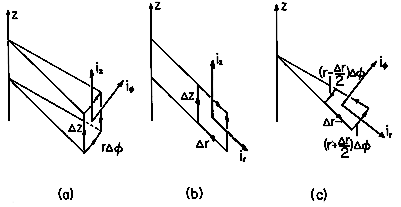 and z directions, respectively, as
shown in Fig.~P2.4.3. Determine the r, , and z components
of the curl operator. Show that the result is as given in Table I at
the end of the text. (Hint: In integrating in the
directions on the outer and inner incremental contours of
Fig.~P2.4.3c, note that not only is A evaluated at r = r
and z directions, respectively, as
shown in Fig.~P2.4.3. Determine the r, , and z components
of the curl operator. Show that the result is as given in Table I at
the end of the text. (Hint: In integrating in the
directions on the outer and inner incremental contours of
Fig.~P2.4.3c, note that not only is A evaluated at r = r
 r, respectively, but so also is r. It is
therefore convenient to treat A r as a single function.)
, and directions, respectively, as described in
Appendix 1. Determine the r, , and components of the
curl operator and compare to the result given in Table I at the end of
the text.
r, respectively, but so also is r. It is
therefore convenient to treat A r as a single function.)
, and directions, respectively, as described in
Appendix 1. Determine the r, , and components of the
curl operator and compare to the result given in Table I at the end of
the text.

arbitrary but closed surface S (one having no edge, so C = 0) and then Gauss' theorem to argue the identity.
| (a) | Apply Stokes' theorem to an |
| (b) | Write out the the divergence of the curl in Cartesian
coordinates and show that it is indeed identically zero.
|
, y = h, x = g, and y = 0. The direction of the
contour is such that da = iz dxdy.
)2 - g2]d2.
(a) Show that the left-hand side of (4) is h Ao [(g +
(b) Verify (4) by obtaining the same
result integrating curl A over the area enclosed by C.

 o E / t = 0, show that Ampère's differential
law is satisfied at each point r < a.
o E / t = 0, show that Ampère's differential
law is satisfied at each point r < a.
o E / t = 0.
 o = 0.
| (a) | Sketch the distributions of charge density and
|
| (b) | Verify that E is irrotational. |
| (c) | From observation of the field sketch, why would you suspect that E is indeed irrotational? |
| (a) | For Prob. 1.4.1. |
| (b) | For Prob. 1.4.4.
|
| (c) | Verify that in each case, H is solenoidal. |
| (d) | From observation of these field sketches, why would you suspect that H is indeed solenoidal? |
| (a) | Which of these is irrotational? |
| (b) | Which are solenoidal? |
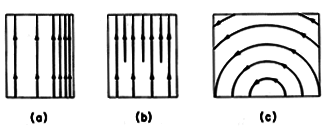 s in the surface y = 0.
Assume that E1 = E2 = o /o > 0 and adhere to the
convention that the field intensity is represented by the spacing of
the field lines.
s in the surface y = 0.
Assume that E1 = E2 = o /o > 0 and adhere to the
convention that the field intensity is represented by the spacing of
the field lines.
s on the surface. Is s positive or
negative?
| (a) | If the field lines represent E, there is a surface |
| (b) | If the field lines represent H, there is a surface current density K = Kz iz on the surface. Is Kz positive or negative? |