

In answering the questions below, please consider the unit sample response and frequency response of two filters, H1 and H2, plotted below.
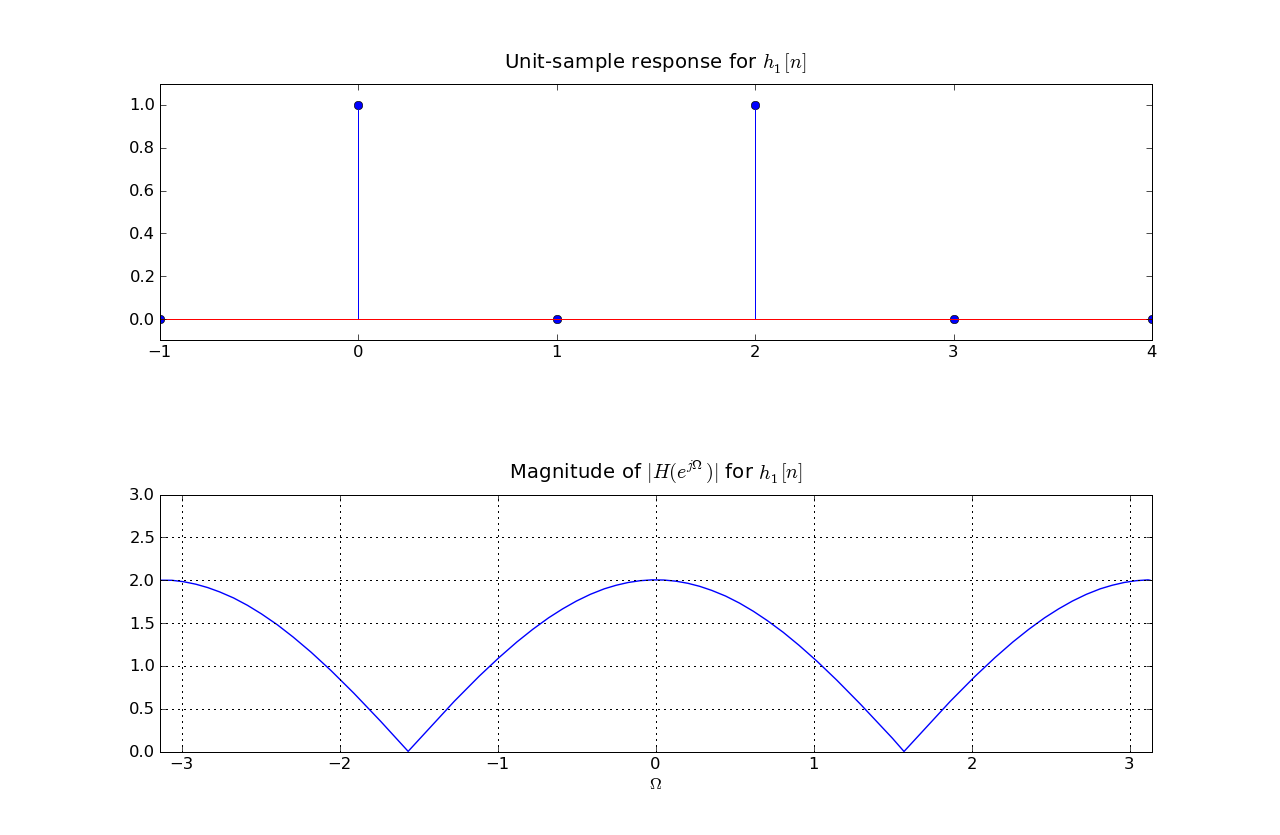
Note: the only nonzero values of unit sample response for H1 are : h1[0] = 1, h1[1]=0, h1[2]=1.
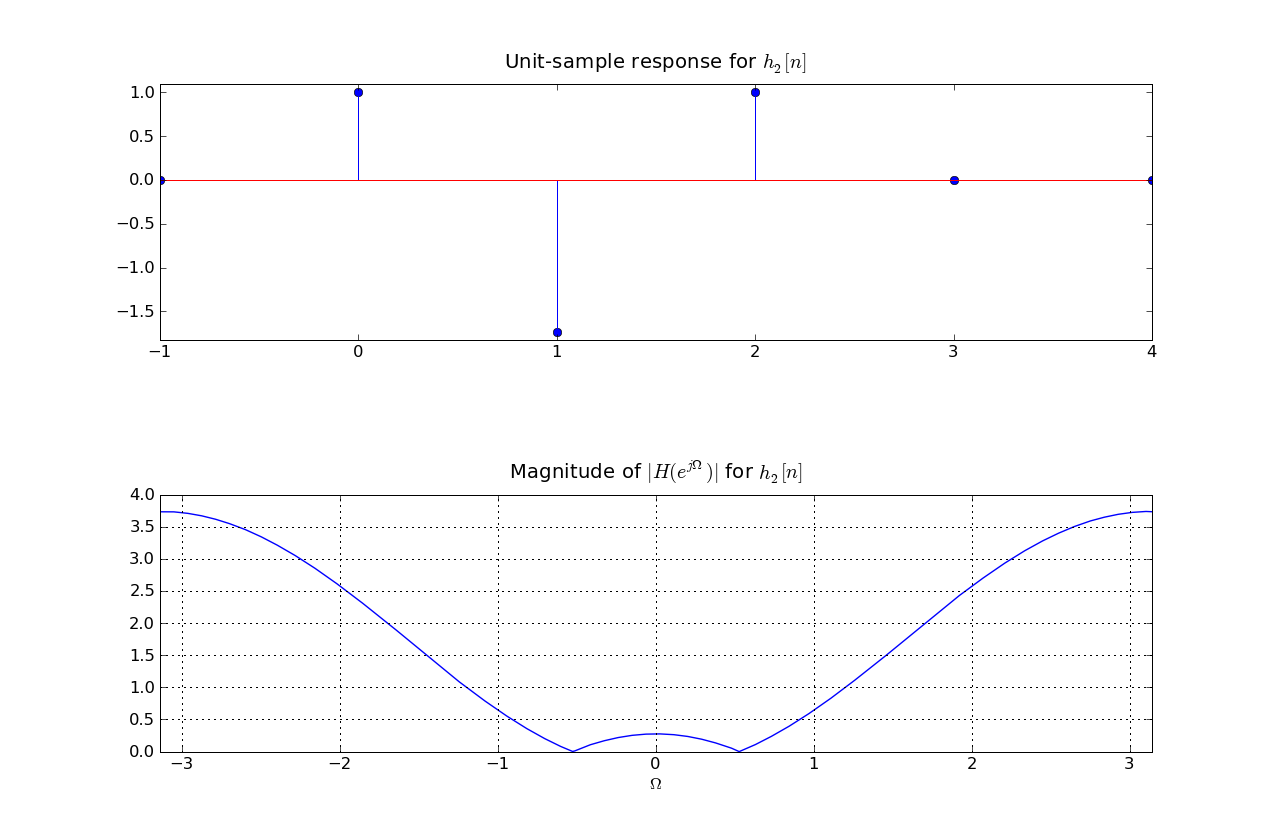
Note, the only nonzero values of unit sample response for H2 are : h2[0] = 1, h2[1]=-sqrt(3), h2[2]=1.
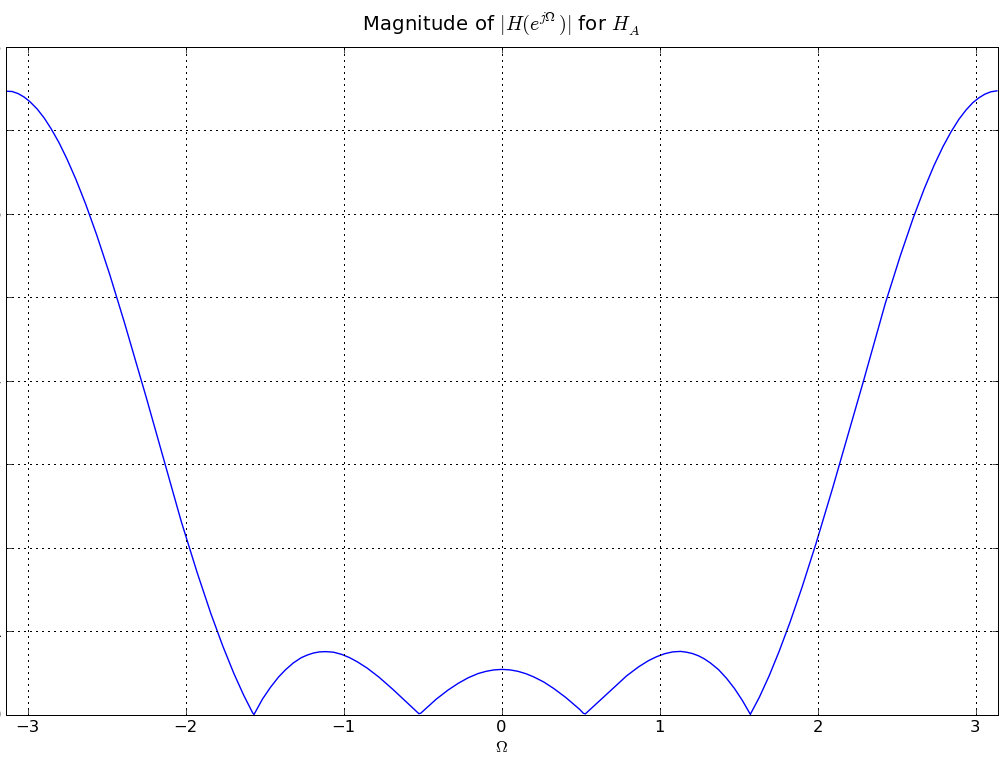
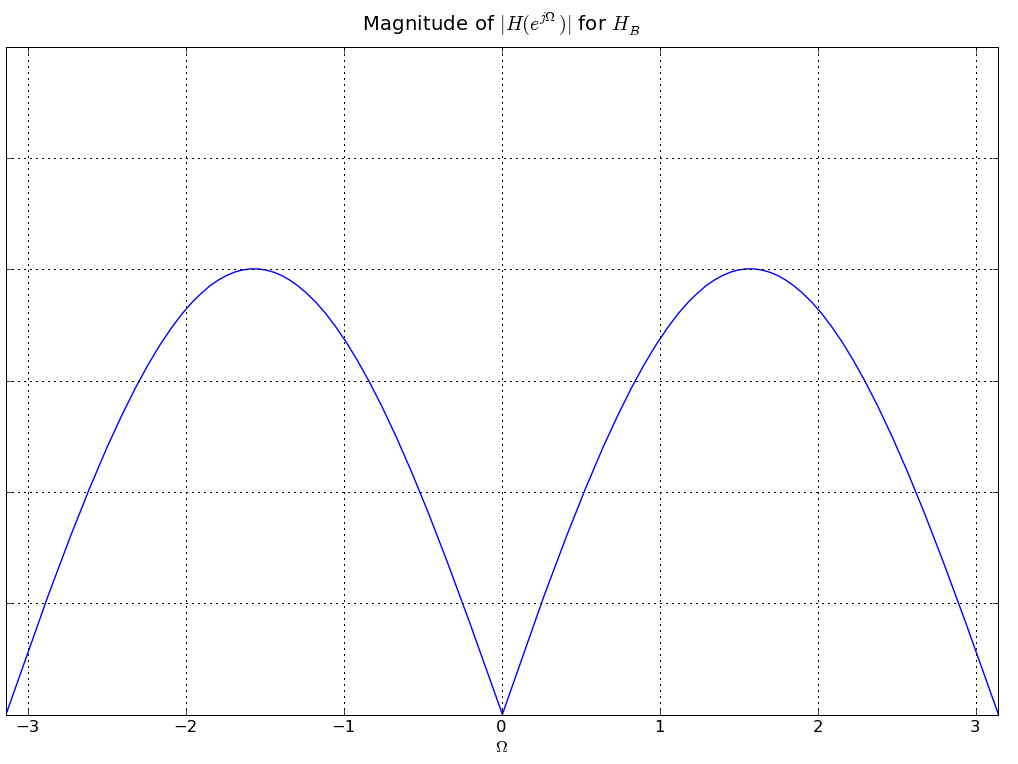
In answering the several parts of this review question consider four linear time-invariant systems, denoted A, B, C, and D, each characterized by the magnitude of its frequency response, |HA(ejΩ)|, |HB(ejΩ)|, |HC(ejΩ})|, and |HD(ejΩ)| respectively, as given in the plots below. This is a review problem, not an actual exam question, so similar concepts are tested multiple times to give you practice
h[n] = α δ[n] - h1[n]
and what is the numerical value of |α|?
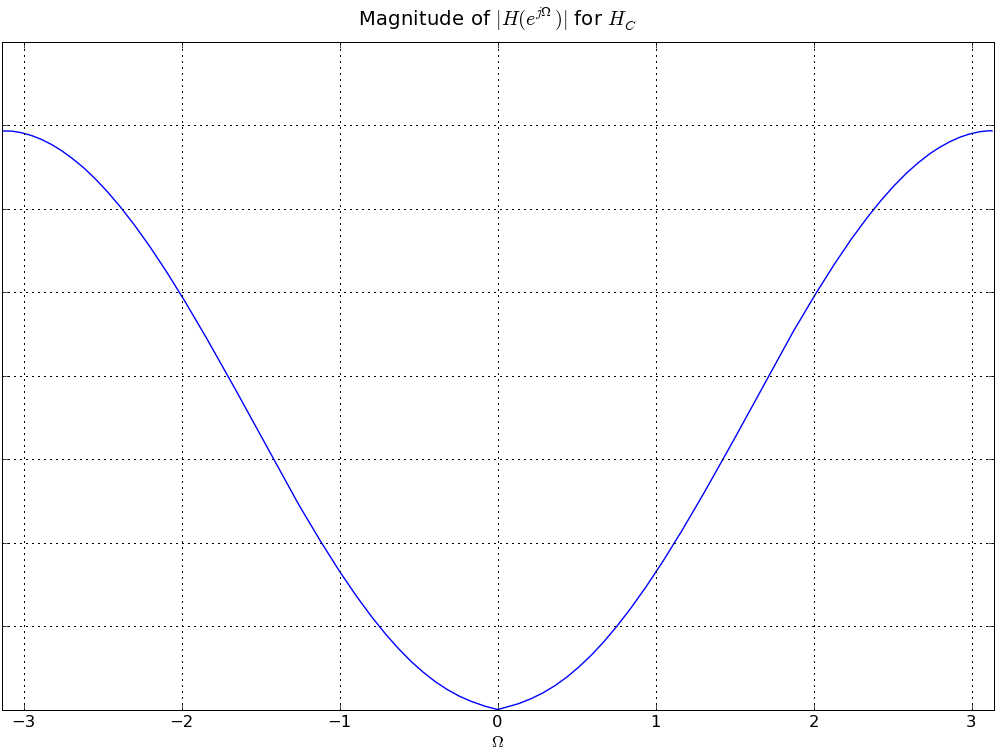
Must be HB as that is the only frequency response that has
the same values at 0 and ±π and extremes at ±&pi/2.
|α|=2 as H1(ej0)=2 but
HB(ej0)=0.
h[n] = Σmh1[m]h2[n-m] for m = 0 to n
and what are the numerical values of h[2], h[3] and H(ej0)?
Must be HA since
H1(ejΩ)H2(ejΩ) = H(ejΩ),
and therefore |H(ejΩ)|=0 whenever H1(ejΩ)=0
or H2(ejΩ)=0.
H(ej0) = H1(ej0)H2(ej0) = 2(2 - sqrt(3)) = 4 - 2sqrt(3)
h[n] = [1,0,1]*[1,-sqrt(3),1] so h[2] = 2 and h[3] = -sqrt(3).
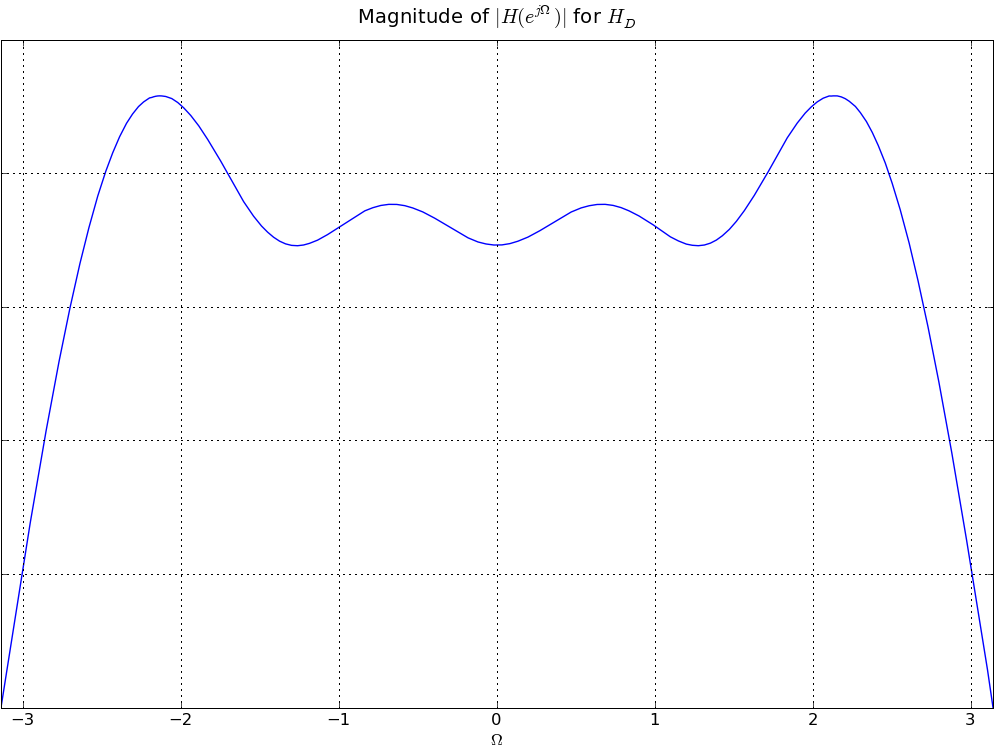
h[n] = α δ[n] - Σmh1[m]h2[n-m] for m = 0 to n
and what is the numerical value of |α|?
Since HA is the frequency response for H1*H2,
HD must be the solution. It's the only frequency response with enough wiggles.
Since |HA(ejπ)| = |H1(ejπ)||H2(ejπ)|,
|α| = 2(2 + sqrt(3)) = 4 + 2sqrt(3).
h[n] = α δ[n] - h2[n]
and what is the numerical value of |α|?
Must be HC by elimination but also because none of the other
frequency repsonse could be generated by a single magnitude shift of
H2(ejΩ).
HC(ej0) = 0 so |α| = |H2(ej0)| = 2 - sqrt(3).
x[n]=0 for n < 0 and
x[n] = cos(nπ/6) + cos(nπ/2) + 1.0 for n &ge 0
Which system (A, B, C or D) produced an output, y[n] below, and what is the value of y[n] for n > 10?
y[n] for n > 10 = |HA(ej0)|*1 = 4 - 2sqrt(3)
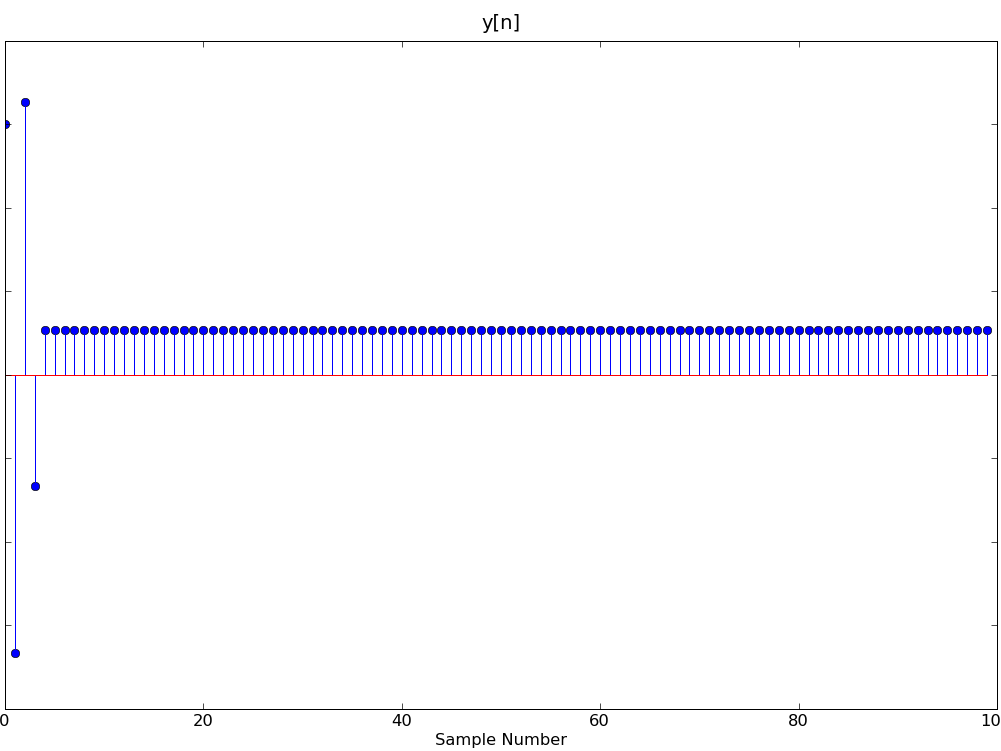 Must be HA, as |HA(ejΩ)| = 0
for Ω=±π/6 and Ω=±π/2.
Must be HA, as |HA(ejΩ)| = 0
for Ω=±π/6 and Ω=±π/2.
x[n]=0 for n < 0 and
x[n] = cos(nπ/6) + cos(nπ/2) + 1.0 for n &ge 0
Which system (H1 or H2) produced an output, y[n] below, and what is the value of y[22]?
y[22] = 2.
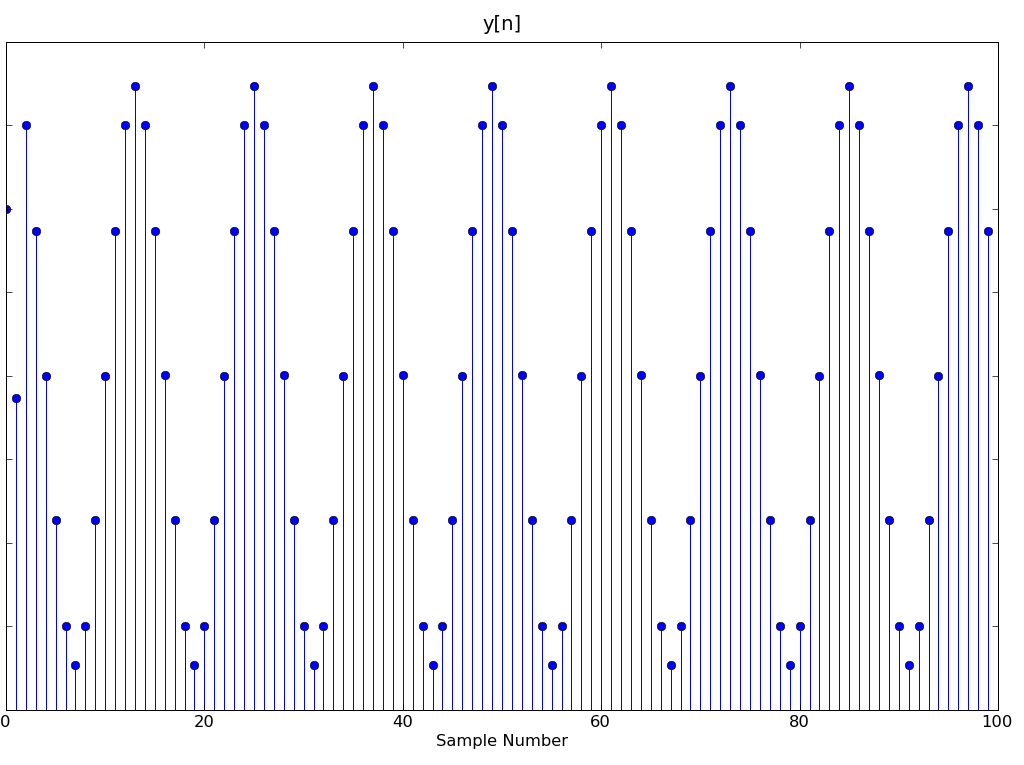 Must be H1 since the H2 system would eliminate cos(π/6),
and since the output will eventually be a cosine offset by H1(ej0)*1.
Must be H1 since the H2 system would eliminate cos(π/6),
and since the output will eventually be a cosine offset by H1(ej0)*1.