9.35 Illusion Laboratory
Spring 2021 Auditory Lab

Do famous perceptual effects such as the categorization of stimuli and the McGurk effect work when the stimuli are played backwards?
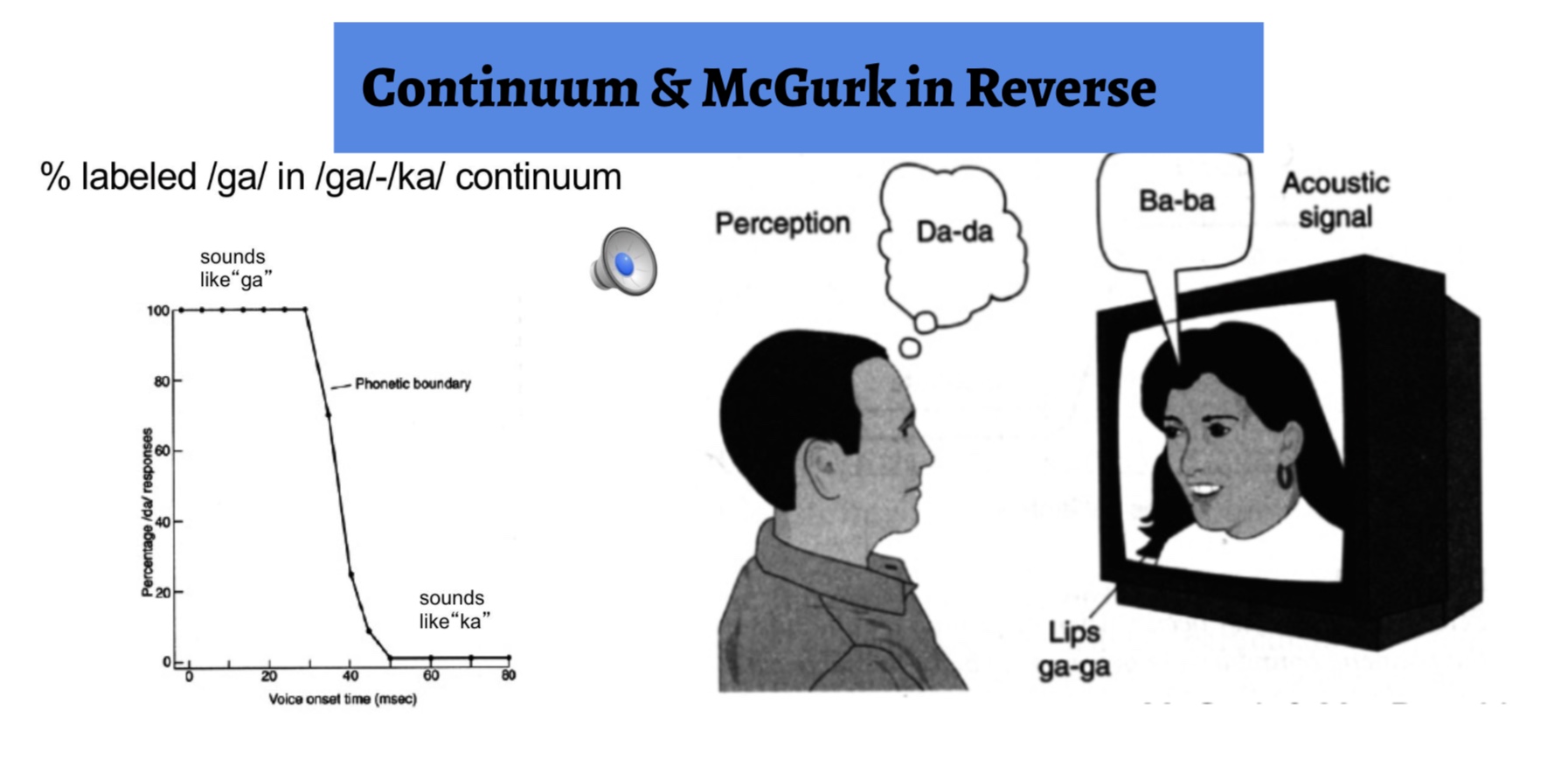
The categorization of stimuli effect normally produces an abrupt change in the perception of the stimuli, as it slowly changes from a voiced consonant to an unvoiced consonant– in our illusion, we use the /ga/-/ka/ continuum. The McGurk effect usually combines both auditory and visual input to produce something perceptually distinct from when the same stimuli are perceived separately. Both of these effects are reliant on us knowing specific phonemes and deducing that we are indeed hearing those specific phonemes, even when the stimulus is unclear. With the reversal of these famous effects, we want to test whether the abrupt shift of the /ga/-/ka/ continuum will still occur when the phoneme isn’t known (i.e., the sound in reverse will not be a familiar sound). Additionally, we want to investigate whether the McGurk effect will still hold and create a new combination of visual and auditory perception with unfamiliar phonemes. These phonemes will be “unfamiliar” because they are natural sounds played in reverse, which will sound unnatural and new. We hypothesize that these classic experiments will have new effects when played in reverse.
Our illusion simply takes the stimuli from these classic illusions and plays them in reverse. When played, these new stimuli will mirror the conditions of the original illusions, just backwards. For the /ga/-/ka/ continuum our illusion first has a perceiver listen to an ordered continuum, then the same continuum in reverse. They will then listen to a random ordered continuum, and once again then the same continuum in reverse. For the McGurk effect, a perceiver will listen to the McGurk audio where they should perceive ‘ba ba’, watch the McGurk visual where they should perceive ‘ga ga’, and finally watch and hear them at the same time where they should perceive ‘da da’. We will then have them go through this same progression of audio only, visual only, and auditory and visual stimuli, but with all of the stimuli in the reverse. Listening to these auditory and visual stimuli in forward and reverse will help us distinguish whether or not known phonemes are crucial for these famous effects to work.
Headphones aren't necessary for this illusion.
‘1.1-ga ka ordered.wav’
‘1.2-reversed_order.wav’
‘1.3-ga ka random.wav’
‘1.4-reversed_rand.wav’
‘2.1-McGurk Audio.wav’
‘2.2-McGurk Mute.mp4’
‘2.3-McGurk.mp4’
‘2.4-McGurk Audio_Reversed.wav’
‘2.5-McGurk_Reversed.mp4’
‘2.6-McGurk_Reversed_Audio+Sound.mp4’
Home Page Image
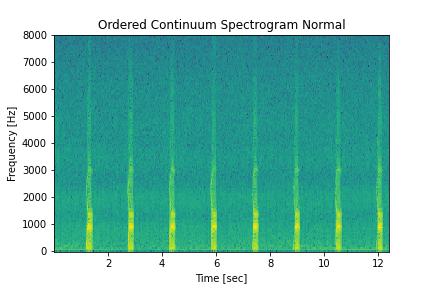
Ordered Continuum Spectrogram Normal
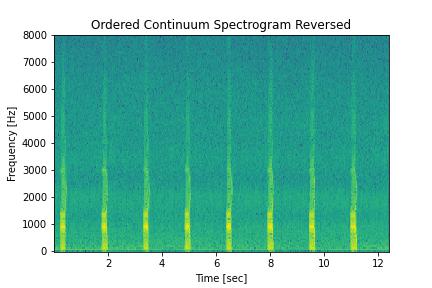
Ordered Continuum Spectrogram Reversed
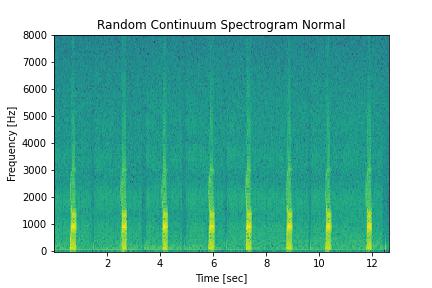
Random Continuum Spectrogram Normal
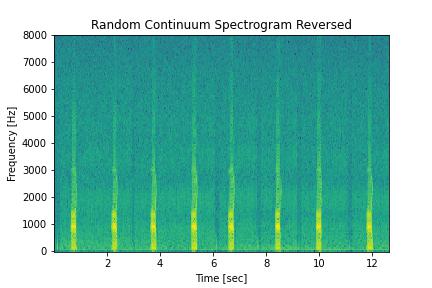
Random Continuum Spectrogram Reversed
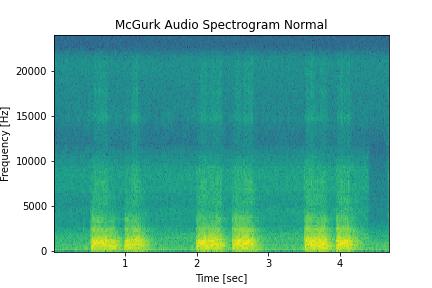
McGurk Audio Spectrogram Normal
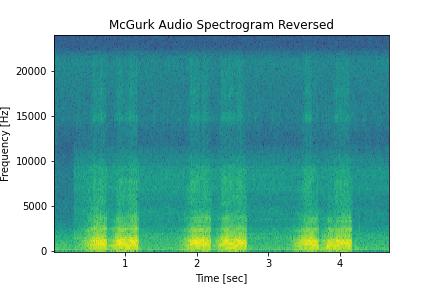
McGurk Audio Spectrogram Reversed
Sources
McWalter, Richard, and Josh H. McDermott. “Illusory Sound Texture Reveals Multi-Second Statistical Completion in Auditory Scene Analysis.” Nature News, Nature Publishing Group, 8 Nov. 2019, https://www.nature.com/articles/s41467-019-12893-0.
Mcgurk, Harry, and John Macdonald. “Hearing Lips and Seeing Voices.” Nature News, Nature Publishing Group, https://www.nature.com/articles/264746a0.