9.35 Illusion Laboratory
Spring 2021 Auditory Lab
Streaming with Complex Tones
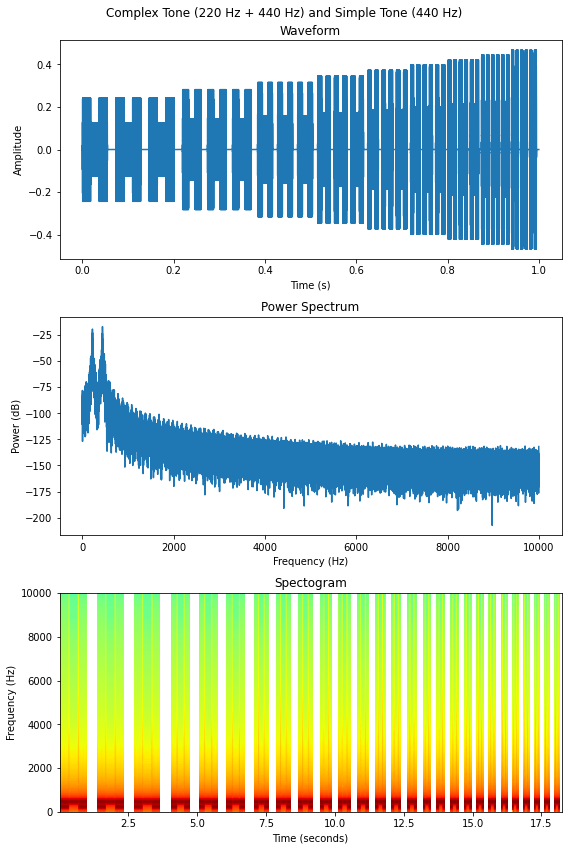
Could streaming be affected if one of the sources is a complex tone containing the second source?
This illusion demonstrates the separation of individual frequencies in complex tones by streaming with a simple tone. A complex tone consisting of a 220Hz and 440Hz sine wave is alternated with a simple 440Hz sine wave. The frequency of alternation starts out slow, but gradually gets faster.
At first, the complex tone should sound like a single 220Hz tone. As the alternation gets faster, the 440Hz frequency in the complex tone should become audible, around the same time as the sound appears to split into two streams, one containing the 220Hz frequency and the other containing the 440Hz frequencies.
Spectrogram
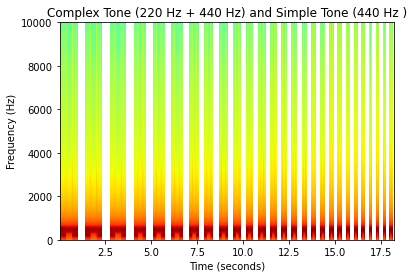
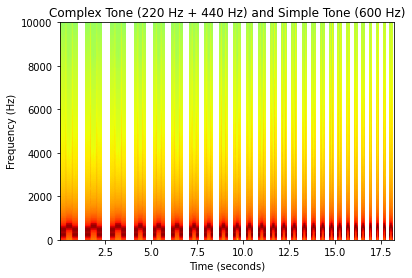
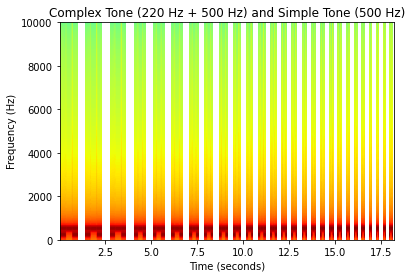
We also sought to examine three different conditions, each changing a variable to evaluate the limitations of the auditory illusion. Our objective was to identify which specific features of the original sound, such as the frequency of the simple tone contained within the complex tone, the harmonicity of the complex tone, or the proximity of frequencies in the complex tone, contributed to the illusion. The following experiments were performed to investigate these conditions: (1) An exploration of a scenario where the complex tone did not comprise the frequency of the simple tone. To achieve this, we created a complex tone including frequencies of 220 Hz and 440 Hz, alongside a simple tone at 600 Hz. (2) An exploration of a scenario where the complex tone contained inharmonious frequencies. To achieve this, we created a complex tone comprising frequencies of 220 Hz and 500 Hz, alongside a simple tone at 500 Hz. (3) An exploration of a scenario where the frequencies within the complex tone were significantly distant from each other. To achieve this, we created a complex tone comprising frequencies of 220 Hz and 1320 Hz, alongside a simple tone at 1320 Hz.
The following sound replaces the 440Hz simple tone with a 660Hz tone, keeping the complex tone the same.
Spectrogram
The following sound replaces all 440Hz frequencies in the simple and complex tone with 500Hz.
Spectrogram
The following sound replaces all 440Hz frequencies in the simple and complex tone with 1320Hz.
Spectrogram
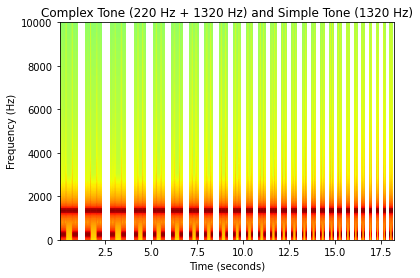
During the other experimental conditions, it was observed that the frequencies within the complex tone separated, even without streaming, when they were inharmonic or too far apart. Interestingly, it was also discovered that the auditory illusion persisted even when the frequency of the simple tone was different from the complex tone frequencies.
Darwin, C. J., & Sutherland, N. S. (1984). Grouping frequency components of vowels: When is a harmonic not a harmonic? The Quarterly Journal of Experimental Psychology, 36A, 193-208. Van Noorden, L. P. A. S. (1975). Temporal coherence in the perception of tone sequences. [PhD thesis, Institute for Perception Research, Eindhoven]. Technische Hogeschool Eindhoven.