9.35 Illusion Laboratory
Spring 2023 Auditory Lab

Can our auditory systems fill in a non-monotonic frequency function?
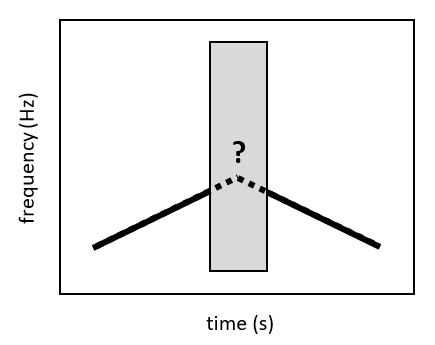
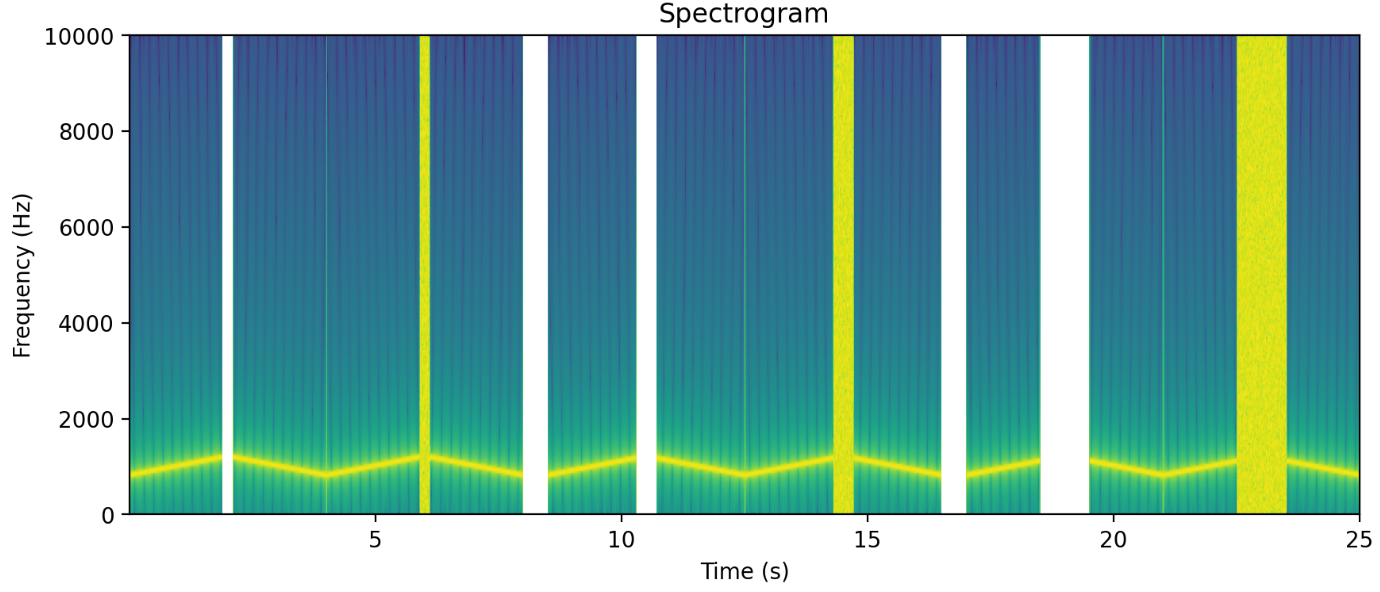
Prior experiments have demonstrated that human auditory systems “fill-in” gaps in pure tones that are replaced with broadband noise, resulting in a perceived continuous pure tone (Warren et al., 1972). Here, we seek to study this filling-in effect when the gap is ostensibly a non-monotonic function of frequency. Specifically, we construct a pure tone that linearly rises in frequency from 800 to 1200 Hz and then falls back to 800 Hz; we then replace an interval, centered at the peak frequency, with broadband noise. Thus, we can see whether our brain chooses not to fill in the gap, to fill in the gap with a non-monotonic function, or to fill in the gap in some other way. In the audio clip, you will hear three versions of the illusion with increasing noise interval length (200 ms, 400 ms, 1s); in each case, we first play the rising-falling tone with silence in the interval, then with noise in the interval.
We find that our auditory systems do fill in the gap according to the expected non-monotonic rise-fall frequency shape. Moreover, we perceive that the illusion weakens as the length of the noise interval increases, corroborating existing literature on monotonic frequency functions. This suggests that our auditory systems actively attempt to infer the most likely frequency function of an interrupted sound. Further work would explore the effects of various parameters, such as tone frequency and noise loudness, and testing whether our auditory system can fill in arbitrary frequency functions of pure tones that go beyond piecewise linear functions.
References
Warren, R. M., Obusek, C. J., & Ackroff, J. M. (1972). Auditory Induction: Perceptual Synthesis of Absent Sounds. Science, 176(4039), 1149–1151.