9.35 Illusion Laboratory
Spring 2021 Auditory Lab

What is the relationship between sound localization and the continuity effect?
For our illusion we wanted to test if the continuity effect still holds when the location of a sound is changed. The basis of the continuity illusion is that when a brief pause occurs after a sound is played but the brief pause is filled with a noise, the sound will be perceived as continuing while the noise is playing. To test this with spatialization, we aimed to play a sound first from the right side and then the noise that fills the gap on the left side to then return to the first sound on the left side. We hypothesized that if spatialization was added to the continuity illusion, the continuity illusion would most likely break. We hypothesized that if it did not break there would be two possibilities of creating an illusion: the sound continues but moves right to left during the masking period or the sound continues but there is an abrupt step function like change of where the sound is heard from sometime during or at the end of the masking period.
We used 2 sound variables – a pure tone and a sound texture of clapping – with 3 different location conditions – the left and right sound sources being equidistant from the head, the left and right sound sources being different distances from the head, and the sound sources being in two random locations that are not necessarily left and right (could be anywhere in 3D space). From our lab, you will be able to listen to 3 pairs of this potential illusion that are the combinations of these variables. The first pair of sounds are with equidistant sources, the second pair has different distances of left and right side sources, and the last pair is with completely random sources. The first of each pair of sounds will involve a clapping texture as the initial sound heard and the second of each pair will involve a pure tone as the initial sound heard. We have come to conclude that our results show agreement with what we know about other illusions, like binaural masking, that show that auditory grouping has a dependence on proper localization.
Using spatial sound. Please use headphones
Case 1: The left and right sound sources are equidistant to the head
Case 2: The left and right sound sources are different distances to the head
Case 3: The sound sources are at random location. For this random iteration the sources begin above and to the right of the head
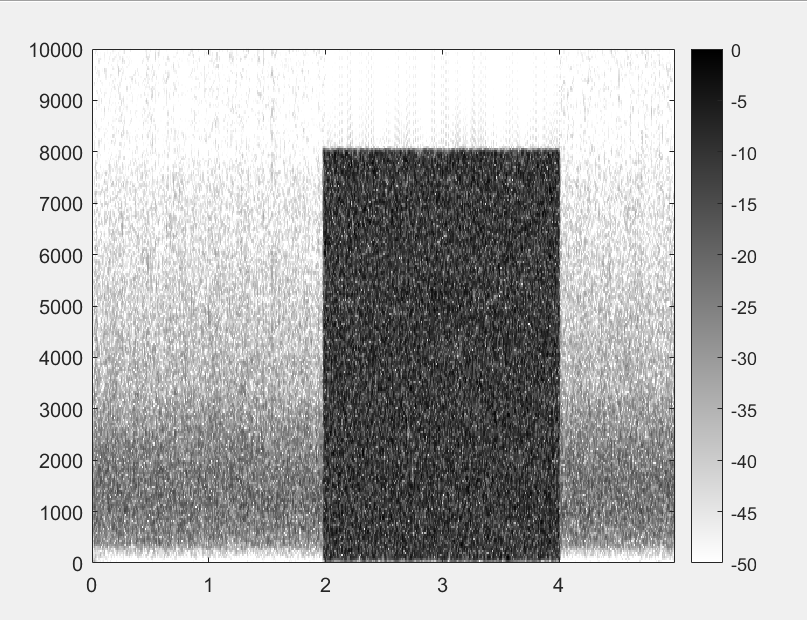
Applause + Noise Spectrogram
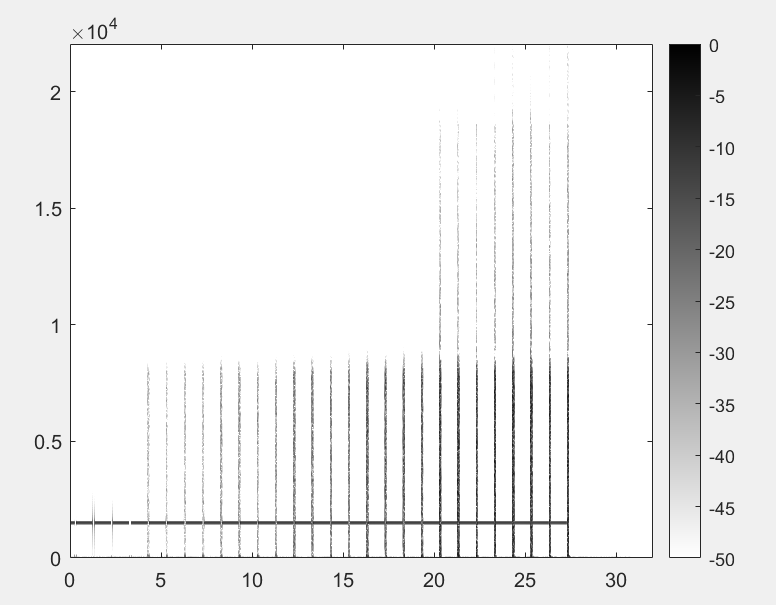
Pure Tone + noise Spectrogram
McWalter, R., McDermott, J.H. Illusory sound texture reveals multi-second statistical completion in auditory scene analysis. Nat Commun 10, 5096 (2019). https://doi.org/10.1038/s41467-019-12893-0