9.35 Illusion Laboratory
Spring 2021 Auditory Lab

How does priming affect the phase locking limit?
In our illusion, we wanted to explore the influence that priming would have on the percieved pitch of notes as a melody was upshifted beyond 4kHz, the limit that the ear can phaselock to soundwaves. We were inspired by the NBC chime illusion, where subjects failed to correclty reproduce the familiar pitches and intervals of the NBC chime above 5,000 Hz. We also thought of the demonstration in class, where a familiar melody that started at a very high frequency was brought down to a lower frequency, and was recongizable as it moved into phaselocking range. We seek to combine this demonstration with the perceptual nature of inference, to see if we can change pitch recognition thresholds. The scientific question we wish to answer is whether priming on a recognizable melody aids, inhibits, or does not affect the ability to discriminate between pitches changes within the melody when shifted above the phaselocking limit. As our illusion relies on priming, we will leave a complete explanation of the illusion until after you have tried it.
For this illusion we have created two samples, one that has a familiar melody with an incorrect rhythm, and the other with the correct rhythm of the melody. The same sound will be played at a high frequency at first, and then decrease in frequency until within phaselocking range, and finally increase to the starting frequency. On your first listen, can you tell what the melody is on the way down? Can you hear any changes on the way up? Listen through each sample twice and see if you notice any differences between each playthrough.
Rhythm Normalized Melody
Correct Rhythm
Melody in Isolation
Illusion Explanation
In brief, our illusion primes the user with the "Imperial March" theme that is shifted around an octave at a time, and changes pitch elements of the sound above the phaselocking limit to see if the changes are detectable to the user. Each illusion begins with noise at a high frequency and shifts it down to where the melody is recognizable, and then shifts it back up; at the high frequencies of both the start and the finish, the melody has notes that are changed. These note changes are clearly perceptible at lower octaves, and we've attached comparisons of the true and altered melodies at the bottom of the page so one can listen to the difference. We believe an illusion rises from the expectation of the melody introduced in the low frequencies. Although the intervals are wrong, by combining the familiar melody with the effects of poor pitch perception above phaselocking, we can create an illusion of melody recognition even though the pitches are different.
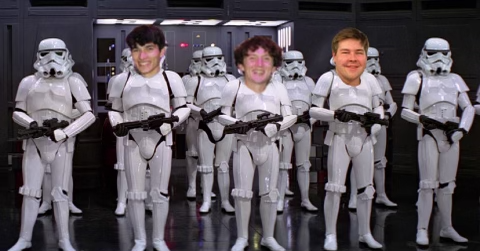
We heard there are musicians in the lab! Click on the above image for extra hard mode. (Answer at the end of the audio file)
Spectrograms of the Illusions
The spectrograms below correspond to the stimulus with rhythm removed (top), the normal rhythm (middle), and hard mode (bottom).
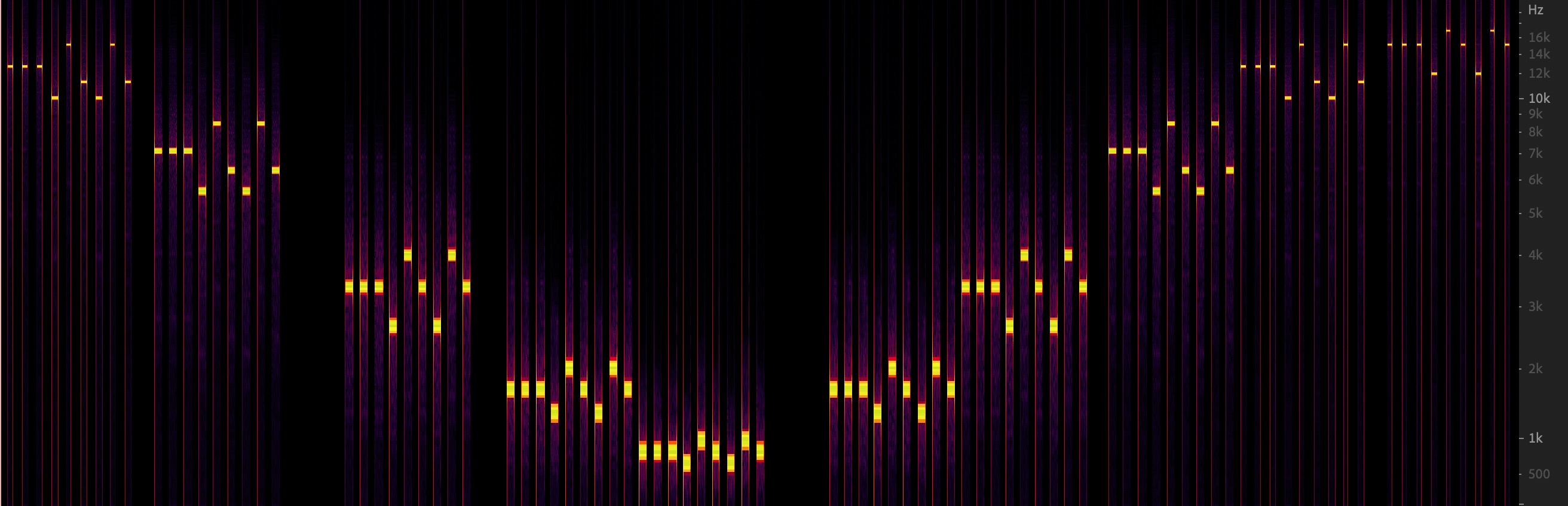
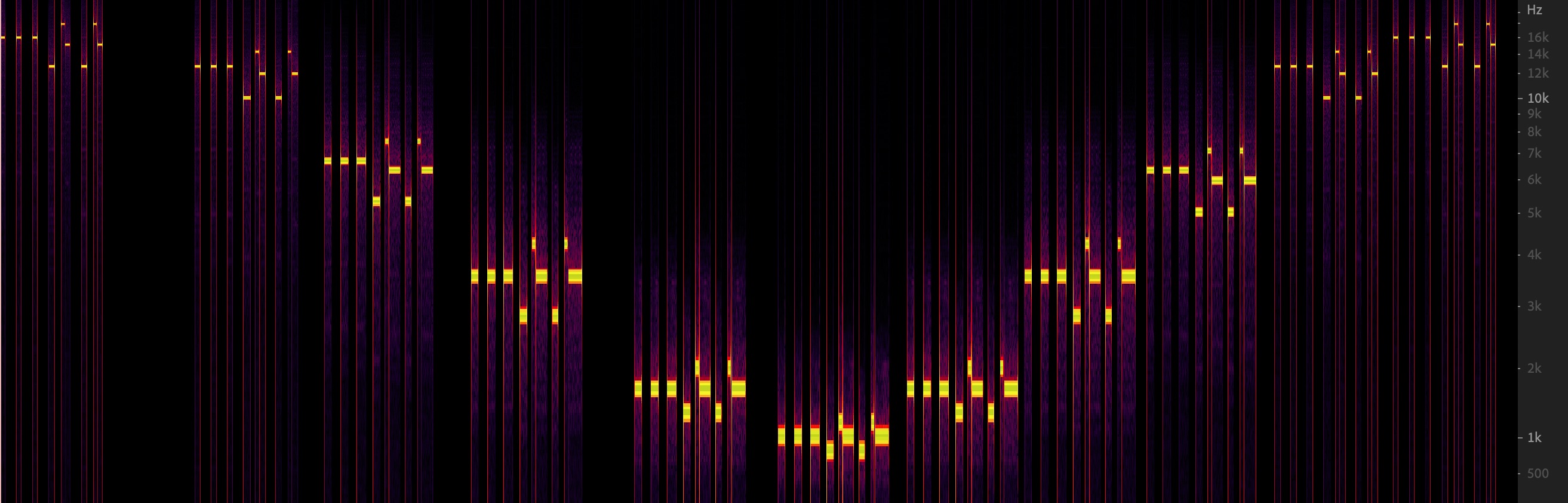
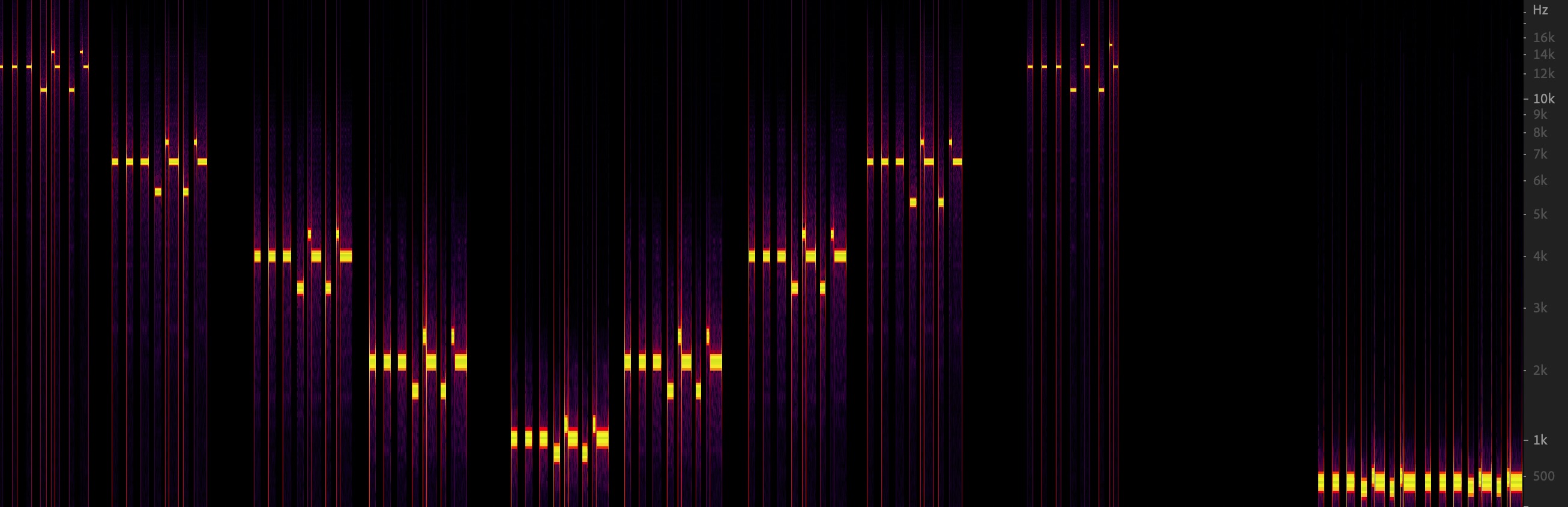
Correct Melody Compared to the Changed Melody in Each Illusion
Each sound plays the correct melody and then the altered melody for each sample. The first is for the normalized rhythm sample, the second is the with rhythm sample, and the third is the answer to "hard mode" (although we acknoledge that all three are not easy!).
References
Attneave, F., & Olson, R. K. (1971). Pitch as a Medium: A New Approach to Psychophysical Scaling. The American Journal of Psychology, 84(2), 147–166. http://www.jstor.org/stable/1421351, Accessed 4/8/2014 15:35