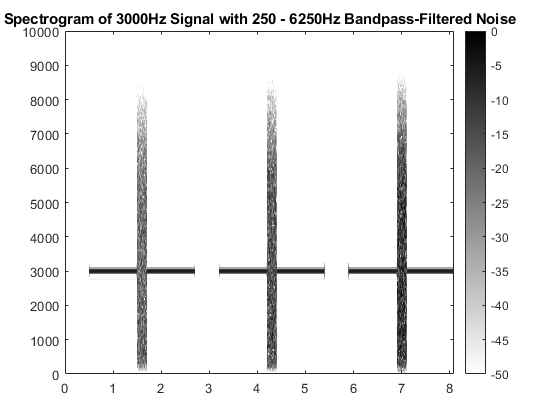
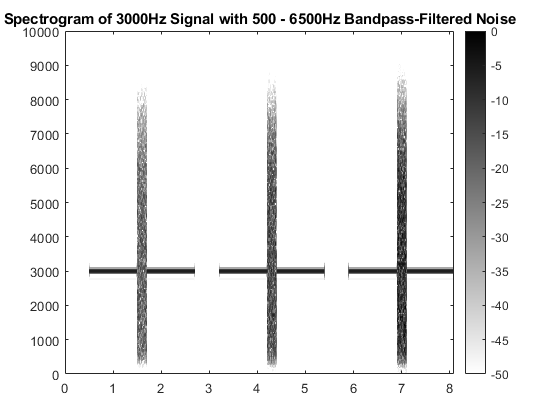
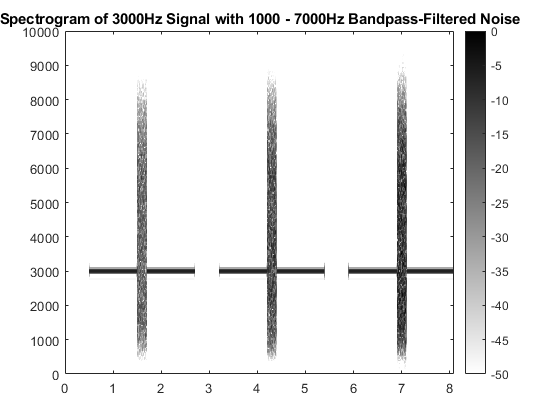
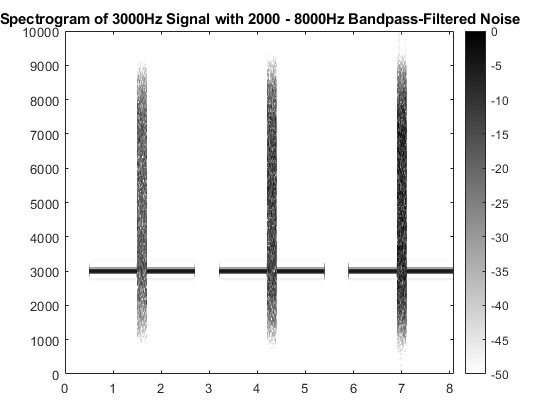
How does the centered frequency of masking noise affect the perception of temporal continuity?
By Nicholas Guiliano
In their study "Auditory Induction: Perceptual Synthesis of Absent Sounds", Warren et al. examine the perceptually induced sounds when a masking noise is present during
a missing gap in a signal. For this illusion of temporal continuity to work, the masking noise must be immediately after the signal and centered around the same frequency.
Warren et al. determined the importance of the masking level by altering its intensity compared to the signal and measuring detection thresholds in each subject.
However, Warren et al. did not fully explore the caveats of the masking noise. If the center frequency of a masking noise is altered, how do the thresholds of the perception of temporal continuity shift?
This idea is critical in understanding the factors affecting temporal continuity and its processing in the brain.
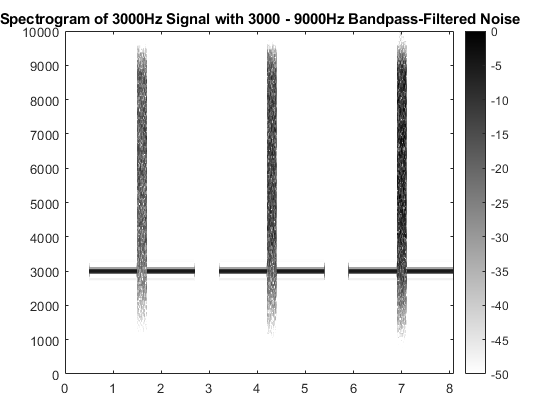
In order to address this question, I created multiple bandpass filters to center the masking noise at different frequencies. Each filter's bandpass was equal in spacing to prevent
the addition of possible confounding variables. The noises were filtered with 250-6250Hz, 500-6500Hz, 1000-7000Hz, 2000-8000Hz, 3000-9000Hz filters.
Similar to Warren et al.'s method of determining threshold, the signal remains a constant 3000Hz while the power of the filters increases throughout each sequence. The threshold for detection can be assessed in each individual sequence
and then compared across sequences to determine the effect of the change in filter.
Citation:
Warren, Richard, Obsusek, Charles, and Ackroff, John, 1972. "Auditory Induction: Perceptual Synthesis of Absent Sounds." Science, vol. 176, no. 4039, p. 1149-1151.
Comments
Matthew Bradford
a)
I found that the lower frequency bands had a worse masking effect.
b)
I found that there were more factors at play in the noise filtering. Isn't it less the range of frequencies and more how the sides of the window are characterized?
0
Nicholas Guiliano
@Elian
c) Your experience with the demo aligns with the hypothesis exactly and answers the question. One difference I had versus your experience was that my perception of continuity fell off in the last 2 examples (2000-8000, 3000-9000), so the overall "contintuity-center frequency relationship" appeared to be parabolic (-x^2 + c) rather than linear.
d) In order to better display this observed relationship, I think altering the signal frequency to a lower tone would help in its perception (phase locking is falling off with this 3000Hz tone and could possibly be confounding- one thing I did not consider in experimental design but realized implied within Jeremy's comment.
@Jeremy
c) Your experience with the continuity effect highlights a shortcoming of my experimental design-- the tone was perhaps too high of a frequency for every listener to accurately assess if there was continuity with the presence of noise. Based off your report, I feel that it rejects the hypothesis-- i.e., no perception of a change in continuity implies no relationship with center-frequency relationship.
d) In order to test this further, replicating the experiment with a lower-frequency tone (e.g. 1kHz, 1.5kHz, etc.) would aid in showing if this lack of perceived continuity difference is a function of tone frequency. For statistical power, these same 5 bandpass-filtered noises should be applied to at least 3 signals of different frequencies (i.e. 15 sequences in total). The use of signal frequency as a covariate will eliminate the confounding variable.
1
Elian Malkin
a) The higher frequency masking noises created a stronger perception of temporal continuity. The first demo (250-6250 Hz) sounded particularly discontinuous to me, while the higher frequency ones seemed to increasingly mask the sound well.
b) Experiencing this demo indicated that altering the centered frequency of masking noise to be closer to the frequency of the pure tone strengthened the perception of temporal continuity, which helped answer the stated question of the effect of masking noise center frequency on perceptual filling-in.
1
Jeremy Ma
a) It doesn't sound like there is an obvious difference in the amount of perceptual filling. However, it is noticeably more difficult to perceive a consistent tone in high frequencies in my opinion.
b) I think this demo was able to answer of how the center frequency of noise affects perceptual filling - since I was able to feel noticeable difference in effort in order for perceptual filling to occur, it seems like the masking effect of higher frequencies was able to 'cover' up more of the tone possibly due to the noise being more similar in frequency (as frequency is log scale).