- Active Noise Control
in Fluid Flows
 Active Noise Control of Blade Tonals in Underwater Propulsors
This project concerns the application of active control to modify
radiated noise characteristics in underwater propulsors. One noise source
is the presence of fluctuating thrust and side forces that are produced due
to the operation of a propulsor blade in a non-uniform wake. Each blade geometry
results in a specific spectrum of noise, and therefore generates a specific
"blade tonal" of the radiated noise. The goal here is to use active control
to appropriately modulate a control surface (for example, a small propulsor
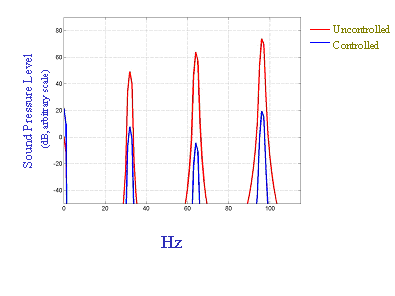
with biomimetic blades) so that the "tonal" is modified suitably. Preliminary
results have shown that a 2-D model based on potential flow and a dynamic
inversion control strategy lead to a significant noise reduction (see figure).
A detailed investigation of this approach that includes analysis and simulation
needs to be carried out.
|
|
A benchtop experimental apparatus has been set
up to validate the biomimetic alteration of the blade tonals. The current
biomimetic actuators under investigation are made from films of polypyrrole
conducting polymer (CP).
The conducting polymer technology is courtesy of MIT's Bioinstrumentation
Lab (director Ian Hunter). The films are formed using an electrochemical
deposition on a glassy carbon beaker. Once formed, the films can be peeled
off with a razor blade. In the presence of a proper electrolyte, the films
contract isotropically under an
applied voltage. To form the actuator itself, the films are laminated
together to form a 3-layer actuator. The two outside layers are the conducting
polymer films, while the middle layer is a special paper that serves as a
spacer. When either side contracts, the actuator curls in the direction. In
order to ensure that the curling takes place in a predestined direction, strategical
slicing (to relieve stress in one direction) and stiffening using materials
such as mylar and carbon fiber are being designed.
|
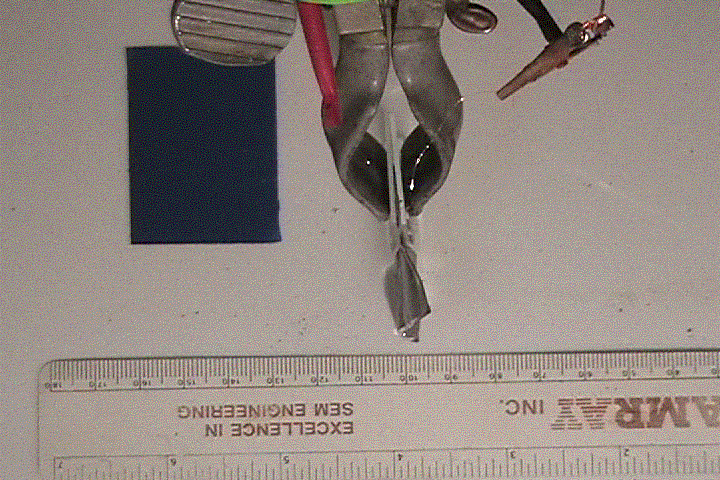
The video below shows one such CP, 60
by 23 by .2 mm, rectangular in cross-section, actuating in water.
Current results show that ~20
degrees in ~17 seconds, for an avg speed of ~1.17 degrees per second can be
achieved with these CPs.
|
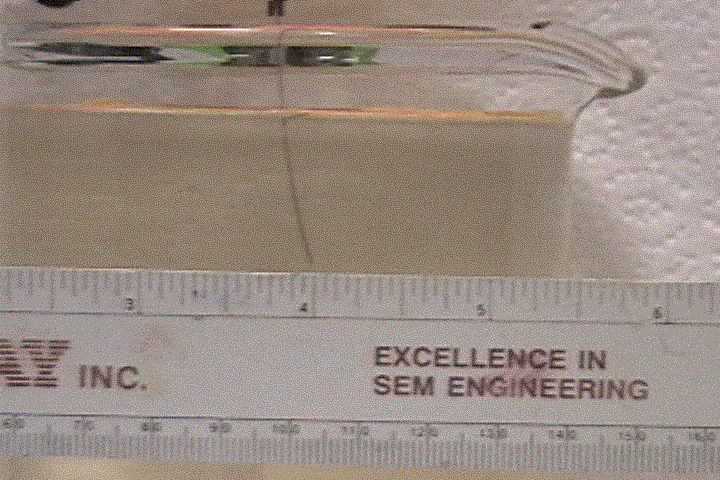
This particular actuator shown below (made in MIT's Bioinstrumentation
Lab) has a different geometry, 40 by 8 by .1 mm, and a vacuum deposited plastic
coating in an attempt to seal it from the water. The sealing/coating method
is still under development..
|
This
is the next actuator deveoped, tested on 3/3/03. The "tail" is twisted slightly,
and the view is top down, thus the view of the tail is slightly distorted.
The actuator is oscillating at .3 Hz in water flowing at 10 cm/s. The scale
at the bottom is in millimeters.

The same actuator oscillating at 1 Hz in water flowing at 10 cm/s can be seen here.
And again at 5 Hz here.
|
 Publications:
P. Bandyopadhyay, W. P Krol, Jr., D. P. Thivierge, W. H. Nedderman, and
Mehran Mojarrad, "A Biomimetic Propulsor for Active
Noise Control. Experiments," NUWC-NPT Technical Report 11,351,March
2002.
W.P. Krol, Jr., A.M. Annaswamy, and P. Bandyopadhyay,
"A Biomimetic
Propulsor for Active Noise Control," NUWC-NPT Technical Report 11,350,,
February 2002.
|