Aqueous chemistry of oxides and metals [1, 2, 3]


    From the prediction of thermochemistry, how can we predict compounds behavior and identify possible electrochemical reactions? This topic relies on electroanalytical techniques and is a necessary step for the understanding of any aqueous electrochemical process (leaching, corrosion, deposition, gas evolution)


Materials chemistry

Molten state chemistry (molten oxides,  glasses, slags or metals) [4]


     This field is the mirror of the previous one at high temperature (>1200°C), in which from thermodynamics, physico-chemical properties (diffusivity, electrical conductivities), one tries to predict the chemical behavior of ions or metals in these challenging environments. Existing knowledge is rather limited, as for example a universal scale of electrochemical potential such as Normal Hydrogen Electrode has not been proposed for these electrolytes. The use of electrochemical techniques in these medium of very different properties, ranging from acidic silicate to basic high calcia melts, can provide a unique chemical insight into important metallurgical processes such as refractory corrosion, metals stability, gas/melt interaction and chemical speciation.

High temperature oxidation of materials in dry atmosphere and in molten oxide in presence of oxygen [5]


    This topic is a typical 'corrosion' problems which was limiting the development of molten oxide electrolysis processes: what is the dynamic of corrosion of metals at very high temperature, and what is the effect of polarization? How does oxygen ions and oxygen gas interact with an electrode in these medium of rare chemical complexity?

Mechanisms of cathodic deposition of metals  [6,7]


    How oxydized metallic species is converted to metal in uncommon electrolytes (aqueous electrolyte at pH=15 and 100°C, suspensions, molten oxides at 1600°C)? This question is of fundamental and practical interest, both to develop energetically efficient electrochemical processes and to describe metal speciation in experimentally challenging environment.

Anode processes and oxygen evolution [8,9]


        Understanding oxydation processes is as important as reduction ones, specially with respect to their implications in corrosion. More specifically, developing anode materials that sustains aggressive chemical environment is important to sustain the development of energetically efficient processes. This imply the understanding of both the fundamental steps, e.g. what is the reactant for oxygen evolution in molten oxides, and the transport phenomena issues for gas evolving anodes, i.e the practical development of large surface electrodes that helps in gas removal.

   Modelling of current distribution


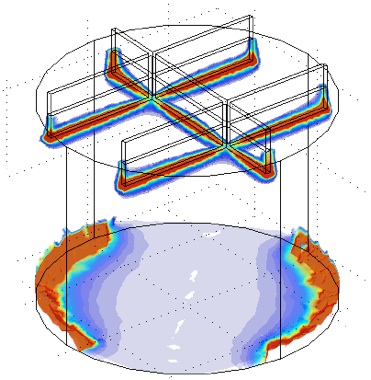
        Determining current distribution is of key importance in the design of successful electrochemical tools, both for the fundamental and pilot-cell studies.

Electrochemistry

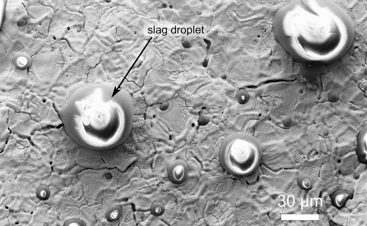
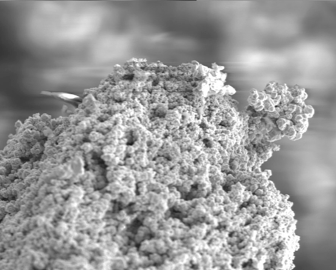
SEM Observation of magnetite (Fe3O4) after immersion in alkaline electrolyte (scalebar 10μm)

iron-iridium alloy / slag interface after electrolysis at 1600°C [Metec 2011]

Have you ever seen molten alumina ?
(Al2O3, MP : 2054°C)(movie G. Lambotte)Science_files/IMG_0399.MOV

Journal of Metals,

Feb. 2012 cover,

De Nora Prize Recipients

  1. J.Yurko & A. Allanore

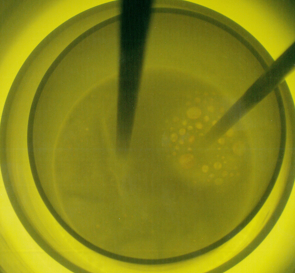
Visualization of oxygen evolution at 1600°C

(movie A. Vai)

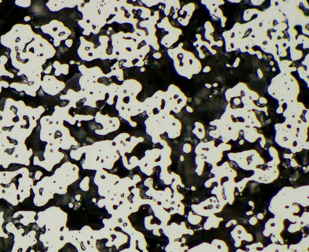
Iridium metal obtained by

decomposition

of its oxide

(image Joy Chen)

Primary current distribution in a molten oxide electrolysis laboratory cell

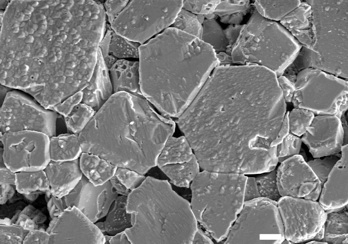
Iron deposit grown on the original iron oxide (hematite) particle at 100°C in alkaline electrolyte

(scalebar 10μm)