
|
122. Good evening ladies and gentlemen. This evening I am faced with the task of giving you the third lecture which is probably for me the most difficult one, because I would like to convey to you, in a way, the most intimate part of the work. This part is the cumulative result of ideas, sculptures, and drawings that have generated this or that building. In showing you these, I am acting somewhat like a cook who wants to give to other people --especially to young people-- his secrets; what ingredients, what kind of herb or spices he has been mixing in to give this or that particular taste. |
123. Although the work is very personal in nature, it is also the culmination of many things that I have learned during my life... the approach of different artists...the approach of the idea of art... of the art of engineering... of the art of architecture, and how these things can be linked together. So what I want to give you is quite a lot. For this reason, I will speak with very simple words, because that is the easiest and most direct way to communicate what I will show you in drawings and images.
124. In the first two lectures I began with small sculptures made from my children's architectural blocks. They were not very big --something like one foot wide. In both, the problem was how to hold a stone hanging from these machines. If you look, it is only the change in the placement of the bearing (I want, specifically to use this word for it is an engineering word) that creates two different ways of ordering the forces. In the first case, the forces are working parallel, and in the second, they are crossing each other, but, in fact, it is exactly the same exercise --how to hold a stone. Relative to this, there are several things that I would like to emphasize. First, to hold a stone is, itself, something important, because you are working against the tendency of the stone to fall. Like the scientist who allegedly was hit on the head by a falling apple, and he started thinking about why the apple hit him on the head. This elementary reasoning is very important; we live in a field of forces and gravity is immediate to us. Probably our bodies would be built completely different if gravity, or the forces around us, were other than they are.
125. Second, a beautiful thing to reflect upon is that the sculptures hold together because the weight of the stone is activating the system. This means that, if the stone was not there, it would be very difficult to hold this machine together. So the weight, or the permanency of gravity, is also something that is materially present. The sculpture stays together because gravity is there and gravity is a constant situation. What would happen if I were to cut the cord that transfers the weight of the stone through the whole system? It is very simple; the stone would fall down, and then, also, the small structure. When the stone falls down, a movement is produced. The forces of the machine are very much related, in their static condition, to this movement. This means that the presence of force is always related to a movement that cannot be established prior to its activation. Consider for a moment, that forces are like crystallized movement. This is, in my opinion, quite a beautiful understanding, because even in its static condition, in the most stable thing, movement is hidden. A movement is there, and because of that, I went from the idea of force and form, which I talked about in relation to my bridges in the previous lecture, to the idea of movement and form, which is much more difficult to represent in slides.
126. As I have been holding these conferences in an autobiographical way, I would like to start by talking about three projects that were done while I was a student at the ETH in Zürich. The first is a very small dynamic model for a roof structure I designed for a competition for the IBA Squash Hall, in which movement was important. By pulling a cord, the roof halves display a sequence of movement.
127. Another project was done with a group of students under the direction of Jürg Altherr. We built a pool hanging from the cupola of the ETH. It was hung by twenty-four wires that supported twenty-four ribs and a skin of polycarbonate that was 1.2 millimeters thick. It contained twenty-four cubic meters of water and it would have been possible to take a bath in it, although it would be uncomfortable to stand up in it because the pressure of one's feet might have broken or deformed the membrane. When you see the pool and the ribs you can appreciate that the construction was a challenge. The dome above had twenty-four ribs too.
128. Different from, but not unrelated to the idea of holding something heavy and as inconsistent as water, at a certain moment, came out the study of the explicit movement of polyhedra. My doctoral thesis was called "On the Foldability of Frames," and its basic focus was on the study of topology and the way in which a polyhedron --a very complex polyhedron-- could be folded or could be changed through transformation into a bundle in which all the lines are parallel. Through a series of phases, this bundle opens, slowly changing its shape to recuperate the major polyhedron, which approximates a dome --even if its full approximation to a half-sphere doesn't appear here (I don't have with me a slide with the completely unfolded shape). The focus was on the complex geometrical process of changing shape from bundle to half-sphere.
129. Another source of interest that I would like to emphasize is nature, and the very simple and pure observation of nature, meaning looking in a straightforward and pure way at the natural objects that exist around us: trees, grass, flowers, or whatever the natural object. One early model that I made attempted to take the structure of a tree and apply it to an idea for a group of trees using steel and glass. I was no longer thinking in terms of the specific qualities of the object itself, but rather, through a kind of systematic approach to the object I decided to make them transformable, meaning in this case that they change their form. So the squares at the tops of the trees --configured as the roof-- hinge at the point at which they are supported, and the entire roof opens through a mechanical transformation.
130. The idea of the trees was later incorporated into the project for the gallery in Toronto which I introduced in my first lecture --the gallery being made of two rows of trees. The idea of mechanical transformability, however, was not incorporated into the trees but into a very large operable window that separates the gallery, which is quiet, from Heritage Square, a noisy, animated space.
131. Continuing with the idea of the tree and the alignment of trees --an idea that is quite general, in my opinion-- we are now building the Orient Railway Station in Lisbon. Here, I used the same vocabulary, specifically choosing it because the city of Lisbon is, not only very beautiful, but also has the very, very soft character of cities on the Atlantic coast. There are hills, small parks and the space is very transparent, with a beautiful quality of light. In this context, I did not want to do a very strong structure, like in Lyon, but a soft one --an open structure with the trains passing on one side and the view passing on the other side.
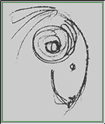
132. Another topic that is also very important in architecture is anatomy and the idea of reading in the human body structures, or appreciating in the human body, a sense of architecture. And this is very important because whatever we do, the magnitude or the dimension of a thing is always related to our bodies. Architecture, in a very natural way, is purely related to humans, because it is done for --and by-- people. This makes anatomy a very powerful source of inspiration. And this is true not just in a Renaissance sense, where the human anatomy was the basis for rules and proportional systems, but also in the twentieth century with the Modulor. Anatomy --the idea of the hand, of the open hand, the idea of the eye, the mouth, the skeleton-- these are a whole source of ideas and inspiration. And in the tectonic of one's own body you can discover an internal logic that you may reproduce in the design of a building. These are some studies of faces, and as you see, also sketches of the eye. I should do a small drawing to explain something to you. This is the human eye and this could be abstracted to such a figure, so, as much as you could have also an eye like this, then, in a symmetrical way we could generate a particular shape.
133. I would also like to emphasize, here, the idea that pure plastic research is important --to recognize in the phenomenon of architecture, its purely plastic or sculptural aspect, which is, I believe, one of the very, very important transcendental faces of architecture. And this is not in contradiction with the functional aspects of architecture, nor is it with the structural aspects. The wings of the station in Lyon, for example, take their geometry from a sculpture that was done previously as a study on the eye.
134. More abstract than my studies on the eye are the studies on how our head is supported over our shoulders. Why and how I can turn my head? The entire mass is supported only by the atlas of the vertebral column, and so the head can move. This wonder of moving the head --rotating it, inclining it, or both simultaneously-- is quite an interesting principle to follow, and in a way, quite dramatic. If you look at my sketches of the heads, and also to this series of sculptures, you see that I have been studying how to hold the head. I begin with a pure volume and mass --a cube-- trying to hold it with a minimum amount of elements; for example, with a very, very thin spindle and a series of cables around it. There is also the situation in which the head does not even touch the body. It is just suspended, like someone who is very anxious, or has a lot of problems, or something like that. Here there is only a single support and the same cables which are coiled around and still the cube --the head-- is in equilibrium.
135. In a later study, there is another idea in which the mass, or head, is supported vertically by one element and a second oblique element is used to push it back --to fix it in its horizontal position. In the section of the Stadelhofen Station, the same principle is used but the mass that is represented as a cube in the sculpture is here given by the earth.
136. I like very much the purity of a single idea, just as the pure expression of a single note can be very powerful, but things ought to get more complex. Complexity comes from a superposition of ideas in a coherent way. This means that, although each one of those ideas is capable of living independently, you can also put them one over the other, like a painter who works not only with black and white, but with several colors, or use a lot of blue behind a painting in order to capture the horizon, that you do not see --as Cezanne did. So, for example, in Stadelhofen, in addition to the reference to the propped head, there is also the idea of the hand --as the open hand-- which can be extremely powerful and you can represent it throughout a whole project as in this case here. You have the profile of the hand and it becomes a leitmotif for the configuration of the station. And also here, this is designed again with the hand: this is the small canopy. And even here, the pergola; and here, the element in the back, and down here --the hand applied twice. And you generate even the cross section of the space. So that in many points there is a gesture that is literally derived from the geometry, or "wants to be", as this doesn't mean that it derives from it, but that it is just an idea for emphasizing and repeating this part of your anatomy in a project. And the use of the anatomy that you see here, the station's interior curves, that you read it as a link between parts, together with the siting of the station --the fact that it is hidden, that it is almost a non-station-- makes it complex, and in addition, there is a certain secret aspect in reading the whole thing.
137. Another important series of plastic studies, of sculptures, goes a step further. Having discovered the head already, we want to discover the spine. These describe how our body stands up. The spine is made of vertebrae which are represented in the sculptures, in a very elemental way, as a series of cubes. In the body the spine curves and concludes in the pelvis. In the sculpture, I make this aspect very abstract with just a cube in white marble, two cones, and a wire behind. And then I add more cubes repeated four times. To stop this repetition in an orderly way, the cord going through all the cubes is attached to a small element.
138. Once you have the concept of the spine, it is very easy to move the elements around, reshaping the spine in several ways. In one case, I staggered the position of the cubes around the central cord. In another, they are stepped out so that the idea of movement is much more explicit. Although the material is the same, the hieratic aspect, or the rigidity, has disappeared so that you now have more the idea of a curving spine. Also quite important is how our spine twists, how it turns around an axis, and how it bends and reaches. There are some other studies that deal with this movement and suddenly, what before was quite a shy movement becomes very explicit.
139. In some later studies, I changed the geometry of the cube in order to make the sculptures bigger. In one project that is twelve meters or forty feet high, I wanted to create a more organic shape, and so I moved away from the cube, using double pyramids, or octahedrons instead. There are a series of seven of these octahedrons in concrete, one after the other, each held back by two pins and a single cable. The seven pieces are counter balanced by two very long legs and this sculpture became the basis for the bridge I built in Seville. At this scale, the sculpture is now more than an abstract form; it is also a construction principle.
140. Starting in a very pure and abstract study of the human body, and anatomical relationships of weight, one can move through to a major problem in steel, and this is the beauty of this transgression, which I also tried to show at the beginning of this lecture, in the swimming pool under the dome of the ETH. It was a construction that was a very particular challenge because under the water was the library. Can you imagine all that water over the library? The construction problem begins when you start building a sculpture that is twelve meters high. How to hold things, how to choose the material; these issues become critical. You have to deal with concrete. You have to deal with cables. You have to deal with supports and with tensions, with transport and with many other things.
141. In particular views of the bridge in Seville, you can recognize the very abstract origin of the bridge's idea. When you look at the bridge from the front or from the back, you do not think of a bridge. Instead, it is the expression of something autonomous. Looking at the bridge at night you can appreciate its scale in relation to the city, and this is an important subject. At this point I underline that both architecture and engineering are a structural, or plastic, or sculptural analysis or exercise that you do, and this exercise is beautiful when you feel free. You only bound yourself in the terms you set, saying, for example, "I would like to be extremely orthodox", "I will work only with cubes." Whatever the specific terms, you limit your vocabulary, but if the only goal you pursue is a pure plastic achievement, you are still free. When you deal with the construction of a bridge, or a building, even if it is a plastic event, you are inevitably going to be bound by functional needs. However, on the other hand, you have a big advantage and that is the scale. No sculpture in itself will ever reach the scale of a bridge or a building. It is this that gives architecture --and particularly architecture that is integrated with engineering-- its significance.
142. Continuing with my studies on anatomy I went forward with another idea --the idea of a walking man; in a very simple sketch, of course, because it is very difficult to represent it and Michelangelo has already done it so well. In this idea, movement is just implied motion, and the rules are very clean. In the sculptures on this theme, I worked purely with cables and cubes, and the cubes do not touch each other.
143. The anatomy of the human figure plays a role in the Telecommunications Tower of Barcelona, built for the 1992 Olympic Games. The tower is designed in steel with a pinnacle at the top. Then two arms hold the platform of telecommunications. You recognize independent experiments in parts of this building. For example, you find the notion of the eye once again in an opening behind the tower; it is a fairly big opening. You see here the support of the tower is very tiny... and the water. The span of the door is something like thirty-six meters. Also, at the base of the tower is a wave --a solid water wave-- which I also represented in a sculpture done in bronze, as a wave that can move. If you saw the wave at the base of the tower you would see it moving, and this bronze sculpture represents a water wave that can effectively move. This is our garden (this is a study of a fountain: a project for the Fondation Cartier) and here is what I told you: it moves.
144. The idea of the spindle support is studied in several sculptures and appears in several projects. For example, it is repeated many times to make the folded 'v' sections in wood, of the cupola in Wohlen; or in steel, as a single element; this very big spindle holds up the shell of the Wohlen library.
145. Another one of my sculptures experiments with light and how the light changes over a special surface such as polished metal. A piece of corrugated metal is held on a prism in wood that has been cut at an angle. The upper part of the block of wood, from which the prism has been cut, is supported by the corrugated metal. The metal is just cut into the wood and the block is held on top without falling by the rigidity provided by corrugation, and you get this stable figure. When you walk around this figure you see these very nice waves in black and silver that constantly change. If you put it into different ambient conditions you find that it is extremely sensitive to the light. From this study, we projected the façade for Ernsting Warehouse in corrugated aluminum. Other research, concerned with making a mechanical eye, was used in the large doors of this warehouse. The mechanism that opens and closes the eye is very similar to the hinging mechanism used for the doors. My work, ideas and references are no more complex than this.
146. Here, I will talk about some research that is related to movement, but more specifically, to simple structures that can move. We built a pavilion for the State of Kuwait in the World's Fair in Seville, and it is done using a series of wooden half arches that can open. This structure covers a terrace whose floor is made of translucent marble. Below this terrace is the interior part of the pavilion and during the day, sunlight is filtered through the marble to light up the interior space. The marble is glued to laminated glass so that you can walk on it. The roof elements are supported by concrete members, and each one of them can be activated by an individual motor so that very slowly the whole roof opens and transforms. Because the elements are independent, you can control the different stages of the roof's opening. When the wings are completely open, they generate a space related to the sky and, in the movement of the roof, one can imagine the hands with their fingers bent down, serving to protect the space and then opening, palms up, to cup the sky.
147. A sculpture that we did for the courtyard of the Museum of Modern Art in New York, was placed beside a weeping willow. The branches of the willow are gently curved. The branches of the sculpture are also curved, and they fall slowly --each one turned by a wheel-- to almost touch the sculpture of The River by Aristide Maillol, which is below, on the surface of a pool. We took this sculpture to Venice for the Biennale. It was placed in front of the Ca Foscari, the university. Here, it too formed a sympathetic relationship with the water and in particular with the Venetian bridges.
148. Just to remind you of another project, my first attempt at movement using concrete was done in a pavilion for the Swiss Association of Concrete Makers, which I already talked about in my first lecture.
149. Sculpture Projects:
150. A leaf that hangs and can turn around, like a kind of windmill, in black marble and brass. In the detail of the hinging point, I tried to express the extreme limits of the material. The leaf is extremely thin yet the point from the support goes into the interior of the leaf at this detail and it can still hang and turn around.
151. A balançoire --a seesaw-- that can move over a disk, in polished black granite.
152. Two stones and a leaf. The leaf is supported by a wire that is held in tension by the weight of the stones which are, themselves, kept from falling by the wire.
153. A leaf jumping out from a stone.
154. A bronze head held by a wire, using also a black stone that is cut in the middle. Through the weight of the bronze part and the wire and stone, the entire composition is held in equilibrium. This is a very early figure and it is influenced by the work of Constantine Brancusi which I admire very much.
155. A reel that can circulate on two cords coming from the idea of a toy on a string.
156. Another project in which the idea of moving structures was explored, was the Alcoy Community Hall. This work helped me resolve certain functional conflicts. Alcoy is a city south of Valencia and the problem was to make a community hall in a very popular plaza in the center of the city. The City Hall is towards the end of the plaza and at the other end is the church, therefore we decided to place the community hall in the middle of the square, but underground. We wanted to build a fountain at one end and the entry into the underground hall at the other end; but because this is a popular place, it is sometimes full of people, and so we had to create a fountain on top of which people can stand. The fountain's motion is possible by two plates that cause the parts to move in a certain manner. Also, the entrance to the underground closes up to become part of the ground so that people can stand on it, if necessary. This is the Alcoy Community Hall subway entrance. There are openings in the roof through which daylight can filter in. The white light you see is daylight.
157. If you go down the staircase of the entry, you arrive at a space that is formed of many, many arches. They are all equal but, because the square is trapezoidal, what starts as one arch on one end becomes two arches at the other end. The intersection of the arches, in a purely geometrical way, generates a longitudinal half arch that spans from one side to the other. So this double shape merges into one, and in between, the crossing gesture generates the longitudinal arch that carries the center of the square.
158. Sculptural studies: The foldability of geometrical elements.
159. This case here is an inside-out inversion of surfaces. It is exactly about the foldability of a geometrical element.
160. Another set of studies for a roof structure came from a series of sculptural studies that were done based on the idea of movement and, specifically, on the idea of topological surfaces that are generated by straight lines that revolve around multiple centers. In the sculptures, straight lines generate the folding curving surfaces.
161. In the architectural work, these straight lines became single elements of construction. You have a shape on the ground, then one central inclined ridge line, and the single construction elements connect the profile of the shape --a circle in one case and a half-ellipse in another-- to the inclined line. This same study was also a source of ideas for making this type of form move and open. The two halves connected by the central line are like two hands that are hinged together along the length of the thumbs. They open up, and close down, around the axis of this hinge. This is a small project that I submitted for a competition in Los Angeles. It is a small chapel for the sculpture of Junípero Serra; and I thought that I would do a design at the end of the Olvera Boulevard that concludes it, where there is a small square. And there, two ramps go to a small chapel, and I would place the sculpture of Junípero Serra in the interior. You see here the ramp going in.
162. The extension for the Milwaukee Art Museum which we are now building, uses a variation of the roof structure that we had studied for the chapel. I will just give you a little information on this project, so as to not get too far from architecture. Both the original building, by Saarinen, and the extension done by David Kahler --from some twenty years ago-- sit on the axis of East Madison Street. In my proposal, I took the axis of Wisconsin Avenue and linked the museum back to the city with a bridge along its axis. The existing museum is, itself, like a bridge, and, in my opinion, what I have done is very respectful of the idea of this museum and its relationship to the city. In the existing museum you have a bridge and a sculpture-like volume in front of the lake; in my project you also have a bridge and another volume in front of the lake. While the existing volume is compact and closed, this new volume is transparent. A very shallow shed building links the new extension to the old extension, permitting from the height of the bridge a view of the lake's horizon beyond.
163. The center pavilion is the reception hall for the museum. Its roof can be opened and closed, and its form is generated by the studies on geometry and the sculptures that I spoke about before. In this case, the structure functions as a large brise soleil that can move in response to the sun through the hours of the day. The bridge and the spire will be seen from far away, so I tried, through an addition of a bridge, and of a roof, to create a whole unity with the idea of wings, the idea of the sails, and the lake that is behind. My idea was not to interfere with the existing museum that is extremely solid, but to create something that is extremely transparent and soft that refers back to the original museum.
164. Now, so as to conclude with architecture, I will speak about the cathedral of Saint John the Divine, which was never completed. It was started by Heins & Lafarge and continued by Ralph Adams Cram, with some work done on the vaults by Rafael Guastavino. Only the nave and the apses exist today. In a competition entry for the cathedral, I thought of the idea of comparing the cathedral with a tree; you see, with the roots, the earth, and green at the top. In fact, one of the topics of the competition was to create a so-called "bioshelter." The bioshelter was supposed to be in the interior of the cathedral, but I thought it would be better outside, or over the cathedral. The idea of bioshelter on top derives from an attempt to improve these dark and closed spaces of cathedrals. You can visit these spaces in many, many cathedrals; even in Nôtre Dame you can observe that this part is closed and dark; and the idea that I proposed is to change the roof --which is provisional today-- and make a glazing structure. And then, create a kind of garden above the cathedral by planting here at the top --which is possible. The vaults of the cathedral, in the interior will stay as they are. And it is interesting that --because the plan of the cathedral follows this geometry-- the garden, will reproduce the temple itself, which is a very romantic idea. You can hear it in some of Beethoven's musical fantasies, for example, Fantasy for Strings, Orchestra and Piano, which is otherwise called Im Tempel der Natur, in the temple of nature. So, conceiving nature as temple, as much as Western religion sees the human body as a temple, you can read the interior of this shape, you see, as the idea of the human body. And I mean, this kind of mystic thought, you see, that reaches from very far away in the conception of a building, is in my opinion --together with this idea that we submitted-- still there. Even if it was difficult to bring the contemporary notion of sacralization of nature: to approach the natural world with respect, the approach to the landscape with much more respect --this is a concern of architects and engineers. And I would like very much to underline this, without going too far into this theme, but the integration of buildings into the landscape is something very important. I think that in the basic idea that we submitted for Saint John the Divine there was an interesting equilibrium. You see the transparent roofs and the triangular segments that are removable, they can turn and let the rain in; and the spire. This is filmed in my hometown in Valencia, in what is probably the most beautiful Gothic hall: a civic hall.
165. I wanted to make the glass roofs of the garden operable so as to let the rain water collect in the garden. Between the garden and the structure you would have to put a waterproof area, of course, so that the vaults stay dry, but this is possible and the garden could work as a true garden. The triangular sections of the glass roof function in a way that is similar to the big windows in the gallery in Toronto. They just turn around an axis. The roof was designed with a very high spire, which could be used for thermal purposes, to create a microclimate on the interior of the roof.
166. My wife has helped me very much in these talks and she has prepared the video that shows some of these structures in movement.
Click on the ram...
Thank you very much to everybody.