Problem 5.2 -- Now, get eqns to balance forces, and you'll be set here
As with so much in mechanical engineering, a critically important step for this problem
will be establishing the correct force balance (as constrained by the geometry).
For each direction (x and y), you have essentially 3 elements at
play (shown here just for the x direction):
Spring forces, look something like
Inertial forces, basically something like
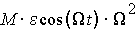
Centrifugal (or centripedal?) forces, expect something like
Also, Don't forget there are FOUR springs, total. Two in x and two in y!
Create a total, net spring constant for each direction.
You need to draw a free-body diagram for 5.2(a), which should help you establish
the correct equations (taking special care to avoid SIGN ERRORS).
To check yourself, consider specific cases, and see if your equations would
give intuitive answers:
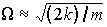
What if Ax >> Ay, and only the left and right springs are used?
You already know how to calculate the equations of motion for a mass moving linearly.
Does this give the same answer as your equations?
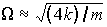
What about Ay >> Ax, where only the top and bottom springs deflect?
Hint, this is why you are asked specifically about the frequencies:
Once you have established the equations of motion, you can plug in values of omega and
solve for Ax and Ay. More tips:
MATLAB can help you solve for Ax and Ay, given some omega (and/or plot resulting shapes)
For the BODE plot, you can think about putting you equations into transfer functions, giving
output of x or y. They should look vaguely of the form:
...since we have a system with NO DAMPING here.
And/or, now that you have made experimental Bode plots (in lab), you can probably also create
a Bode plot (perhaps somewhat more painstakingly) by using MATLAB to plug in a variety of frequencies
(omega) and recording gain (Ay [or Ax]) and phase (0 or -180 degrees, depending on the sign
of Ay [or +/- 90 degrees for Ax, since sin and cos are 90 degrees out of phase]) at each frequency.