

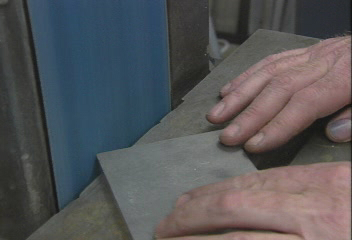
Whenever possible, you should sand with your piece on the bed of the machine. To eliminate hot spots on the belt, move your piece back and forth across the surface of the belt.
To sand the edges of a piece, you'll need to tilt it. With relatively thick parts, say a half-inch or thicker, it's reasonable to do this just by raising one end of the piece.
But there is a danger when doing this with small parts. There's a gap between the belt and the table, and if the gap is larger that the piece, it's possible for your piece to get grabbed by the belt and sucked down through the gap. If you're lucky, the part and nothing else will be sucked into the machine. In the worse case, your fingers get pulled down with it. You can avoid this by holding your part above the table, away from the gap.

|

|

|

|
Sanding corners |
|
|
|
|
|
Sanding edges |
|
|
|
|
|
Sanding thin parts |
You should also be careful about the angle which you hold this part relative to the belt. Holding the part point-down is safe; holding it point-up is incredibly dangerous. When pointed up, the belt can grab the edge of the part and drive it down into your hand, possible causing you to lose finger. If you hold the part point-down, the worse that can happen is that the part will be pulled from your hands.