Team Research Briefing:
Home Banking
March 12, 1997
Table of Contents:
1. Introduction
2. Benefits (Customer and Institution)
Branchlessness
Time and Geography
Cost
Accuracy
Efficiency
Flexibility
Reuse of data infrastructure
Data mining opportunities
3. Issues
Security
Up Front Investments
Pace of Technology Adoption
Transformation in the Finance Industry and the issue of Regulation
4. U.S. and International Home Banking Deployment
Proprietary Dial-in Systems
Third Party Providers
On-line Services
World Wide Web Connectivity
5. Trends
What is Driving These Tendencies for Electronic Commerce?
Internet
EDI
Interactive TV's
Types of E-CommerceDebit Card Model
Digital Coin Model or Blinded E-cash
Traveler's Cheque Model
Electronic Purse Model
6. Conclusions
7. References
Performing banking functions outside of the
traditional notion of a brick and mortar bank is not a new idea
for bank customers. Automated teller machines (ATM's - for
withdrawals, deposits, transfers, and information) and credit
cards (for payments without getting cash from a bank) have been
in widespread use for decades, allowing people access to their
money without the use of a teller. These functions give people
freedom from the constraints of banking hours, etc., but still
mainly require them to leave their homes. In this paper we will
cover banking activities that customers can perform from the
comfort of their homes.
Consumers have been able to perform certain retail banking functions at home for almost 30 years. As early as 1970, bank customers were able to check the balances of their accounts, perform transfers of funds between accounts, and pay certain bills using a touch-tone telephone. At that time, the telephone was believed by some to be the ideal home banking technology as most people had access to a telephone. This did not prove to be true as the touch-tone telephone was not so ubiquitous and customers missed visual verifications of their actions. Home banking also seemed prime to take center stage in the 1980's with cable television as a possible medium. Although visuals were not the problem, two-way communication was - as it is today with talks of telephony and interactive video over the cable infrastructure. In the 1990's, the tool most able to help consumers with all tasks, not just home banking is the Personal Computer (PC). Initially, home banking using this tool was also a failure. Banks failed to get the needed critical mass of willing PC users - an example of an initial failure was Chemical Bank's Pronto System.
As we sit here in 1997, why do we think that
home banking will finally work? There are a few reasons why home
banking has become and will continue to become a very common
activity for consumers. Today's very computer literate consumers
should be more accepting of the PC-based home banking model.
These consumers have become dependent on the use of the ATM,
embraced e-mail, and now surf the web, all with increasing ease
and expertise. These types of consumers combined with the
proliferation of PC's and modems as commodity goods in the
household create the critical mass that businesses need to make
the large investments in consumer friendly technologies.
Additionally, increasing media attention will pique the interest
of many users and equip them with knowledge about banking
alternatives - including home banking. Finally, competition from
non-banking institutions such as Microsoft, Intuit, and personal brokerage houses offering new services to
differentiate themselves will force banks to offer similar
services just to keep up, and will create a need to enhance
customer service to keep and attract customers. Offering home
banking through the purchase of software or combining many,
previously separate, services will seem like a value added
proposition to many consumers.
Kalakota &Whinston discuss a new
competitive environment created by five distinct factors: (1)
changing consumer needs driven by on-line commerce, (2)
optimization of branch networks in order to reduce costs, (3)
changing demographic trends and potential new consumer markets,
(4) cross-industry competition caused by deregulation, and (5)
new on-line financial products. Throughout this paper, we will
touch on these concepts as they affect consumers, banks and
competitors, and the overall industry.
As mentioned, home banking is partially spurred
on by the proliferation of personal computers in the home. At the
end of 1996, there were PC's in 37% of U.S. telephone households
(34.8 million PC households) and modems in 23% of U.S. households
(62% of PC households, or 21.6 million modem households). In 1996
there was a 68% increase in commercial on-line service and/or
Internet use by PC households (from 9 million in 1995 to 15.1
million in 1996, or 42% of home PC households). 1996 also saw a
dramatic 138% increase in Internet usage, from 6.2 million to
14.7 million U.S. households in 1996. There was also a 28%
increase in commercial on-line service usage, from 6.9 million to
8.9 million U.S. households. In total, 9.2 million households
(27% of PC households or 10% of all U.S. households) use on-line
services or the Internet to do some sort of financial management.
Of the total PC households, 55% (19.1 million)
use the PC to help manage finances, making home finance a
"killer app" (killer or very successful application)
among PC functions. Home finance ranks 3rd in home PC
function popularity behind games and children's educational
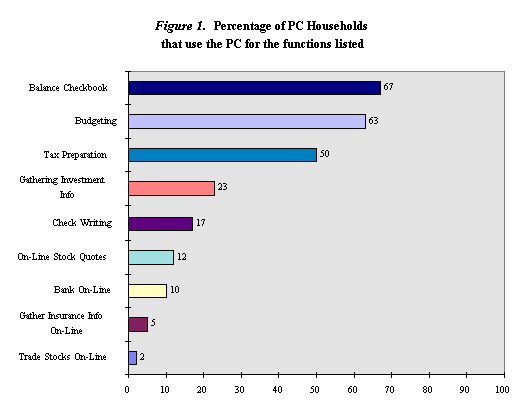
activities. Home finance consists of many different functions; a
consumer can partake in one or many of these functions. The
specific functions can be generalized into the following
categories: tracking account balances (balancing a checkbook),
writing checks, budgeting, tax preparation, gathering investment
and insurance information, gathering on-line stock quotes,
trading stocks, and banking on-line. These functions and the
percentage of U.S. PC households that perform them are depicted
in Figure 1.
Source: American Home Financial Services Survey
FIND/SVP & Jupiter Communications
These consumers have many needs that can be met
very well through home banking services. According to surveys,
many of today's banking customers are striving to gain more
control of their financial situations through better record
keeping in all financial categories, including their accounts and
investments. They look to receive faster and more personalized
access to relevant investment information. Many of them are
saving for retirement, and today's tools allow them to monitor
and control their financial futures themselves. They also seeking
improved customer service, as customer satisfaction in many areas
of financial services is declining.
The current state of home banking enables a
banking customer to: (1) receive on-line delivery of marketing
information, (2) have electronic access to bank statements, (3)
transfer funds between accounts, (4) pay bills electronically via
check or bank-merchant transfer, (5) use software products with
full memorized and scheduled transactions to perform full
financial management activities.
Although there seems to be an increase in the
amount of home banking being performed, there are still
persistent barriers to adoption. 40% of PC owners say they have
no need or are not interested in on-line banking. The American Home Financial Services Survey suggests that most do not know enough about home
banking features to make a real assessment. The survey also found
that 1 in 5 PC owners will begin to do home banking in next 12
months, meaning that if even half of them actually do, the number
of home on-line banking households will double to about 6.6
million by the end of 1997.
In this paper we will explore some of the
reasons why banks and consumers are so attracted to home banking.
We will look at cost reductions, changing consumer needs and
demographic trends, increased competition, and the general impact
of technology. We will also look at some of the issues, such as
pricing and security, facing the consumer and the institutions.
We will examine a few specific examples and methods of home
banking such as proprietary bank dial-up services, Intuit's Quicken and Microsoft's Money financial
software, commercial on-line services, and the use of the World
Wide Web (WWW) as a banking tool. We will conclude by looking at
some of the latest trends in home banking such as smartcards.
Consumers are increasingly careful about their
time and their money, especially regarding their personal finance
issues. They are spending more time working than ever before, and
are placing a higher premium on their leisure time. Therefore,
customers are becoming a very receptive audience for time-saving
products and services. On the other hand, regarding the offer
side, since 1984 the banking industry has been consolidating at a
rapid pace. The central goal of the mergers in this industry is
to reduce operating costs.
On-line technology can deliver services far
more economically than the traditional methods, as the
infrastructure costs can be shared with the consumer (for
instance, the PC´s). Additionally, banks are facing increasing
competition not only from the traditional financial industry, but
also from companies such as automobile manufacturers (credit), Microsoft (financial information, bill payment management, etc.),
and others. If banks are going to compete with these new
competitors, they are going to have to address their traditional
banking overhead structures, as well as their retailing
strategies. A possible solution in this sense is through
providing on-line financial services.
Home banking and in general, on-line financial services, have benefits for customers and the offering companies in terms of branchlessness, time and geography, cost, accuracy, efficiency, flexibility, safety, reuse of data infrastructure and data mining opportunities.
Using the Hammer and Mangurian (1987) model
(see Figure 2), the impact-value-framework combines potential
impact of telecommunications in terms of time compression (time),
overcoming distances (geography) and the altering of the
structure of organizational relationships (relationships). The
objectives are efficiency (the optimal allocation of resources),
effectiveness (the optimal realization of goals) and innovation
(the realization of new, more attractive goals by improving
products and/or services or by entering new markets).
Figure 2.
Impact/Value Framework (based on Hammer & Mangurian, 1987)
| Impact/Value | Efficiency | Effectiveness | Innovation |
| Time | Accelerate business process | Reduce information float | Create service excellence |
| Geography | Recapture size | Ensure global management control | Penetrate new markets |
| Relationships | Bypass intermediaries | Replicate scarce knowledge | Build umbilical cords |
Branchlessness refers to the possibility of
delivering the financial services through virtual channels,
different from the traditional branch approach where the
customers have to devote part of their time to physically go to
the bank, wait on line for the availability of resources from the
bank to make the inquiries or make the needed financial
operations. The branchless aspect of the home banking service is
a dramatic change in the interface and in the resources required
to operate by the customer (releasing time to work or to leisure)
and to the bank (releasing resources that, because of the
non-linear nature of the physical interface with customers can
mean an important amount of released/reduced resources and
overhead costs). The branch is at home at any time desired by the
customer. In terms of the benefits for the banks, branchlessness
means higher efficiency levels at every level of costs and
investments, because it can reach a broader scope of customers
and offer a higher level of services in terms of type and
quality. In this sense, branchlessness, more than a cost
advantage, is an operational advantage, a leverage point for the
operations.
By replacing the physical lines by electronic dispatch there is an important impact in terms of the delivery of the service to the customers and also in terms of the required facilities for the targeted level of service the bank wants to deliver.
The use of home banking has an immediate impact in terms of the availability of the services for the customers, in terms of time and geography, as they can connect to the required information or service from their respective locations. It is especially valuable for customers since they can access those services in hours that are now normally out of the office hours for banks, which was the one of the initial impacts of using ATM's. Now the scope of the services at home is increasing, and the flow of services in terms of what service, when I can get the service and where the service is, is a restless boutique of products that are used as the flow of information, coming from different sources, brings new information that changes the decisions for customers. The flexibility of time/geography is a must now, when the customer is becoming more sophisticated in terms of the information that he/she is managing. The increase in geographic and time scope means that the financial offers get closer and richer to the customers, being able to better satisfy their needs.
Banks reduce their overheads per customer with the sharing of infrastructure costs. Furthermore, the replication of the service requires 1/10 of the traditional cost, being able to provide 10 times of the traditional offering. On the other side, the customers face a decreasing alternative cost of getting the financial services, as they do not have to receive the service physically in the bank, avoiding the waiting lines. The customer can choose the time to interface with the bank, from home, saving time from work or leisure. Additionally, now the customer can make better decisions as they are using wider and better sources of information using the same interface that the banks now use for operating with the customers, the PC´s.
The customer interfaces directly with the bank, reducing the number of processes and transactions between what the customer does and the final operation in the bank systems, which reduces the possibility of errors in the process. This issue is important for the banks, in terms of reducing the cost of quality for banks.
Basically a result from reduction in cost, efficiency manifests itself as an increase of accuracy and increase in the information to the customer. The bank is able to manage the same customers with less resources providing a better service in terms of the information the customer is managing and the customers manage their personal finances allocating time now in a more efficient way regarding work or leisure.
The bank offers a wider range of alternatives for customers in terms of what, when and where it is offering its financial services/products. This is flexibility in terms of delivering the product/services and also is flexibility in terms of the possibilities of mass customization of the product/services that the bank can deliver. By managing properly the information of the transactions realized by its customers and their individual characteristics, the bank can deliver new offers to the customers, tailored according to their revealed needs, habits and personal characteristics, This is a powerful tool in terms of the higher flexibility in creating value to the customers, by leveraging the business with Information Technology tools, applied to the customer through careful marketing practices and processes.
Data can be stored and then reused by the customers, at almost any point of time, allowing scale economies in the sourcing and delivery of financial information for the bank (in terms of overheads, infrastructure required to provide certain level of service, etc.). Customers can access general, specific and private information directly now using this new interface, avoiding the traditional investment of time and patience in the branches, by plugging directly into the bank's information systems.
The increasing number of services/products and
operation in home banking is structuring and increasing customer
databases in terms of personal characteristics, personal finance
habits and a wide variety of information about them (what they
buy, when, where, what are their payment habits, etc.) This
information opens an opportunity for customizing offers for
customers having analyzed their characteristics and behavior.
This information will become more valuable as the banks have to
think how to compete in the emerging industry where information
is the key factor and where a closer knowledge of the customers
and their needs, a tailored offer, may be the key to gain and
retain the business.
The issue of security is undoubtedly the most
polemical and discussed concern of electronic home-banking.
Financial institutions and government have not yet reached a
common understanding of the significance of the risk involved in
electronic transactions (particularly through the Internet), nor
of the required actions to increase security.
However, despite the lack of a clear vision
about security, there are some incontestable ideas that have been
mentioned by industry experts:
Data encryption should be seen not as an invulnerable protection against cyber-pirates, but as a time-delay lock that detects possible hazardous users and activates defense mechanisms.
It should not be seen as a static defense, but as a dynamic, continuous, and ongoing defense plan.
Banks spend half of their non-interest expense on retail delivery systems and channels. Experiences with new channels show that they stimulate more transactions than divert from current ones, so people will continue to use multiple channels (branches, call centers, ATM's, etc.) depending on the type of transaction. Therefore costs incurred by banks will increase in the new home electronic channels long before they decrease in the existing channels.
Regardless of the convenience of home-banking, only 12 million U.S. households are expected to use remote home-banking by the year 2000. Non-tech-savvy people are not ready for such innovations and certainly will be suspicious of doing money transactions from their home PC's (if they have one). On the other hand, tech-savvy people will constantly benchmark all the services from different banks, and change for those with better features or lower costs. Hence, banks will need both to create state-of-art services, as well as, basic easy-to-use applications. The same will happen with marketing campaigns to acquire new customers. Marketing efforts will be driven not only by conventional media, but also through web advertisement.
The fact that electronic home-banking services
need not to be provided directly by financial institutions (e.g. Intuit) raises an issue of sustainability of competitive
advantages of retail banks. Electronic transactions can be done
through different interfaces provide by non-financial firms.
These firms, which may be better prepared to offer
state-of-the-art interactive interfaces, can establish a direct
link with customers, who will lose contact with banks.
In order to react, banks have to increase their
portfolio of products. To do that, commercial and investment
banking would need to be offered as a single service by the same
institution, which is hitherto prohibited (Glass-Steagall Act of
1933).
Thus, advances in electronic home-banking should and must come simultaneously with deregulation of financial services. So that the financial industry will be able to reconfigure itself (probably through consolidation) and react positively to technical innovation.
Personal computer home banking implementations fall into four categories that we will explain below. It is important to realize that these are only the front-end (customer interface) of the systems, the actual information processing is fairly independent of the front-end and is subject to different constraints.
Proprietary dial systems are the oldest form of PC home banking. The bank typically provides the personalized connection software that does not work with any other institution. In fact, the customer has to call the bank to access the service. These programs were, and in some cases still are, developed by the bank itself or contracted from a third party. This old implementations does not allow for account management as the modern personal finance management software does (e.g. Quicken, MS Money and Managing Your Money). Almost every big commercial bank offers this kind of service (e.g. Citibank and the Brazilian bank Bradesco)
As the personal finance management software business grew more competitive, Intuit developed relationships with a number of banks in order to sustain the leading position of its Quicken software package. Nowadays Intuit Financial Partners comprise more than 40 financial institutions including Citibank, Chase, Wells Fargo, J.P. Morgan, and American Express. Quicken still holds the leadership position, being used by more than 12 million consumers and small businesses in the US. After a sluggish start and a failed attempt to buy Intuit, Microsoft Money is capturing significant market share due to its integration with the Office software suite, the Microsoft name and the creation of the on-line Money Zone service, where you can connect to banks or get financial information.
Since the boom in Web surfing, on-line services are under significant price and revenue pressure. The price pressure comes from the Internet Service Providers that offer flat-rate Internet connectivity. The revenue pressure comes from the Web Home Pages that deliver content for free. On-line financial services represent one of the attempts to leverage the large customer to generate revenues. The most widely known service is America On Line's BankNow which was developed, interestingly enough, by Intuit.
Use of the World Wide Web for banking is the latest trend. A financial institution provides branded service at the customer home through a public network without having to pay for the connection or the front-end software. Furthermore, the institution does not open an opportunity for any intermediary to capture the customer relationship interface. This kind of implementation still presents many issues, such as actual and perceived security. On the institution's side this is a great option, as it presents low costs and broad reach. On the customer side it lacks the personal accounts management facilities provided by Quicken or Money. This customer interface puts every bank in same playing field, be it Citibank, Security First Network Bank or Brazil's Bradesco.
The fast dynamics of this market and the pressure to achieve large market share and economies of scale is driving the birth of some consortia. The two of the most significant are the following:
This consortium puts together IBM and a group of 16 banks that represent over 60 million households in the United States, more than half of the retail banking population in North America. Initially, customers of Integrion member institutions will use a personalized version of MECA's "Managing Your Money". Integrion's, so called, Gold Standard does not restrict the users to this software and is an open standard that may be embraced by other vendors. Integrion plans to solve the back-end processing problem by offering common infrastructure and setting standards that stabilize the market. The services include a parallel private network that has been handling transactions safely for a long period - the IBM Global Network.
This consortium puts together the leading
competitors in the personal finance management and electronic
payments areas. It represents the convergence of Intuit's Open Exchange, Microsoft's Open Financial Connectivity, and CheckFree's electronic banking and payment protocols. As a
front-end protocol standard it will link to Integrion's back-end
Gold Standard for transaction processing.
A Palo Alto-based market research firm predicts
in "E-cash Payments: Impact and Opportunity", that
e-cash transactions (consisting of secured credit and debit
cards, phone cards, electronic checks, stored-value systems,
ATM's, derivatives, money transfers, automated fares/tolls and
coupons/script systems), which were responsible for one billion
transactions in 1995, will grow to nine billion in the year 2000
and nearly 30 billion by 2005. The study estimates that the
Internet and electronic commerce will drive 85 to 90 percent of
growth in e-cash transactions. The level of global e-cash
transactions, according to Killen & Associates, will surpass
U.S. credit card transactions by almost three billion in the year
2005.
On the other hand, OVUM stipulates that e-cash
will have profound effects on three banking technologies: ATM's,
the number of banks providing full service banking on the
Internet, and the amount of personal financial management
packages on the market. The amount of e-cash in circulation
world-wide will rise, it is claimed, to $8.63 billion (U.S.) by
2006 with rapid uptake beginning in 2001.
If the hype merchants are to be believed, money
as we know it will soon be as much of a relic as the gold
standard. Instead of bills and coins, we will spend electronic
currency, "e-money", that we zap to merchants from our
PC's or carry with us on smart cards.
Mainly, there are three technologies that have changed the market place: the Internet, EDI systems between companies and suppliers, and the possible Interactive TV's.
This technology has been able to connect directly with a fixed charged any possible combination within the customers, companies and suppliers in any part of the world, thus enabling near real-time commerce as well as an economic motivation to perform transactions. As one result of the Internet's surging popularity, business-to-consumer e-commerce has become more attractive, especially in the retail industry. Indeed, many see the business-to-consumer field as ripe with possibilities.
The business benefits of electronic data interchange (EDI) include lower costs and more flexible systems, enabling closer and more efficient relationships with a wider range of suppliers, partners, and customers.
This technology has not been out in the market (except for WebTV which fits the WWW model better). Yet, if it becomes available it offers another tool where e-commerce can grow substantially.
Once having seen the importance of electronic cash to make transactions in this new environment, there are a number of ways of implementing e-cash. Banks must understand the benefits of the different models and find which model may be the standard in the marketplace.
Every transaction is cleared through the bank at the time of transaction. There is no privacy at all here, as both the payer and payee are known. Data mining techniques are easily used to build up finely-targeted demographic profiles for fun and profit.
Developed and patented by David Chaum of DigiCash, this method allows the payer to remain anonymous. Cash
is dispensed by the bank in fixed-size units, or
"coins", that are encoded with a unique serial number.
The user further encrypts them with a "blinding factor"
that hides the payer's identity, but maintains the proof of
authenticity. DigiCash e-cash is still in
the trial phase. This system makes it possible for two e-cash
users to exchange money over the Internet. The consumer pays
nothing to use the system. Its weakness is that it assumes the
encryption system can never be broken.
CyberCash/CheckFree Wallet gives away client-side software that encrypts and forwards transaction and credit card information to a Web-based merchant, who then forwards the information to a CyberCash server. The server takes the information behind a firewall, decrypts it, and sends it to the merchant's bank using a crypto box and EDI, just like a retail store. The merchant's bank then forwards an authorization request to the bank that issued the credit card. After performing a verification, the credit bank forwards an approval or denial to CyberCash. CyberCash passes it along to the merchant, who sends notification to the consumer.
This model is similar to the digital coin model, but allows the consumer to spend any amount up to a predetermined maximum. Also allow transactions to be as anonymous as cash.
This system uses a "smart card" that
is loaded with a specific value of e-cash. As the e-cash is
spent, the value loaded on the card is reduced. The information
kept at the merchant site is never downloaded to the bank, and is
part of a fail-safe mechanism to detect counterfeits in the
unlikely case the encryption is broken.
Right now, the various schemes are only in the
field-trial stage. Now is the time to find potential problems,
voice concerns, and find solutions to the inevitable problems.
Problems such as security, consumer confidence in the system,
confidentiality, companies infrastructure (processes and
operational systems are on extremely control), pricing and
standardized products must be solved for the development of
e-commerce and the involvement of banks.
For instance, Chase Manhattan and Wells Fargo are shying away from the Internet. Instead, these institutions are teaming up with companies like CheckFree, Intuit, and Microsoft, which have all built private consumer banking networks that have powerful security schemes, including secure firewalls and automatic encryption for all of their transactions. Other financial institutions, including Bank of America and Citibank, are going it alone, hoping to lure customers to their Internet sites with better services.
Due to the cost efficiencies and higher level
of security obtained utilizing e-cash, non-banking institutions,
including software vendors, can view the market as an opportunity
to compete for traditional bank business. And that means banks
will have to pick up the pace if they plan to hold on to their
market share: only 50 of the nearly 600 banks currently with Web
sites have the capability to facilitate online banking services.
There has been a trend, however, for a new
Integration Financial Network, IBM and major banks, including ABN AMRO BANK NV, Bank of
America, First Chicago NBD and Nations Bank say they will offer
online banking and electronic commerce services to banks in the
United States and Canada starting next year. They will use IBM's Global Network for the most sensitive transactions.
This concept is an outgrowth of the kind of
strategic maneuvers that characterize the Internet as a whole.
Financial service providers want to migrate their services to the
Internet. Platform manufacturers, server vendors, and ISP's are
struggling to provide secure transactions. With the stars thus
aligned, major players have banded together to capture part of
the growing stream of cyberdollars. AT&T, BBNPlanet, UUnet,
Digex, and USWeb all offer commerce services, taking advantage of
a variety of partnerships among tool vendors, payment processing
services, and financial service companies.
Kalakota, R. and Whinston, A.B. Electronic
Commerce: A Manager's Guide. Reading, MA: Addison-Wesley, 1997.
American Home Financial Services Survey, by FIND/SVP emerging technologies
research group & Jupiter Communications
Diogo Teixera, "Start Thinking About
Retail Delivery Break Points", The American Banker,
January 6 1997.
Kutler, J. and Mead, W.S., "Web
Possibilities Make Security People Insecure", The
American Banker, February 27, 1997.
Kelley, E., Federal Reserve Report June 1996
Nouwens, J. and Bouwman, H., Living Apart Together In Electronic Commerce: The Use Of Information And
Communication Technology To Create Network
Organizations, University of Amsterdam
Other Quotes:
"Electronic commerce generated about 700
million in transactions in 1996. That is what VISA and MASTERCARD
transact every 70 minutes." - Lou Gerstner
"We expect the number of US home banking users to grow 75% annually until the year 2000. To handle this demand , US commercial banks may be forced to grow their home banking expenditures to over $1 billion by 2000" - Diogo Teixeira - Tower Group