

Cleanup! can be used to instruct in the characterization and remediation of hazardous waste sites. Characterization and remediation of actual hazardous waste sites are greatly complicated by the difficulties and expense of obtaining information about the subsurface environment. To introduce the student to these constraints, realistic sites can be simulated with the contouring capabilities of Cleanup! disabled. Without benefit of the contours, the student must rely on monitoring wells to obtain information.
These example screen shots illustrate a hypothetical characterization and remediation of the Landfill-1 plume at the MMR.
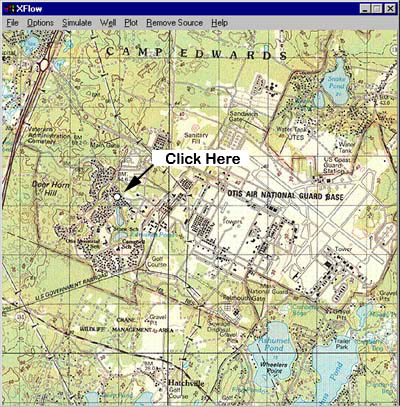
 Tetrachloroethene
and trichloroethene were discovered in the MMR water
supply Well G in 1983. The approximate location of Well G
is indicated by the Well Symbol (white circle).
Tetrachloroethene
and trichloroethene were discovered in the MMR water
supply Well G in 1983. The approximate location of Well G
is indicated by the Well Symbol (white circle). To open the Well Interface and sample groundwater, click on the Well Symbol.
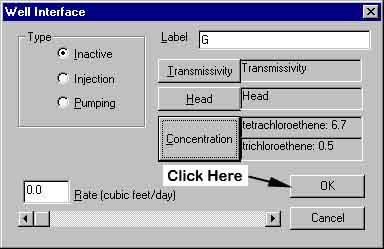 Well
Interface Screen
Well
Interface ScreenThe Well Interface indicates the concentrations of tetrachloroethene and trichloroethene to be 6.7 and 0.5 ppb.
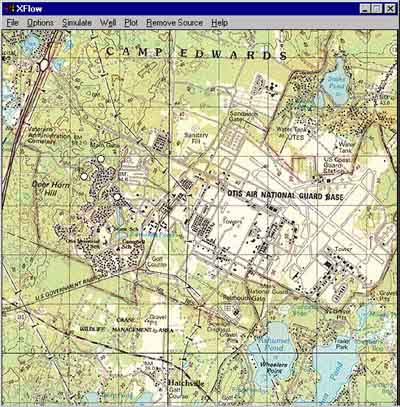 Characterization
Upon discovery of groundwater contamination, a site characterization program would be carried out. This figure illustrates the installation of two additional wells.
Once the contamination has been characterized (or the characterization budget is spent), a pump-and-treat Remedial System can be designed.
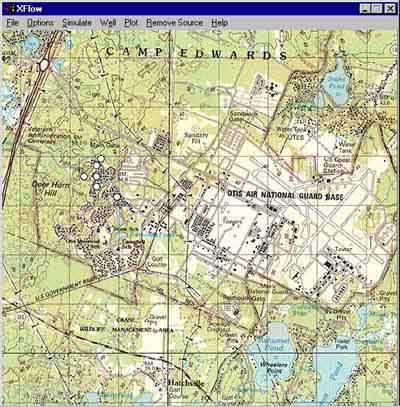 Remedial
Design
Remedial
DesignWithin a given budget and timeframe, the student must specify well placement, pumping rates, and degree of treatment.
This figure illustrates the installation of three capture wells.
The student must assess the performance of different well configurations.
Performance
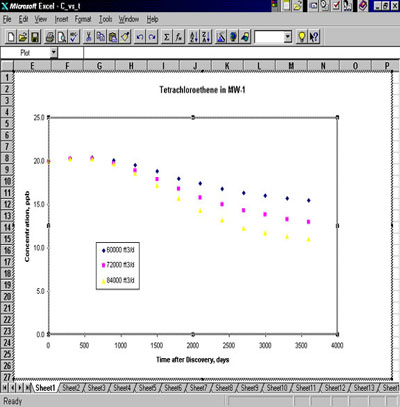
AssessmentFor purposes of summary and reporting, results can be exported to MS Word and Excel. In this figure, groundwater concentrations in a monitoring well are plotted to assess the performance of different pumping rates. The student might select the middle rate of 72,000 cubic feet per day as one that balances benefits and costs.
Upon selection of pumping rates, the student attempts to remediate the plume.
 Instructor
Feedback
Instructor
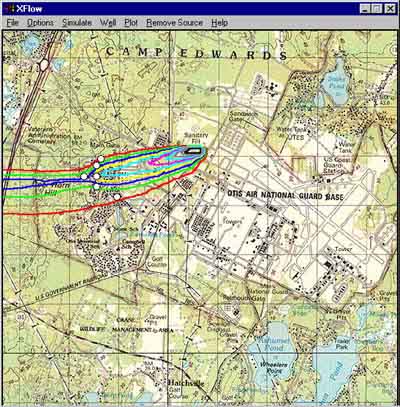
FeedbackUpon completion of site characterization and remediation activities, the student can submit a summary report of his or her actions at the site and the costs incurred. With the contours enabled, the instructor can evaluate the student’s performance and provide feedback. This figure shows the hypothetical Landfill-1 plume after approximately 10 years of remedial pumping.
