| velocity | U |
 |
| length | L |
 |
| time | T |
 |
| pressure | p - p - p |
 |
13.021 - Marine Hydrodynamics, Fall 2003
Lecture 6
Copyright © 2003 MIT - Department of Ocean
Engineering,
All rights reserved.
Non-dimensionalize and normalize basic equations by
scaling:
Identify characteristic scales for the problem
All ()* quantities are dimensionless and normalized (i.e. O(1)), e.g.
 . Apply to governing equations: (also internal constitution, boundary conditions)
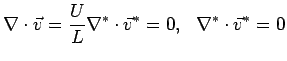
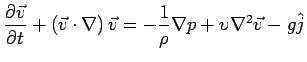

 (order of magnitude of the convective inertia term)

 measure the relative importance of each term (as compared to the convective inertia term):

 ignore
 assume steady-state.
 cavitation number (measures likelihood of cavitation)
 no cavitation. Alternatively, when
cavitation is not a concern
no cavitation. Alternatively, when
cavitation is not a concern
 .
.
 Euler
number
Euler
number
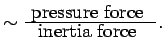
 Reynold's number
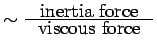
 , ignore viscosity.
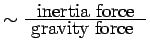
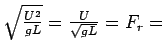 Froude number

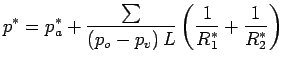
 where where 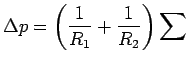 |
||
 |
||
where 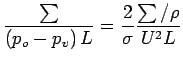 |
 Weber number
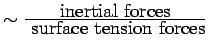
note:
 usually
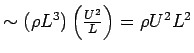
Alternatively, using physical arguments: forces acting on a fluid particle
 mass
mass  acceleration
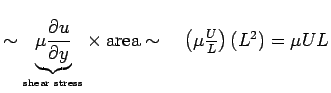
mass gravity


For similar streamlines, particles must be acted on by forces whose resultant is in the same direction at geosimilar points. Therefore, forces must be in the same ratios:
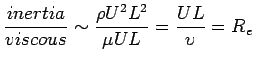
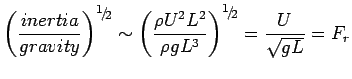
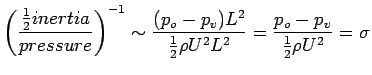
For example, hydrofoil traveling close to the fluid surface.
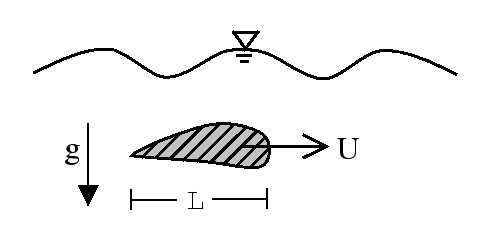
Parameters:
 |
Force coefficient on the foil:
 |
 , change
  with
with  ,
,  ,
,  ,
,
 fixed.
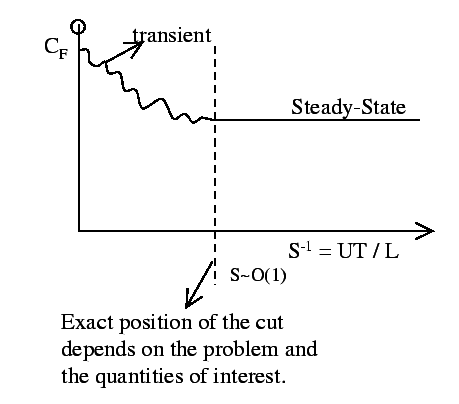
For  , assume steady-state:

For  , unsteady effect is dominant.
For example:
, unsteady effect is dominant.
For example:
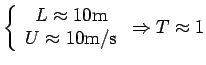 seconds gives seconds gives  assume steady state since assume steady state since  |
So, for steady-state problem:
 |
 (fixed
 and ).
| P: |
vapor pressure | ||||
 |
State of fluid changes from liquid to gas
 CAVITATION CAVITATION |
||||
| Mechanism: |
 Fluids
cannot withstand tensions, the state of fluids changes. Fluids
cannot withstand tensions, the state of fluids changes.
|
||||
| Consequence: | (1) Unsteady  Vibration of the structures, which may lead to fatigue Vibration of the structures, which may lead to fatigue
(2) Unstable |
||||
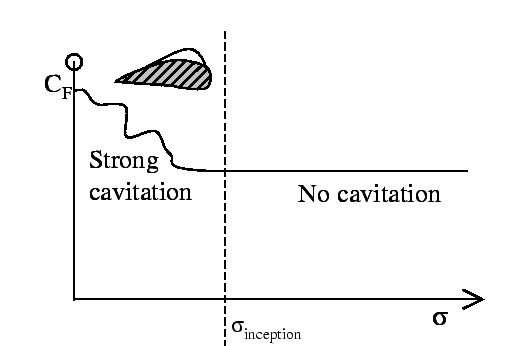
For
 , there is cavitation, and for
 , there is no cavitation. For example:
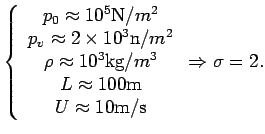 To have cavitation we need large To have cavitation we need large  or or  |
Note:  is the pressure at which the water boils.
For steady non-cavitation flow (
)

 (fixed and ). For example, if
 (water-air
20
(water-air
20 C),
C),  =10
=10 kg/m and
  m, we end up
with
m, we end up
with
 . If we want
 , we need
 m. Then, for
 m,
m,
 and
and
 , so neglect
surface tension effect.
, so neglect
surface tension effect.
For steady, non-cavitation, non-surface tension effect,

 , which measures the effect of
gravity.
, which measures the effect of
gravity.
For problems without dynamic boundary conditions (i.e.
if free surface is absent) or if the free-surface is far away or
not displaced, gravity effects are irrelevant and is not
important

e.g.
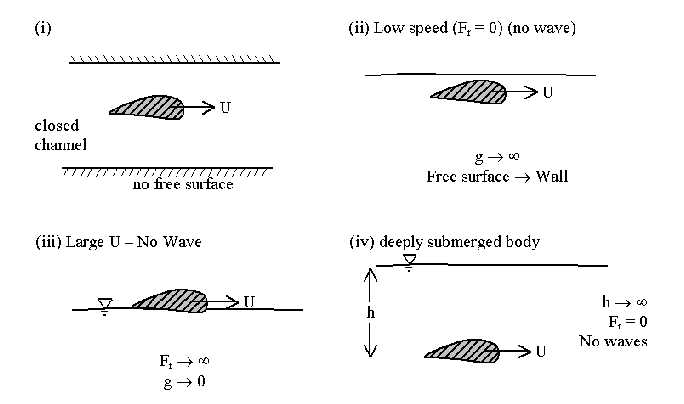
In general
 Froude's Hypothesis
Dynamic similarity requires:
 |
|
 |
 ,
,
 for the same
  and
and  .
.
 .
, no , no gravity
effects,
.
, no , no gravity
effects,

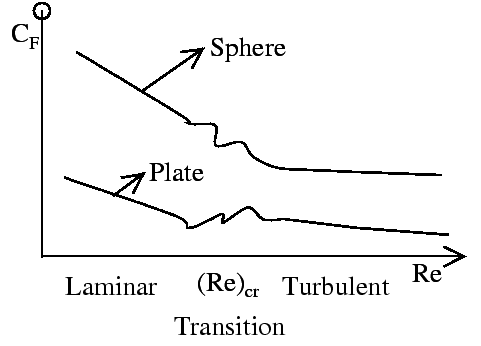
 |
Stokes flow (creeping flow) | |
 |
Laminar flow | |
 |
Turbulent flow | |
 |
Ideal flow |
For example:
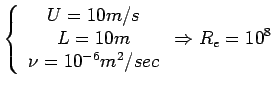 or or
 |
For steady, no , no , no gravity effect and ideal fluid:
 constant
 D'Alembert's Paradox: No drag force on moving body.