A Final Word on the Infinite Undergound

•December 11, 2009 • Leave a Comment (Edit)

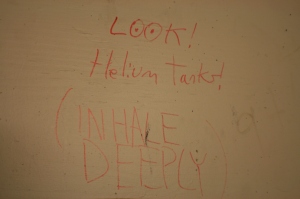
I feel compelled to share the story of my journey through the infinite tunnels not because I want an audience, but more so because I no longer want to keep this inside of me. At the beginning of this semester, this project began innocently enough. I selected my site – the tunnels beneath MIT – and began exploring the dark, dank, twisting, disorienting, seemingly infinite, then abruptly terminating, monotonous, incongruent, enclosing, expansive, network of tunnels running beneath MIT’s main campus buildings. Several weeks later, after extensive explorations and documentation, it dawned on me that my life had taken on similar trends or traits as those I experienced while navigating through the tunnels. It was as if the events I had encountered in my life during that period, the challenges I faced, the paths I chose in attempt to either overcome or circumscribe these challenges, became synonymous with journeying through the tunnels. I felt oppressed, trapped, hopeless. I felt that there was no end to the misery I kept facing. I tried to be as resilient as possible, and I kept telling myself that things could be much worse, but my spirit grew more and more weary, and the light at the end of the tunnel became a mirage.

This experience made me think of actors who become too absorbed in their characters; I felt as if my site, and the essay I wanted to tell of it (explorations of this dark, mysterious place, that’s almost impossible to escape from) had begun to absorb me. The tunnels – this place I had once seen as a refuge from the hustle and bustle of above-ground activity – had turned into a place I had come to despise almost because in my mind it (and the experience of traversing through) came to represent the turmoil, disorientation, darkness, and hopeless that was submerging me.

Alas, perhaps I have cast unfair judgment on my site. But that aside, perhaps the greater lesson that I have learned from this experience is that one’s relationship with one’s site changes as one explores it, analyzes it, reflects on it. As the level of intimacy increases, so too does one’s perception. I am still coming to terms with my change in perception / sentiment towards the tunnels. I am saddened by the fact that I feel as if I have lost one of my places of refuge which are so few and so precious in the hostile environment of this campus. However, I am grateful for now knowing and understanding that I should expect that my feelings towards a certain may change (for the worse, that is the greater fear I think) when I decide to do an in-depth investigation. This revelation is of course timely and relevant as I get ready to embark on my second photo-journalistic effort: The Industrial Landscapes of Trinidad.

Death of a Valley – storyboarding

•November 17, 2009 • Leave a Comment (Edit)

Death of a Valley

The photos of this essay are sequenced so that it tells the story of how life was in this valley prior to the dam being built, and then the massive destruction and disruption that took place in the name of development and betterment for all. The first few images capture a peaceful, quiet, well-rooted life. Life seemingly is going on the way it has always gone on – boys riding their bicycles, ranchers herding their cattle, and Mr. McKenzie still taking care of business in his store. Then we being to see images of change, of uprooting, of loss – people being forced to give up their way of life to make way for this new development.

Visible changes came slowly and quietly. There was packing, selling, moving. Families disappeared, melting away, emptying the valley. There were sounds of ripping wood for salvage amid the buzz of insects and smell of tarweed in the air, as it had always been.

Euphemism ran strong throughout t this photo-essay. The pace and meanings of the sentences of the first few pages are simple enough in themselves, but they allude that something greater, something ominous is approaching; that the time of the present is drawing to an end and that a new wave is about to inundate the lives in the valley.

There was still time in the summer of 1957 to bring the cattle down from the hills. Time to ship them out of the valley…time for one more harvest…time for a few of the homes to e moved to higher ground.

And then when time was up, and the wave was upon them, it changed everything that stood in its way. Even the bodies of the dead, which had long since been returned to the soil were displaced. The extent of this “development” was such that even the dead had to move out of its way.

The changes came slowly and quietly…gravediggers came into the alley. They disinterred bodies from the family plots and carried then down the road, gravestones and all, toward new plots that had been prepared on higher ground.

The authors descriptive, euphemistic prose, combined with extracts from real documents, and the transcriptions of comments made by bystanders really captures the stance of the various actors of the scenes. (e.g. page 151)

Then, the final image which shows the almost complete dam is the smallest image of them all. Interesting. It is as if the effect of it coming, and then its presence was so omnipotent that the final image was intentionally made smaller than all the others to suppress the magnitude of the force of its focus. It’s also interesting that this is the only night shot in the entire essay possibly to re-emphasize that the dawn of the dam was a dark day for the valley.

With regards to putting together my photo essay I’m having trouble determining how much to say with photos and how much to say with text. My initial instinct is to want to show as much as possible so that the viewer will be exposed to all corners of the site. However, I recognize that this will make the story to long, the viewer will most likely lose interest and will not have a sense of context for most of the photos. So, I’m still searching for some suitable text to accompany my photos, and also still trying to compose the sequence and unfolding of the story of the tunnels.

Here is an excerpt from Dolores Hayden’s Power of Place which I found really insightful:

Identity is intimately tied to memory: both our personal memories (where we have come from and where we have dwelt) and the collective or social memories interconnected with the histories f our families, neighbors, fellow workers, and ethnic communities. Urban landscapes are storehouses for these social memories, because natural features such as hills of harbors, as well as streets, buildings, and patterns of settlement, frame the lives of many people and often outlast many lifetimes. Decades of “urban renewal” and “redevelopment” of a savage kind have taught many communities that when the urban landscape is battered, important collective memories are obliterated. Yet even totally bulldozed places can be marked to restore some shared public meaning, a recognition of the experience of spatial conflict, or bitterness or despair. At the same time, in ordinary neighborhoods that have escaped the bulldozer but have never been the object of lavish municipal spending, it is possible to enhance social meaning in public places with modest expenditures for projects that are sensitive to all citizens and their diverse heritage, and developed with public processes that recognize both the cultural and the political importance of place.


Polemical Landscapes

•November 2, 2009 • Leave a Comment (Edit)

It is dangerous to erase the past. It prevents dealing with memories and forfeits the possibility of transformation. Reading this statement reminded me of my statement of interest I wrote when applying to grad school. Back then (wow, already two years ago!!) I wanted to come to grad school to explore the relationship between war and architecture/built environment. I proposed, and still contend, that the destruction of the built environment is tantamount to genocide for within a society’s built form are expressions of its values, norms and history. To erase evidence of existence is another layer of elimination, of eradication, in addition to eradicating the authors of this life script. To destroy museums, libraries, religious houses, schools, universities, parks, etc., is to destroy a societies repository of heritage and history. In other instances, the natural landscape may be a particular society’s repository of history and culture, and oftentimes in that case it is not through war (in the traditional sense) but rather in the name of “development” and “social progress” that their repositories are destroyed. Following this, if evidence of existence is erased, but the people continue to exist (that is, some survive the struggle), then how does this society persevere? How does it begin to recover from this tragedy – let’s say in this case it is war: an intentional onslaught, a deliberate attempt at eradication. How do societies begin to rebuild after war? Particularly in heterogeneous communities (Serbia and Rwanda come to mind)in which neighbors who turned enemies-at-war who returned to being civilian neighbors, how do they go forth rebuilding their landscape in the aftermath of one group failing to eradicate the other. Whose history should be remembered and celebrated in public places? Indeed, one sure thing we know about history is that it is the victor who creates the narrative of historical events rendering the story inherently biased.


Landscapes of memory are often polemical…[they] take their authority from the past but present a sanitized sentimentalized version of past and present. It seems as though in every large city (in the US and Europe) that I visit there is at least one Jewish Holocaust memorial, and it makes me wonder how come other groups don’t receive as much recognition for the atrocities exercised upon them. Why is there so much more emphasis on commemorating the strife and suffering of this group far more than any other group of people? “Whose history should be remembered and celebrated in public places?” or in other words, “Whose plight will be commemorated in public places?”. Those whose survivors can afford to fund their memorials, those whose survivors have the power and influence to ensure that their suffering is not forgotten. Memorials require a certain amount of public support and financial backing to be constructed, in the absence of which it is perhaps on the survivors who would privately remember and acknowledge their suffering.

The dark side of identity is that it is often defined not by what people have in common, but against those others who are uncommon, those seen as different and, by implication, inferior or unimportant. Perceiving difference seems to be easier than sensing similarity. The human habit of constructing dualisms runs deep: us and them, city and wilderness, nature and culture. But, similarity and difference need to be held simultaneously: the us in the them and the them in the us; the role of natural processes in cities and of human imagination in wilderness the symbiosis of nature and culture. We need to shift from a focus on the Other to a reverence for all life, to a delight in diversity.

The language of landscape highlights similarities while both acknowledging difference and permitting the assertion of individual and culture within a framework of commonality. Landscapes themselves harbor both genetic and cultural diversity and collectively, human habitats comprise a record of diverse adaptations to similar conditions. That diversity of response is a resource to be treasured. Some day we may have o sift through the human repertoire for answers to difficult questions.


Poetics of Landscape

•October 25, 2009 • Leave a Comment (Edit)

Contrast

The more homogenous and extensive the context, the more powerful the potential contrast…

The extent and monotony of the long corridors are occasionally punctuated with and intersection with another tunnel creating either a dead-end corner or a cross-path, or a space for repose or a view outside. These interjections are a welcome respite to the seemingly endless monotony of long corridors, repeated, static lighting, continuous surface treatments on the walls and floors, and the infinite pipes, cables, and ducts meandering, bobbing, and weaving their way through this underground labyrinth.

Climax

In climax, the “highest or most intense point in an experience or series of events,” intensity and significance increase step by step.

Is there are climax in the tunnels? I don’t think so. There are moments of interjections – breaks from the monotony of the repetition of wall, floor, light, and enclosure, but at no point is there a build-up – a crescendo – to a place of pause, or even to a place elevated experience in passage. There are simply changes from the mood and rhythm of one place to another without the elicitation of anticipation of something extraordinary.

Rhythm

Rhythm is a succession of accented beats or pulses, a pattern of sounds, sights, or sensations, a periodic recurrence or regular alternation with interval, meter, cadence… Rhythms emerge out of a contextual background; they go with or against, in counterpoint.

The most evident manifestation of rhythm in these tunnels is in the lighting, especially along very long corridors. I have even noticed that now not all the lights are switched on, especially at night. Usually every one out of three lights are switched on along long corridors. This creates a distinct patter of light and shadow along the paths, and in fact I feel as if it helps to break the monotony of passage. When walking I become more aware of the pace of my gait, and I try to set my stride to a rhythm that coincides with that of the lights. (What else am I to do to amuse myself when I get bored while walking in these tunnels?!)

Paradox and Irony

Paradox and irony, the one contradictory yet true, the other an incongruity between what is and what seems to be – expected and actual, expressed and intended – are closely related and often combined. Both are dualisms, but irony contrasts surface meaning and underlying reality.

The paradox of the tunnels is that it provides a refuge from the exterior – these enclosed and buried tunnels shelter users from the harsh climate of what is above ground and also from what is outside (bad weather perhaps?), however, because the tunnels are so enclosed and one hardly has views to the outside, it is easy to get lost in the absence of visual cues to guide one’s passage. The tunnels do not always follow the same path as one would take when walking above ground. In fact this underground path is more circuitous and seemingly longer than the path above ground. Thus the irony is that in evading unfavorable above-ground conditions, one runs the risk of disorientation and unintentional entrapment!

Aposiopesis

In aposiopesis a statement or address is broken off, to be completed in the imagination…

There is a small roadway which severs the tunnel beneath building 7. Closing off these severed ends are 2 pairs of heavy wooden doors, which seal the tunnel environment from the outdoors.

Expressive content: Euphony, Cacophony, Mood, Mystery

If personification attributes feelings, thoughts, intentions to the nonhuman world, expressive context attributes the ability to evoke or amplify human feeling to landscape features and phenomena.

When walking through the tunnels it becomes obvious when one is in an area that is a main thoroughfare, as opposed to when one is in a more restricted area even though there may not be explicit signage denoting restricted access. The main thoroughfares are well lit, and the corridors are a bit wider. They are typically flanked by offices and labs. Corridors through service and storage areas are flanked by chain-linked storage areas and are dimly lit and narrow.

The Wider Net – Eudora Welty

Welty’s short story depicts scenes of isolation and silence – the lone house, Livvie’s solitude, and the lack of dialogue. Of contrast – the old, strict husband (Solomon), and his young, innocent, servile bride (Livvie). The climax of Solomon’s death leading to Livvie’s emancipation preceded by the coming of spring, the visit from the vendor-woman, Livvie’s stirring curiosity and awakening restlessness and rebellion. There is momentary antithesis (more like a suspension of build-up) at the moment when Solomon opens his eyes, and Cash raises his hands but fails to act. For all his preceding boldness and arrogance, I was disappointed that he did not stand up to the dying Solomon, frail, withered and on his last breath.

Significant Detail – Landscape Grammar

•October 18, 2009 • Leave a Comment (Edit)

This week I don’t have any comments to add about these excerpts even though they stood out as I went through the reading. Nonetheless, I think it is still worth sharing even  though I have reserved comment.

Excerpts from Language of Landscape:

Through grammar, meanings are shared; grammar is an aid to reading and telling landscape more fluently, deeply, expressively, and gracefully. The language is living, so grammar – derived from speech and the literature of landscape – is timeless, yet not rigid, but evolving and various. There are formulas, rules – artifacts of inherited usage – but also free expression, the renewal of language through the invention of new patterns.

Readers do not use grammar the same way tellers do. Readers decode meaning, move form perception of an element to an appreciation of its function, to understanding. Tellers have a message to relate and search for ways to express its significance by the choice and ordering of landscape’s elements.

Multiple, overlapping grammars is what makes human landscapes so interesting and complex. Pg 168.

Just a word’s meaning is mere potential until shaped by specific relationships with other word in context of phrase, clause, or sentence, so the meaning of an element of landscape is merely immanent until shaped by relationships with other elements in context.  Pg 170.

The successive sometimes hierarchical, relationship of parts and wholes in landscape gives its language a nested structure. Rules of grammar – modification, agreement, correspondence, subordination, and coordination – apply across scales, as well as within. Pg 173.

Disorder, wrote Rudolf Arnheim, “is not the absence of all order but rather the clash of uncoordinated orders.” Arnheim defined order as “the degree and kind of lawfulness governing the relations among the parts of an entity” and complexity as the multiplicity of the relationships among those parts. Pg 180.

Local landscape dialects emerge out of dialogue with enduring contexts of place; traditional vernacular landscapes are a consequence of collective learning, trial and error, finding what works and repeating it, refining through experience. They tend to correspond more closely to local conditions than do landscapes of cultures of highly developed technology.  Pg 181.

As I keep revisiting my, I keep thinking about the theme of ephemeral vs. enduring from last week’s reading. I keep dwelling on the notion that the physical passage through my site is an ephemeral experience, whilst the actual thought of it – and of going down or underground or under – has a much more pervasive meaning the extends prior to and beyond the experience of passing through the tunnels. Every so often I come upon a doorway with yet another staircase, but with stairs leading down. I have only taken one of these stairs once. I dare not take any of the others. I think I am actually scared to. I ask myself (am I not on the lowest level already?.. I don’t think I want to go down any further…).

If you take the elevators in building 10 down to the basement, then turn left onto the infinite corridor, and then another left into building 13, at first you come upon a pleasant area where there are large half-wall windows, opening onto another hidden courtyard garden. This is my favourite garden on campus. It has many trees and some flowers. There are concrete tiles creating a footpath from the western tip of building 13 to the stairway leading to the small recessed entryway of building 10. A couple weeks ago I noticed that the bottom-most window along this half-wall is broken. Since then, I have been toying with the idea of how best to photography this broken window with the one shard dangling from the top of the frame and crack lines radiating through the rest of the glass that is still set in the frame. Should I photograph it from the outside looking in, or from the inside looking out. I finally decided that from the inside looking out was better captured the context of this window in its setting.

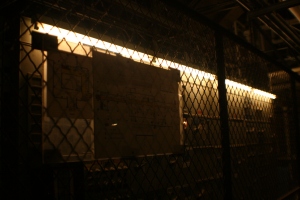
Along the eastern end of building 13 is a very narrow corridor with chain-linked storages areas on one side and a smooth plaster wall on the other side. At the end of this corridor, just next to the exit sign is one word of graffiti. Then, on the doorway leading to the escape stairway is another bit of graffiti which says, “spot the wonder slug ?”. I have no idea what this means but it’s so amusing to me; I wish there was more graffiti in these tunnels. This got me wondering why indeed there was not more graffiti in these tunnels. The wall I just described would make a good canvas for graffiti. If only I was skilled at it, I would venture to do some artwork on these walls. My greater hope is that someone will read this blog and become motivated to apply some artwork to some of these drab walls.
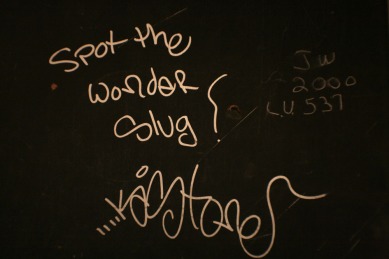
Spot the wonder slug graffiti

I subsequently did manage to find some more artwork underground. Perhaps this is the greatest treasure hidden down there. I was only able to see the full extent of it because someone had left one of these chain-linked cages unlocked. Up the stairs onto to make-shift wooden platform crossing some huge pipes are the tags of MIT’s hackers! From behind the cage one can only get a slight glimpse of one of the tags which resembles the label of Jack Daniel’s whiskey bottle. I crawled over the platform into the alcove which housed the tags of about 7 hackers. They were huge! Then I looked up, and there were writings on the ceiling and ducts – remarkable because they were about 30 feet high! All the while I was there I was nervous because I knew that I was actually below the tunnels at this point, and also fearful that I might be discovered in what I perceived as some sort of “sacred”/secret space. Alas, I have not disclosed the location of this shrine, and I don’t intend to…
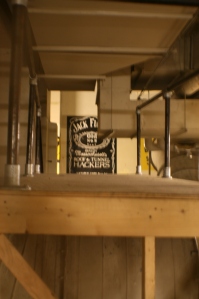
Hacker tag

Jack_daniels

After weeks of exploring the tunnels from within, I have begun to explore them from the outside. In most instances reference to this underground space is through office windows opening out to some courtyard garden. The majority of the tunnels are double-loaded corridors (flanked with rooms on both sides), however on a few occasions they are single-loaded and usually at these intervals they run alongside courtyards providing passers-by with a relieving reprieve from the confinement of the tunnels. The designers of these buildings should be commended for allow passers-by a break from the constant enclosure of the corridors and a chance to enjoy a softer, more natural view.

Thus far I have only shown my site in static frames. None of my photos contain images of people using the space. This will come in the next section – Poetics. The static elements set the tone and give the sense of place. The various ways in which people utilize the spaces creates a sort of poetry in motion. From the glass-blowers drawing glowing, molten glass out of the kiln; to the researchers scurrying into their labs; to the traversers using the tunnels either to escape the pedestrian traffic along the above floors or to escape the outdoor weather, or both; to the occasional cyclist sprinting through the underground labyrinth; to the custodians stamping their timecards as they check in for (or out of) their shifts.

This is another excerpt from a book I was reading for another assignment. I think it presents very pertinent notions of how one experiences place. Once again, I will withhold comment and simply share the inspiring text…

Excerpts from Sense of Place: Its Relationship to Self and Time by Yi-Fu Tuan

Sense of place would seem clearly a function of time: a period of time must lapse before one can have a sense of place. Yet this is not quite right for, as we shall see later, we can identify with a place immediately. More true is this, place must stop changing for a human being to be able to grasp it and so have a sense of it. Some places change so slowly that, from a human perspective, they are timeless. Large natural features – mountains, forests, and rivers – are outstanding examples. People come and go, generations pass, but the mountain or river stays much the same. Some old habitations seem changeless. Of course, they have a history, but that history – history of development – came to a stop, or seems to have come to a stop; and thereafter, human beings see it and remember it as changeless. A key characteristic of modern times, as we all know, is the rapidity and ubiquity of change… How can we develop as sense of place – f any place – if nothing stays put?

Even if places stay put and change little with time, human individuals do not. They age. The child sees the mountain or village one way, the adult another. At what period in our growth is our sense of pace fixed. Not in childhood when every year brings about a new way of seeing and understanding. The answer would have to be maturity – a phase in life conceived as a standstill of some duration in the human life cycle, somewhat analogous to the solstice in the passage of the sun. In the course of this standstill a firm sense of place develops that alters little thereafter. Our sense of place thus stabilized, we count on the material places themselves to be stable, especially those that are important to our emotional well-being.

Significant Detail – on site and urban landscape

•October 12, 2009 • Leave a Comment (Edit)

The more I explore my site, the more I realize how intimately intertwined the distinct details present are. The dark floors, the exposed overhead piping and wires, the coolness of the air, the dullness of the sounds, the acerbic odors emanating from pipe joints, the hissing valves, the dim lighting – together all of these elements serve to reinforce the feeling of being underground, or at least in some less habited, more hidden space. The more traversed passages are certainly better lit than those leading to main utility and service spaces. One can also get a sense of the condition of the rest of the building that is above ground by the condition of the tunnels that run beneath them. For instance the Physics department has some of the nicest tunnel space – they even have a small lounge/coffee nook with half-wall windows looking out to one of the hidden courtyards! Whereas the tunnels beneath building 12 mirror the drabness that exists in the spaces above ground.  Perhaps one of the most significant details of my site is one that is not at all tangible. It is the lack of the presence of this element that is most telling rather than its presence. There are almost no people in the tunnels. On the rare occasion I pass someone, but usually I see a few people behind glass windows working in their windowless (no windows to the exterior) offices. They seem more like lab specimens rather than humans. I imagine myself as a researcher and they my specimens whose behavior I observe (ironically I also feel like a specimen while working in my studio and visitors walk by pointing and taking photos of me “hard at work”!).

No, context is  not the same as place. Context, being dynamic, relates to the way various elements interrelate to give greater meaning to all the elements present. Various combinations of elements and their sensory attributes come together to create context. In isolation each component has a different (and at times abstract) meaning. Their juxtapositioning, intertwining, dialogue, symbiosis alter their individual meaning, and create a new collective meaning.

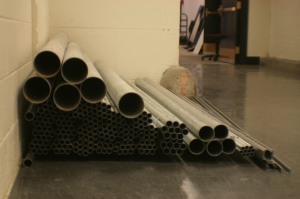
The pile of pipes on the floor; the discarded DNA extracting kits (unopened and unused); bits of trash hidden amongst the overhead pipes and wires; the sign that says “End of the game”. All of these elements on their own lend to the feeling that the underground is where things are hidden because they are not worthy of being seen, where things are discarded, where activities come to an end. The tunnels are the basement of MIT; the repository for things rendered useless, or that are in the way but not to be completely disposed of.

IMG_0423

IMG_0650

IMG_0462

With regards to the urban landscape I traverse on my daily path perhaps the ground treatment is the most significant element. Variations in the ground treatment give clues to the age of the development and also its social rank. Fresh, clean paving bricks, sometimes in a patterned design, indicate a more recent development, a recent attempt at urban regeneration. This treatment is common in front of new or renovated buildings such as the Cambridge Theater and the plaza at the intersection of Massachusetts Ave. and Columbia Road. Just in front of Economy Hardware the brick paving is dirty, littered with gaps between the bricks. The doorways along this area become urinals for late night revelers. The primary occupants of the benches in this area  seem to have the same grit and grime that is present of the ground, on them and their clothes.

Significant Detail 2

•October 12, 2009 • Leave a Comment (Edit)

Excerpts from Joel Meyerowitz:  Creating A Sense of Place, Smithsonian Institution Press, 1990

I have been thinking about what a photographer’s responsibility is—his social responsibility, the responsibility to the craft, to the telling of the message, to the print. Although I started with what I thought was a moral imperative, that America was this crazy place that needed to be described and I had a social responsibility to tell it as it is-the Great American Novel in photographs—somehow over time, during my middle years, the aesthetics of photography played a greater role, and I became less concerned with serving moral issues (Meyerowitz).

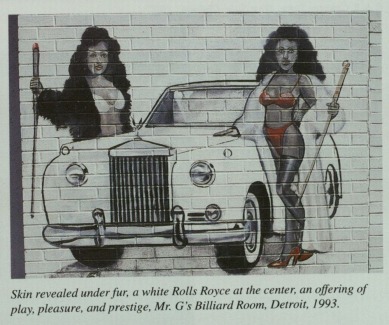
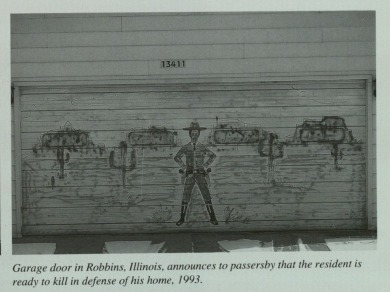
These statements made me reflect on Camilo Vergara’s work, which was insightful yet difficult to look at. At times I felt a sense of appreciation towards Vergara for having taken the time and effort to document that aspect of society which if oftentimes ignored, and banished to mental oblivion. I wonder if Vergara felt a conscious sense of responsibility in what he was documenting. His writing leads me to think that overall he had good intention when he undertook this project. The care that he took to match the photos with captions from other sources, and to make it seem as if the quote was in direct response to the photo is commendable, however, at times his own captions betrayed underlying prejudices. For instance, there were several occasions when Vergara’s captions seemed heavy-handed and served to negatively color the viewers perceptions of the captured scene.

ghetto hos

policeman garage

Maybe you can’t correct it by pointing it out, but you can at least certify that you saw it at that time, and that it was painful to you (Meyerowitz).

So I’m not convinced that Vergara embarked upon his endeavor to document the US ghettos in an attempt to solve all of the problems that these places face. Maybe he saw this as his way of giving voice to the marginalized and unheard/ignored. My greatest concern about this book, and similar types of works, is that it may actually serve as fuel to perpetuate stereotypes and justifications for neglect, rather than inspire a yearning for social harmony, equality, and justice. In the absence of reading its accompanying text this book simply captures the negative, fetid conditions of ghetto life. But even when reading the text, I found that I was more moved by the words of other authors, commentators, and residents, than from Vergara himself.

There have been times in my life when I have discovered that I know something. And then I am overcome with a sense of wonder about how I could have known this for so long, yet not have known that I knew this. And that I knew it so well that I can make a declaration about it with absolute surety. The first time I can recall an incident like this was one time I was at a natural history museum with a friend. We were looking at sea animals, and to enhance the ambience of the exhibition there were ocean sounds playing in the background. The scene laid out in front of us was one of a white sand beach, but the sound being broadcast did not match the scene. I told my friend that this was not the correct sounds for the seascape on display. You see, the sounds being played must have been recorded at a stony seaside, with a pebble (as opposed to sandy) shore. Along with this the water would be quite clear, with moderate waves. I was in as much awe as my friend as I described the source of this sound to him. I did not know that I knew what different beaches sound like. But evidently, I had acquired such information from growing up next to the water and experiencing different sea conditions. This “knowing” that I had had been lived, was illiterate and unconscious. There are some things that I know as intimately as I know how to breathe, but these things were never formally taught to me, nor did I perceive myself as being an active student of the subject matter.

For the most part I do agree with Heaney’s assertion that in the absence felt knowledge of a place we are unable to truly register the intangible sentiments embodied by the place. For instance, if I visit a place which I’ve been told is significant because of its connection to my ancestors, I hold that place in higher esteem or I am more attuned to its inherent subtleties, more so than if I regard a place as being significant to someone else’s ancestors; then the experience is more abstract, more objective, perhaps more focused on the tangible qualities of the space.

Should a landscape be designed in such a way that it seems as if it was created by nature, that the manipulations by a human hand are imperceptible, then I think this sense of place can me manifested. One the one hand I believe that we hold “natural” in higher reverence than we do “artificial”, “man-made”, “choreographed”. Perhaps this is because we consider natural to be tangible evidence of divine intervention. Whereas man-made or constructed or designed, is created by man, who is flawed and inferior to God, and hence, what he creates is of inferior quality. Or, it can also be that with designed elements, sometimes “natural laws” are broken and thus the creation appears flawed.

Significant Detail 1

•October 4, 2009 • Leave a Comment (Edit)

IMG_0468

My first experience with the tunnels at MIT was during last fall. As the weather began to get colder and colder, I was soon looking for ways to avoid going outdoors as I traversed across campus. I had heard that the tunnels could take me from building 7 (where I was mainly stationed) to close to the Kendal T-station. On one cold morning, I had a few minutes to spare before classes began so I decided to seek out the path from the medical building next to the t-station, all the way to building 7. Thank goodness for the small maps all along the way, otherwise I would have probably still been stumbling around underground! Almost one year later, I am still finding new hallways and nooks in these tunnels.

I often retreat to the tunnels when I want to escape from the bustle of the main floor hallways, when I want more tranquility as I make my way around. These quiet, usually unoccupied tunnels give me the solitude and tranquility I need sometimes to think or to clear my mind as I go from one place to another. Without the distraction of voices, and trying to navigate through crowds, and maneuvering bystanders and random obstacles, the tunnels offer a more peaceful journey through the MIT campus.

I notice my surroundings more when in the tunnels. Without the distraction of people I am more attuned to the materials of the walls and floors, the various lighting fixtures, the sounds and smells. I am more aware of the distance I am covering and my orientation. The long, unencumbered corridors create long perspective vistas leading the eyes to the far end of the passage. I am more aware of my stride, the cadence of my gait as it relates to the rhythm of the lighting fixtures, to the tiles on the floor, to the windows of the offices, to the suspended grill holding up cables and pipes overhead.

Paths, boundaries, and gateways are conditions, not things, spatial patterns defined by processes. Paths are places of movement, boundaries limits to movement, gateways places of passage and exchange. A path s maintained by movement. Once a process ceases, space becomes a shell of past practices. Pg 119.

The tunnels, the pathways, are straddled by various spaces – offices, labs, utility rooms, storage rooms, restrooms. One is compelled to keep moving in these tunnels. The ceiling is too low, the walls too narrow for one to stop without feeling as if one has become an obstacle/obstruction in the flow through the tunnels. Windows along the tunnels gives one glimpses into sedentary life in the offices and labs. It is almost as if the occupants of these spaces are in another time zone, or they are frozen in time. The metalwork and glass blowing shop in building 10 can cause one to slow down, if not come to a complete halt to be captivated by the glowing oven and the choreography of the glass blowers molding the molten glass. Another stopping point is truly a place for pausing along the tunnels. I can’t recall the exact building (somewhere near the spectronomy labs) it is in, but there is a small nook of a couple tables and chairs, next to a half-wall window that opens out into one of the few green courtyards/gardens on campus. It is the only place (at least that I have found thus far) that offers not only views to the natural outdoors, but also a place to sit and enjoy the outdoors.

In terms of details which reveal the character of my site a few items have already caught my eye. For instance, I am particularly interested in the seams between buildings. At the seams there is a sort of metal grill, almost like a sleeve that is holding the two separate tunnels pieces together. It seems that the base of the seams also act as drains, or at least there seems to be water in these seams. But it is difficult to photograph these seams in detail without losing wider the character of the tunnels. Framed up close they seem like some random strip of metal sheeting. But thus far I have only tried photographing them head-on. Perhaps a slanted view at a corner (for instance where wall meets floor or ceiling) will better articulate that the metal strip is the seam between two separate bodies.

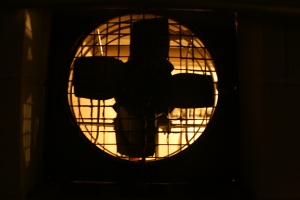
Then there are the storage areas behind chain link partitions. For a long time I have been fascinated looking through chain link fencing to objects that lie behind. Somehow the chain link adds another interesting lay to the scene, making me even more aware of the layers behind it. The most interesting chain link storage areas I have found so far are under building 13. Within these areas a huge HVAC and other building systems machinery, blasting steam, hissing sounds, flickering bulbs. This is where some of the main organs of the campus are enclosed.

Of equal interest are the bowels of the campus – the endless lines of cables, wires, tubing, and piping, carrying data, water, steam (nutrients?) and effluent (excrement?) vital to the proper functioning of the buildings and in support of the occupants of them. These bowels run parallel to the tunnels and seem to “move” at the same speed too. The silently disappear and emerge from behind walls, they elegantly rise and fall in response to changing overhead topography; they are unrelenting in their journey from origin to destination.

Hello world!

•September 28, 2009 • Leave a Comment (Edit)

I’m here!!! I feel like I’ve been born again!