Thursday, March 8, 2001
5:00 - 7:00 p.m.
Summary
[The
text below is an edited summary, not a complete transcript.]
|
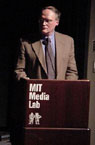
Moderator PETER
WALSH said that museums and new technology are often
thought of as contradictions in terms - "the new versus
the old and dusty" - but, in fact, when museums were
first founded in the Age of Discovery to house, classify and
study all the objects flowing into western Europe from around
the world, they were the new technology. These collections,
Walsh said, served as the basis for great advances in evolutionary
biology, paleontology, geology and anthropology. Noting that
the American Museum of Natural History has contributed to
all of those fields, he introduced the first speaker, Kevin
De Vorsey of the anthropology division in the AMNH.
|
|
|
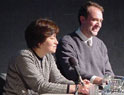
KEVIN
DE VORSEY pointed to three recent milestones in the
130-year history of the American
Museum of Natural History (AMNH) that have fostered the
adaptation of new technologies in the anthropology
division.
|
|
About 23 years ago, De Vorsey
said, the decision was made to create a computer record of
the anthropology collection, and the development of these
simple databases provided "more sophisticated access
to the collection," though this access was still very
limited.
In 1990 Congress
passed the Native American Graves Protection and Repatriation
Act mandating that institutions receiving federal funding
provide a detailed inventory of any Native American holdings
to all recognized tribes in the U.S.
To be able
to retrieve meaningful information from its disparate collections
and to provide that information to native tribes not familiar
with the scholarly terminology used by the anthropology division
was a major task.
A true data
management system was needed and implemented, De Vorsey recalled,
and "with all the intense work of cleaning the data and
complying with the law we came up with a nice repository of
information beyond the basic catalog."
Finally, he
continued, about four years ago funding agencies began to
require museum projects that used public funds be made available
on the World Wide Web. "Happily," De Vorsey said,
"we had a resource that was worthy if this, and we began
to develop our website."
De Vorsey demonstrated
several features of the anthropology division's web pages
including the Exhibition History
where a user can select from recent past exhibits such as
Body Art: Marks of Identity, can click on Exhibited Artifacts,
and then can click on any of a number of objects from the
exhibit to get such basic information as country and culture
of origin, time period, actual size and owning institution.
Differentiating
www.AMNH.org's main interface from the anthropology division's
portion of the museum's website, De Vorsey explained, "We
in anthropology don't try to compete with the museum as a
whole or with the other departments. Our website is a scholarly
tool to enhance the research capabilities of our collections.
This is fundamentally different from the work that goes on
in, say, the education department where the work is geared
toward public programming and outreach."
One problem
the anthropology division encountered in trying to serve the
research community was that the terminology used to describe
the museum's collections was in some cases archaic.
"To do
meaningful queries," De Vorsey said, "you almost
have to be an anthropologist. To overcome this we have been
working on alternate ways to look at our data and have developed
a simplified search interface based on a map. Most people
at least know from where they want to see things." He
demonstrated this feature on a password-protected part of
the site reserved for the research community.
De Vorsey summed
up by saying that the anthropology division would continue
to explore new technologies with an eye toward allowing "unprecedented
access to our collections."
|
| WALSH: Our next speaker
Lori Gross of the Museum Loan Network has the enviable job of
dealing with one of the great embarrassments of many American
museums -- that is, their embarrassment of riches. |
|
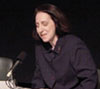
LORI
GROSS recounted a recent visit to the Museum
of Fine Arts in Boston to see an exhibit called Dangerous
Curves about the history of guitars. As she entered, she
said, she was given an MP3 player that allowed her to stand
in front of any guitar in the exhibit and hear it being played.
|
|
"We need
to understand that the technology was not cutting edge,"
Gross pointed out, "but for a major art museum to employ
it in a major exhibit is a huge step" toward incorporating
digital technology into the museum experience.
She said that
predictions made five years ago that digital replicas of objects
would make visiting museums obsolete have proven false, and
that museum crowds are growing along with web access to museum
collections.
To demonstrate
the application of digital technologies to the museum world,
Gross showed the website for the Museum
Loan Network, a national museum collection-sharing program
that is administered through the MIT
Office of the Arts and is funded by the John S. and James
L. Knight Foundation and The Pew Charitable Trusts.
Gross showed
eight virtual
exhibitions, online versions of real exhibits that MLN
helped to create. These virtual exhibitions, relying on software
developed at MIT, allow users to explore the physical space
of the exhibits, and to examine objects from all angles, as
if in three-dimensional space. Gross also showed a section
of the MLN site called Match
of the Month in which so-called curatorial ambassadors
select objects that are related in some compelling way in
order to demonstrate some of the creative uses of the MLN
catalog.
Digital technologies
were especially enabling, Gross said, for curators and directors
of exhibitions looking for connections and relationships among
objects housed in various museums around the country. She
demonstrated the password-protected MLN
Directory portion of the site that permits curatorial
staff to search for objects across a number of different variables
including museums, time periods and keywords.
The MLN Directory,
Gross said, allows users to create "a collection in virtual
space. You can make connections between collections that you
may have not thought of before."
Gross concluded
by reminding the audience of her earlier remarks about the
way the Internet has stimulated museum-going. Digital technology
"is bringing greater audiences through our doors to see
the real objects after their appetites are whetted online.
|
| WALSH: Back in the very
dark ages of the late 1980s, art museum publications were very
expensive, phonebook-sized tomes that took years and years to
produce and were not interactive in the least. Our next speaker
Ben Davis of Razorfish has helped transform these publications
into something unrecognizable using these digital technologies.
|
|
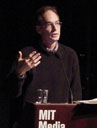
BEN
DAVIS said that when a museum comes to his consulting
firm, Razorfish, seeking
help in the use of digital technology, the first question
asked is "why?"
"Are you trying to brand
your identity? Do you need some way to get your huge databases
upgraded for a digital world? Are you building a gateway to
increase accessibility as both the AMNH
and MLN presentations
demonstrated?
|
| Do you want to
make people smarter? Do you want to create a self-sustaining
museum? Are you looking at this as a source of revenue or as
a way of increasing the value of your collection? Do you want
to find new audiences?"
On a different
level, Davis continued, "museums are repositories of
memory" and are using digital technology to create new
forms of cultural and institutional memory. A museum's collection
is enlarged and altered, he said, when more information is
added or made newly available in databases, on-line catalogues
and lists.
Moreover, as
digital technologies are implemented to create greater access
and other visitor services, they are integrated into sales
and marketing. "What's always interested me about museums
is that they are a confluence of products and services,"
Davis said.
Enabling people
to think creatively about exhibitions with a system that allows
them to choose objects from different sources, as the online
Museum
Loan Network Directory does, has commercial and well as
intellectual ramifications.
Such technologies
allow a museum to be a dealer; matching objects with people.
Curators can now think like brokers, building an exhibition
that will enlarge an institution's core audience or bring
attention to the institution.
One way to
think about these new technologies, then, Davis said, is as
a tool for strategic development.
|
|
DISCUSSION:
DEBORAH
DOUGLAS, Curator, science and technology collections, MIT
Museum: The description for this Forum was framed
in revolutionary terms - museums were "reinventing"
themselves. But what I've heard here seems merely a difference
in scale and scope than in kind. We're dancing around the
question of how, or whether, these digital tools redefine
the museum itself. When the members of the public think of
a museum they think of a place that collects objects and then
reveals information about those objects in the form of exhibitions
and publications. Do these technologies as you have used them
over time change that or simply enhance it?
GROSS:
From my point of view, they don't change that. Nor do I actually
think that technologies themselves should change that. I think
it's more of an evolution than a revolution. It is more of
an enhancement. I think the revolution in museums has much
more to do with getting a museum from being an object-centered
experience to an audience-centered experience. Digital technology
is one instrument helps that revolution, but that's much more
of a revolutionary change than the addition of digital technology.
It helps us get to the audience, rather centering everything
on the object.
DE VORSEY:
In the anthropology world, the new technologies provide freedom
for the researcher. My first job involved fielding research
requests; I noticed all the requests involved objects that
were listed in publications. People knew about them and that's
what they wanted to come and see. They didn't know what was
back on the shelves covered in dust, and they don't want to
come to New York and sift through stuff and waste their time,
so they would gear their research requests to the things they
knew about from previous exhibitions or books.
But now, in
our project of digitizing and cataloging all our holdings,
we're aiming to throw open the doors and free researchers
to figure out for themselves what they are really interested
in, no longer dependent on what they've seen before. It's
not revolutionary but it's realistic in that not everyone
has access to the storerooms of these great museums. But through
these new technologies hopefully we can give some greater
access to those collections.
DAVIS:
Every time I hear this discussion, I think: What if you went
to the public library and they didn't let you borrow a book?
What if they didn't let you touch the book? Maybe you could
read it through a glass case. That would ruin the library
experience. One hope for digital technology is that it will
bring museum patrons closer to the curators, to those who
get to touch all the objects. The technology doesn't so much
enhance the museum as enhance the visitor's experience of
the museum. It can allow them to get closer to the objects
and holdings in a museum.
So far, websites
don't do this. Digital images don't do it. But the attempt
is there. The more you go after that experience, the closer
you get to what the technology will be capable of. Certainly,
this technology has made museums a lot more popular. It would
be nice if you could checkout the stuff. You can check it
out on the web I guess, in virtual form.
|
|
WILLIAM
URICCHIO, Professor of Comparative
Media Studies, MIT: It seems to me crucial to think
about what parameters we use to set up databases. I am aware
of a system that was used for 18th-century emblems, and it
really broke away from ideas of name and date and geographic
location. It offered ways to access visual images visually.
You could ask for many images that had a star and moon or
a tree and bird; you could access materials in a sort of unfamiliar
way. That resulted in some interesting associations. Suddenly,
you start to see different kinds of images linked together
in new ways.
This in some
sense displaces connoisseurship. People study for years, memorize
slides and in their own brains they can make these wonderful
associations. But now these associations are possible because
of creative databases. That museum community, at least where
I have witnessed it in the Netherlands, feels threatened and
has been severe in its criticism of radical new approaches
of organizing data.
My question
is two-fold: Is there money to setup radical new databases?
And if there is, are you noticing resistance or delight?
GROSS:
I don't think there is a lot of money, and this is a big problem
for museums. But as for the other part of your question, I
think there is a lot of fear on the part of curatorial experts
that the uninitiated will make inroads into their territory.
A lot is going on now in some exhibitions in terms of multiple
perspectives and getting audiences more involved. If the technical
and financial problem were solved, you would still be left
with curatorial issues.
|
|
QUESTION:
Do you think these new technologies can offer museum visitors
new ways to maneuver through an exhibit? You mentioned the
Dangerous Curves exhibit at the MFA. That exhibit remains
linear; the visitor goes from one object to another and hears
some music and discussion. What about strategies and technologies
that encourage a more random access to exhibited items or
that are customized to individual visitors and their interests?
What's your vision for that? And what's in the museum culture
to prevent it from becoming more audience-centered?
GROSS:
I think there's a lot in the museum culture that prevents
people from doing anything [laughter]. But there is a lot
of talk about such new approaches to the museum experience.
Dangerous Curves was not revolutionary, but it did
allow random access. You could go where you wanted.
WALSH:
I work for a number of museums. Five years ago there was a
lot of resistance to electronic publications on the web. Just
this year, curators are saying 'we want our publications on
the web because people will read them.' This was a big revelation.
There probably is a strong desire on the part of the curatorial
community to communicate directly with the audience. Some
of the resistance those of us inside the profession often
feel in speaking to a broader audience is the fear that no
one is listening.
|
|
MARY HOPPER,
Visiting Scholar, CMS:
I am more familiar with the archival community where a lot
of the resistance to these changes is pragmatic. They don't
have a lot of money and they fear the technology is not yet
stable enough to make purchasing decisions. Is that a concern
in the museum community?
DE VORSEY:
In the anthropology department, all of our images are digital.
We don't have a cold room and we have no slides. So that kind
of concern with the technology is my nightmare everyday. Kodak
says a CD can last 217 years and we're going to find out.
The American
Museum of Natural History is an institution with a slow-changing
culture. It has been interesting to watch the culture change
in adapting to new technologies. Everyone is dependent on
computers now, but when I started at the museum the scientific
assistants were technophobic and used manual typewriters.
In terms of
the longevity of technology, my boss is the chair of the department
and in the last four years it has been ingrained into her
that this technology is expensive and its not going to go
away. It has to be drilled into the staff that if you are
going to commit to this it's an ongoing thing, like paper
and pencils. One lump sum of money is great, but unless you
are committed to continually upgrading, you are going to be
in trouble. We are always looking at what are we going to
have to do next.
WALSH:
Last fall I heard a talk about the early history of the first
public museum, the Ashmolean Museum at Oxford, founded in
1683 to house the first great cabinet of curiosities. Apparently,
in this moment of infancy for the idea of the museum, they
had not yet invented guards and glass cases and all this other
paraphernalia of protection and distancing. They would open
the doors in the morning and people would pour into the museum
off the streets - just anybody - and pour through all these
objects and laugh about them and be excited. In some ways
the web and this new technology return us to that kind of
excitement, to the feeling that we don't have to be dressed
up, we don't have to be solemn and quiet in a museum. We can
really explore and experiment with this. This doesn't require
a lot of money; it just requires a certain thought about what
a museum is and what an object is.
GROSS:
Interactivity is the way people learn, and they want interactivity.
Digital technology may be one way of doing this. I saw a wonderful
exhibition where people took yellow stickies and put them
up on the wall with their comments on them. So again it's
back to trying to figure out all the different ways we can
change the culture of the museum, and digital technology is
certainly one of the ways we're going to do that, but I think
it goes back to what you [referring to Davis] were saying
about 'why do you want to change your museum? Why do you want
to reinvent yourself?' I think that's the ultimate question.
|
|
KURT HASSELBALCH,
Curator, Hart Nautical Collections, MIT
Museum: We're talking about museums as if everyone
in the world has that experience. How many people on the face
of the earth have been to the Smithsonian or the MFA? It's
a small percentage. If everyone had the capacity to plug into
this digital technology, that would be a revolution.
What is a
museum but a compilation of human ideas; there are an infinite
number of ideas about how to use this technology and that
discussion is ongoing. But we need to remember that it will
take immense amounts of money to put the material culture
that exists on this planet into this new medium. Think of
the total material culture that is housed in the world. It
is a gigantic cash question and something we have to move
forward on.
But what excites
me is the potential that people who have never even considered
that this material is available to them might have the opportunity
to see it.
WALSH:
The process of digitizing catalogs is going on now; some of
the funding is a shifting of money from the old to the new.
In some ways it is cheaper to do these things digitally. So
there is some hope for getting these materials all online
DE VORSEY:
We work with museums in Africa, we work with museums in Vietnam,
and so we try to be sensitive to the different levels of technology
around the world. If we are working with someone we can send
them a CD or give them our URL, but we are also glad to send
them a batch of slides. We try not to shove technology down
people's throats if they are not ready for it.
|
|
TERRY MARTIN, Director,
Harvard Law Library:
I am a little troubled by this discussion of "The"
Museum, because there are many kinds of museums and their
needs are different. I am not sure they would all apply digital
technologies properly. As a librarian, I have had a lot of
experience with the problems of preserving paper. First, it
went to microfilm and now to digital form.
This is about money to some
extent, but it's also about time. A lot of the discussion
about the resistance of curators is pragmatic to some degree
because the new technologies represent additional, time-consuming
work. Even if the money is available, this is new work they
have to do, and where do they find the people and time to
do it?
Ninety percent of today's museums
were created after World War II. I think there are too many
museums, and many museums have too much stuff. There's no
way you can digitize everything. On the other hand, not every
object in every museum is worthy of veneration. We're going
to have all this wonderful technology in the digital museum,
but not everything has to go into that museum.
Why not sell off some of the
stuff and use part of the purchase price to digitize the artifact;
the buyer can take the original while its image would be available
on the net?
DE VORSEY: Funding agencies
have asked, 'Why don't you just do the greatest hits?' Why
don't you digitize selectively, choosing only your strongest,
most significant holdings? But, the strength of an anthropology
collection is its scope. We collect utensils as well as beautiful
objects of art, and our digitization efforts are not selective.
We're doing it across the board. That's my defense of the
anthropology department.
GROSS: You get a different
defense from different museums. The question of who decides
what to part with is important. You look at art from 20 years
ago and some artists who were not in vogue then are now valued.
You don't know what to keep. So, if you start this it's a
slippery slope.
|
|
LESLIE JOHNSTON,
Head of Instructional Technology,
Harvard School of Design: I am really pleased to see
so many institutions working on these integrated, centralized
information resources that allow greater distribution and
the serendipitous discovery of relationships between objects.
I'd like to hear about how the institutions you all are working
with are creating new digital education resources based on
their new digital assets.
GROSS:
Digital technology has allowed more opportunities for museums
to work with schools. The Museum Loan Network worked with
the Memorial Art Gallery in Rochester, NY, which created a
website and connected it to the school system so that students
could study and work on items in the collection and then visit
the museum to see them.
DE VORSEY:
We are a scientific department, and K through 12 has never
been a primary focus for us. But since we have made materials
available on our website, we do now get questions every week
from high school and grade school students doing research.
There's no way a high school student would be allowed into
our storerooms, but via our website there is now access for
a school project that didn't exist three years ago.
WALSH:
Five or six years ago I was at a conference where differences
between American and other museum systems were highlighted.
The European and Canadian museums which are state funded for
the most part had created huge consortia and were collaborating
to get materials out to the schools. The American museums
which are by and large privately funded saw themselves as
totally individual, totally subversive, trying to break up
the museum culture, trying not to be cooperative with anybody.
So, the technology has brought about some interesting developments
in terms of international differences.
|
|
QUESTION:
I want to comment on what the librarian from Harvard said
about digitizing and disposing of objects. We have felt the
wrath that is visited on libraries by both scholars and the
public at large when they think you are disposing of objects.
The lesson we learned is that you do not dispose of your objects.
The digital object is never a substitute for the original.
The second
thing I want to say is that the digital technology may not
be transforming the museum, it may be transforming the object.
When you digitize text it turns it into an object. I do think
that in a way, the technology does transform our experience
of the object.
DAVIS:
We don't quite understand all of the implications of digitization,
but it certainly gives the object a voice, or a lot of voices
it never had before.
|
|
QUESTION:
In museums, when you digitize something, you haven't replaced
it. If there is any commerce that devolves from it, it will
go the museum. Museums hold the property rights to the objects
they display. The situation in libraries is much different.
There seems to be a growing attempt on the part of publishers
who control property rights to produce the electronic version
of books and to cut libraries out of the picture, dealing directly
with the public. I wonder if museums in looking at their cultural
sisters are worrying about similar problems as more electronic
items become available.
DAVIS:
Yes, they are worried about it. Digital rights management is
the big topic everywhere right now, and forever probably. It
goes to the heart of the value of the experience. The big question
is: What does digital technology do to private property? That's
huge question. Napster tried to answer it and look where it
got them.
WALSH:
This is another change in culture issue. Traditionally, at least
for art museums, museums have taken a very paternalistic approach
to distributing images of their art works and regulating how
they are reproduced. In terms of the internal culture of museums,
the desire to control the context of images is stronger concern
over revenue flow. What is appropriate to let people do with
these images? Are they going to end up in beer ads? Many curators
and museum directors worry bout how to keep this common, crass,
vulgar culture just beyond our walls from crashing in?
|
|
MIKE
BARKER, MIT: A comment, not so much a question. One of
the metaphors I have heard is that if you go back a few years
and ask people on campus, 'Where is the computer center?'
they could point to it. If you ask them today, there is no
computer center, it is everywhere. In relation to libraries
some have said we are moving toward a library without walls
or a ubiquitous library.
Today's
discussion implies that we are doing the same with museums.
What happens when Lori Gross's virtual exhibitions are available
for everyoneÕs use, when those exhibitions themselves are
ubiquitous?
GROSS:
Well, virtual museums are wonderfully important and exciting.
But when all is said and done, nothing substitutes for the
real object.
|
|