
Thursday, May 10,
2001
5:00 - 6:30 p.m.
Summary
[The
text below is an edited summary, not a complete transcript.]
|
DENISE
BROSSEAU
described the challenges she faced in 1993 when she co-founded the
Forum for Women Entrepreneurs (FWE)
, a San Francisco-based networking organization for women in
business and investors. |
|
|
In the early and mid 1990s, only about 21 percent of top management
positions (vice president or higher) in high-growth companies were
held by women, Brosseau said, and it was difficult for women to attract
venture capital primarily because they had no track record of securing
funding, starting up and succeeding with companies. The dot-com investment boom of the late 1990s changed that. In
1999, as Internet funding ballooned, the percentage of women holding
top management positions increased to 41 percent, and in the first
quarter of 2000 women-led companies were getting 12.7 percent of
the available venture capital, up from five percent in 1999. |
|
| Today
the door to venture capital has been opened to women. In fact, FWE
and Springboard.org,
its collaboration with the federal government's National Women's Business
Council, have raised more than $550 million for women-led businesses.
For this trend to continue, Brosseau said, more women must become
venture capitalists themselves as their own businesses succeed.
Brosseau explained that before the year 2000, which she refers
to as the "Year of the Woman Entrepreneur," a handful of "poster
girls" received all the press attention for running business in
Silicon Valley. That changed drastically last year, according to
Brosseau, when the media began reporting women entrepreneur success
stories on a daily basis. If the same success can be duplicated outside of Silicon Valley
and the San Francisco Bay Area, and if successful female executives
serve as mentors for other women in business, then half the available
venture capital will be support to women-led companies in the next
20-30 years, according to Brosseau. |
|
 |
MARNEY
MORRIS ,
who founded of interactive design firm Animatrix
in 1984, said she was one of those "poster girls" routinely paraded
out as women-in-business success stories before the boom of the late
1990s. |
| Morris
described her early work with Apple, Microsoft and other digital pioneers.
She said she often selected clients in part because collaborating
with cutting-edge companies would be a learning experience for her
staff of engineers and graphic designers. Morris concluded by examining a website designed by Animatrix
called SprocketWorks.com
, a graphically rich interactive website designed by Animatrix
and intended as a showcase for the company. This site includes subpages
devoted to a range of subjects: the solar system, the history of
music, U.S. history, space flight, horses, chemistry, birds, ships,
oceans. The site includes a Demonstrating the link to space and the solar system from the
Sprocketworks homepage,
Morris clicked through a number of interactive features. For example,
a user can retrieve information about the planets by clicking through
a model of the solar system, or access a comprehensive history of
space flight that includes images of satellites floating across
the computer screen in a simulation of outer space. This interactive
page even permits users to build and launch a virtual rocket. Clicking on the music link from the Sprocketworks
homepage, Morris showed a timeline of classical music in which
signature passages by composers are played when the cursor rolls
across their names. Pass the cursor across "Mozart," for example,
and you hear the beginning of his Eine Kleine Nachtmusik. Click
on "Mozart," and you go to a page containing his portrait, a brief
biography and more musical selections. Morris also demonstrated the "learn music" link, which allows
users to play a note on a piano keyboard, and then have that note
recorded as well as displayed graphically as a composer would write
it. Users can play back their compositions, or edit them by rearranging
notes before replaying them. |
|
|
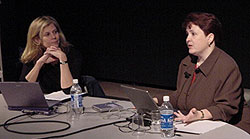
DISCUSSION: MORRIS
responded to a question from the audience by explaining that Animatrix
had retained topic specialists to work in each area covered by
the Sprocketworks site. BROSSEAU
asked her where she put all these employees when they got together.
MORRIS
explained that there had been very little "face to face" time
on the project, and most of the work was done by telecommuters
in remote locations. Eventually, she said, everyone will be working
out of their home. BROSSEAU
I work in an incubator building full of women-led business in
California. We found that when this whole virtual-office trend
exploded, people still wanted to meet, so the building has conference
rooms you can rent so you can bring your people together. You
can rent parking spaces just for a meeting. It is great to work
at home, but it can be isolating. People do want to come together
sometimes. HENRY
JENKINS, Director of Comparative
Media Studies, MIT: It has been suggested that the reason
so many women have opened more small businesses online is this
ability to work at home but remain publicly active. What has your
research found? BROSSEAU:
People start businesses for a variety of reasons. Women who joined
the Internet boom were looking for freedom, independence and balance.
They weren't finding that at big companies. Many women started
Internet business because of the low cost of entry, but they also
wanted to create their own environment, a place where they really
wanted to work. I see a similar flow among men in what I call
new-economy businesses. It's not about doing the drone thing,
it's about creating a company that reflects your own values. RICHARD
BARBALACE: How can men encourage female entrepreneurs? Especially
if you are a male entrepreneur and you want to promote this diversity
how do you find and attract a woman to be a co-founder in a startup? BROSSEAU:
On the FWE website, you can
post positions. That's primarily a west coast resource, but a
lot of women visit that area because you can find jobs that are
startup related. Girlgeeks.com
is another site that lists opportunities for women in cyberspace. A
recent study showed that companies with gender balance are more
successful than companies without gender balance. So if you want
to create a company without glass ceilings where woman hold positions
are at all levels of the organization, you have to start early
to create that culture. It is an important thing to strive for.
If we can't help you, there are many organizations that can. LINDA
SAMUELS: When you have an idea for starting a business, what
materials do you actually need and where do go to get money? BROSSEAU:
What kind of business do you have in mind? SAMUELS:
It is called the Science of Learning Center. After 30 years in
teaching, I want to figure out what really works in terms of learning
and improving memory at all ages. So I enrolled in an MBA program
and have begun working on this project. But would like some guidance. BROSSEAU:
If you are in an MBA program, it is important that you use as
many of your class projects as possible to get your business plan
written. In fact, FWE was started as a class project at Stanford
by my co-founder. It's a great opportunity to bring your classmates'
brainpower to bear on what you want to do. Another piece is to
build an advisory board of people who have done something similar.
You don't want to have to reinvent the wheel. And
find someone whose skills complement your own. Let's say are good
at marketing and sales, you may need someone who is good on the
money raising side. A fourth key task is to figure out what you
need in the way of money. Until you do that, you cannot go out
and get funded. Ask yourself, what I am trying to do here? Am
I opening up a single learning center in the first year, and want
ten branches in the first year, and 100 in the third? The answer
will affect your money needs, and how you'll get financing - whether
you'll get a bank loan or, God forbid, use your credit cards or
find an equity investor. If you are a woman, add 20 percent to
what you think you need because women tend to underestimate. MORRIS:
Yes, one of the most important decisions to make in starting a
new company is the funding model - is it a debt model or an equity
model? A debt model with a service company is what I did. When
I used my credit cards to get started, it wasn't that much money.
If you choose equity you are going to have someone sitting on
your board. You're not going to be making decisions yourself.
Your company is going to have a different structure. You have
to have an exit strategy because the people who put money into
your company want to be able to get it out. BROSSEAU:
They want it out in a short amount of time, in fewer than ten
years; sometimes less than seven. MORRIS:
There is an advantage to having that big investor to help you
along. But, if you do a debt model as I did, you are in control.
I had several offers to buy the company, and I could have sold
it. But my interest was in being a designer and my endgame wasn't
to cash out. If I had had an investor, I might have been forced
to cash out. I started my company with a five-year plan and 17
years later I am still doing it. Not because I am stuck, but because
it's what I want to do. DIANE
BELLAVANCE: You said you wanted to be totally home-based.
How will you separate home from your work? BROSSEAU:
The question is, has she ever done that? [LAUGHTER] Not too
many entrepreneurs I know have succeeded at that. MORRIS:
I made a conscious decision to buy a house that is big enough
to do that. Now that the business is successful, I can see how
the house can serve as a conference center such as Denise mentioned,
and as a place to meet clients and make a deal. Plus, I have moved
to Southern California where that Hollywood model lends itself
to doing technology projects at home. BROSSEAU:
There are caveats to be offered here. For years, I have watched
friends being taken over by work. Only in the last three months
have I seen people reconnecting with their friends and families
and disconnecting from their pagers and cell phones. You have
to be careful about what your own style can be and what your personality
can adjust to. I have taken computers out of my house. I find
I do need to completely disconnect because I am a workaholic.
I will work non-stop if I don't disconnect. I don't work out of
my house for that very reason. Or, you have the other side of
it: you are a small consultant and not too busy and the television
looks more interesting than what you are doing. It can be dangerous.
MORRIS:
I make sure to schedule personal time for myself everyday.
You have to set your priorities and my family and friends come
first. People say, 'you can have it all, but you can't have it
all at once.' I have been thinking about that a lot and am not
sure it is true. Maybe you can't have it all, but you can prioritize
the different aspects of your life. For me it has always been
friends and family first, my business second. If you can keep
your goals straight, I think it works. Have you [to Denise Brosseau]
ever achieved that balance? BROSSEAU:
I have never achieved it, and I don't know anybody who has. I
have seen very few people who have it all and don't have an ulcer
or a backache all the time, or aren't stressed out. But things
may be changing. How
many folks did I talk to within the last few years with business
plans that were just okay? You would tell them their plan is just
okay, and they wouldn't ask what could be done to improve it because
somewhere along the way people started thinking that anything
could be turned into a business and any business could get funding.
It was very destructive. Now,
we are seeing some realism returning. And, we are seeing some
people listening and other folks who lost businesses that could
have been better if they had listened. We are also seeing some
babies thrown out with the bathwater, a sad consequence of the
euphoria over Internet businesses changing. This return to sanity
- to where not every business in the world will make you rich,
and not every job you take will make you a millionaire - is a
healthy thing. DAVID
THORBURN, Professor of Literature, MIT: Marney, I was immensely
impressed by the demonstration you gave of Sprocketworks.com.
It is rich in graphic and intellectual substance, but it doesn't
seem commercially viable. That site is informative and beautiful,
but it is hard for me to see its commercial aspects. Can
you address this problem: that some of your most creative, intellectually
satisfying and substantive projects might not be the ones that
will find a market? What if your most valuable projects don't
get commercial support? MORRIS:
It's a decision you have to make. We were aware of the whole dot-com
craze, and we could have gone into any area, but as designers
we wanted to do Sprocketworks. We had serious discussions with
major education companies about investing, but we didn't follow
through because I didn't want to work for someone else. If I had
equity partners, I wouldn't be able to be so altruistic about
things. THORBURN:
From my viewpoint, that's the most radical and inspiring
message that you have for us. Maybe this new entrepreneurial model
doesn't have to be so profit obsessed. If you have the impulse
to pursue creative projects that are genuinely satisfying such
as Sprocketworks, you're suggesting that that is a viable way
to go. MORRIS:
Sprocketworks is certainly a showcase of what interactive design
can be, and it certainly has led to other projects and opportunities.
I think every company devotes a certain amount of resources to
R&D. Also, we were very profitable on our service side and that
allowed us to do Sprocketworks. We were fortunate, and are very
happy that we created Sprocketworks. |